
NICET Highway Construction Inspector Level III Practice Exam
$69.00
- Buy to unlock unlimited access to all Quiz questions and Answers in this Quiz.
- After purchase you can print a PDF of the whole quiz at any point. The PDF will contain the questions and the correct answers.
About this Exam
The NICET Highway Construction Inspection Level III certification is designed for advanced engineering technicians who have demonstrated extensive field experience and a high level of technical proficiency.
This program is tailored for individuals who can work independently, interpret complex plans and specifications, supervise lower-level inspectors, and make critical field decisions regarding conformance with project documents. It is not just a test of knowledge but a verification of your ability to apply engineering principles to real-world construction scenarios.
Earning this credential tells employers, regulatory agencies, and clients that you possess the necessary expertise to ensure the quality, safety, and durability of vital highway infrastructure, from pavement systems to major bridge structures.
Ready to test your knowledge?
Buy Now to Access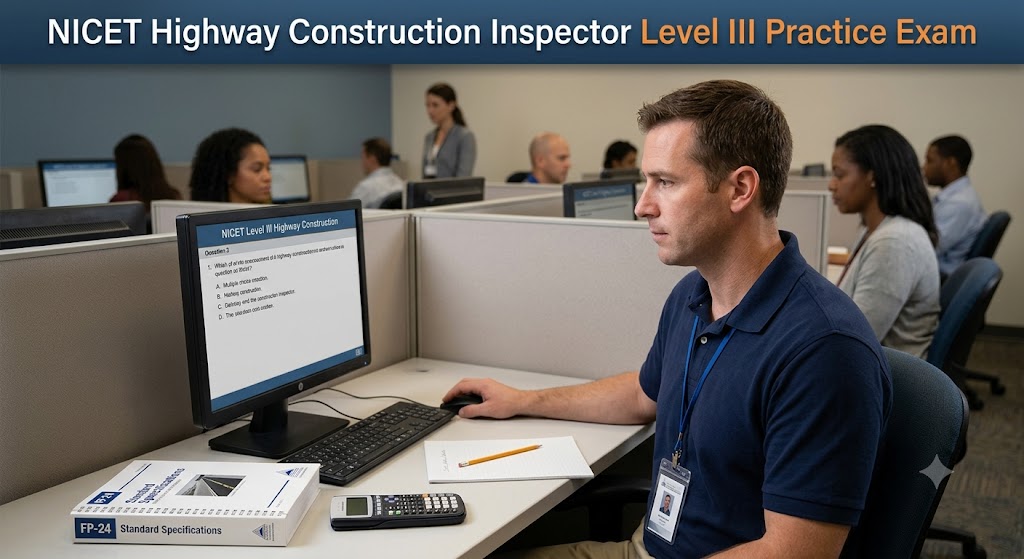
Additional Information
What the Course Entails and Exam Details
Preparing for the Level III exam requires mastering a broad
and deep syllabus of content area. While it is a computer-based exam rather
than a "course," your preparation should be structured like one,
focusing on the core work areas defined by NICET.
The major domains covered in this exam include:
- Plan
and Specification Interpretation: Advanced analysis of contract
drawings, standard specifications (like DOT or Federal Lands), and special
provisions.
- Structural
Inspection: In-depth knowledge of inspecting bridges, culverts,
retaining walls, and other drainage structures. This includes steel
erection, bolted/welded connections, and pre-stressed concrete components.
- Materials
and Testing: Interpretation of field and laboratory test results for
soils, aggregates, hot mix asphalt, and Portland cement concrete.
- Supervision
and Documentation: Leading inspection crews, reviewing their work
reports, managing project documentation, and ensuring accurate
"as-built" records.
- Work
Zone Safety: Advanced knowledge of OSHA regulations and MUTCD
standards to inspect and enforce safe traffic flow and worker safety.
- Erosion
Control and Site Operations: Inspecting environmental controls, slope
stabilization, and complex site layouts including transitions and tie-ins.
What to Expect in
the Final Exam
The NICET Level III exam is a rigorous assessment of your
senior-level competency.
Exam Format: The exam is computer-based (CBT) and
consists primarily of multiple-choice questions. It is designed to test your
knowledge, application of standards, and problem-solving skills. The total
appointment time is usually around 3.5 to 4 hours, which includes a tutorial
and a small break.
Open Book Policy: One of the most important aspects
of the NICET Highway Construction exam is that it is typically open book.
However, you are only permitted to bring specific, bound references into the
testing center. Candidates are strongly urged to review the updated NICET
reference list before the exam. Proctors will strictly inspect all materials
brought in.
Passing Score: NICET uses a scaled scoring system,
where a score of 500 is required to pass. The number of correct answers
needed to achieve this score can vary slightly between different versions of
the exam.
Rules: No loose papers, freetanding sticky notes, or
handwritten notes are allowed in your reference books. You must bring valid
government-issued photo identification to the testing center.
How to Study and
Exam Centers
Effective study for Level III requires a strategic blend of
reviewing technical material and simulating exam conditions.
Recommended Study Strategies
Understand the NICET Content
Outline: Start by downloading the official program detail from NICET. Study
the list of tasks and knowledge requirements.
Master Your References:
Since the exam is open-book, knowing how to find information quickly in
the standard specifications (e.g., FP-24 or your state DOT manual) is more
valuable than simple memorization. Use permanent tabs to mark key sections like
Concrete, Pavement, and Structures.
Take Level III Practice Exams:
Utilizing specialized [NICET Highway Construction Inspector Level III Practice
Exams] is perhaps the single most effective way to prepare. They help you get
used to the phrasing of questions, manage your time, and identify technical
areas where you need more review.
Join Study Groups: Discussing
complex scenarios or interpreting specs with peers can provide new insights.
Where to Take the Exam
The final exam is administered by Pearson VUE at physical
testing centers located throughout the United States and internationally. While
some Level I NICET exams offer online remote proctoring (OnVUE), higher levels
typically require attendance at a physical Pearson VUE Professional Center to
ensure the integrity of the open-book process. You can register for your exam
date and location through your NICET portal after purchasing the exam.
Job Opportunities
from the Course
Achieving Level III certification unlocks advanced career
paths and supervisory responsibilities.
This credential makes you an attractive candidate for the
following roles:
- Senior
Highway Construction Inspector
- Chief
Construction Inspector
- Chief
of Survey Party
- Construction
Manager / Assistant Construction Manager
- Office
Engineer (Construction)
- Resident
Engineer / Assistant Resident Engineer
- Quality
Assurance Manager (for contractors)
Frequently Asked Questions
Reviews
5.0
Based on 0 reviews
Leave a Review
No reviews yet. Be the first to review!