
NIMS Incident Command System (ICS) Practice Exam
$69.00
- Buy to unlock unlimited access to all Quiz questions and Answers in this Quiz.
- After purchase you can print a PDF of the whole quiz at any point. The PDF will contain the questions and the correct answers.
About this Exam
The National Incident Management System (NIMS) Incident Command System (ICS) is a standardized, on-scene, all-hazards incident management concept. It is designed to allow responders to adopt an integrated organizational structure that matches the complexities and demands of single or multiple incidents without being hindered by jurisdictional boundaries. This certification is essential for personnel within fire services, law enforcement, emergency medical services, public works, and other response agencies, from the entry-level responder to the incident commander.
Ready to test your knowledge?
Buy Now to Access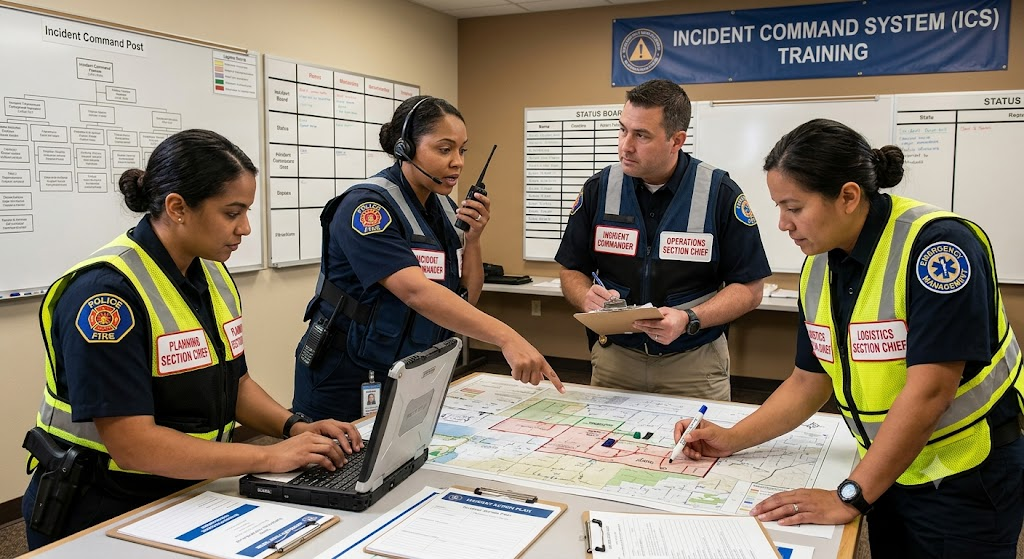
Additional Information
What the Course Entails and Exam Details
The ICS program covers a standardized response hierarchy, key principles of resource management, and communication protocols. While specific topics can vary by course level (e.g., ICS-100, ICS-200), core areas include:
ICS Principles and Features: The 14 essential management characteristics, including chain of command, modular organization, and manageable span of control.
Incident Commander (IC) and Command Staff: Roles of the IC, Public Information Officer, Safety Officer, and Liaison Officer.
General Staff: Functions of the Operations, Planning, Logistics, and Finance/Administration Sections.
Unified Command: How multiple agencies coordinate their command functions.
Resource Management: Standard practices for identifying, ordering, and managing personnel and equipment.
Terminology: Using common terms to ensure clear and unambiguous communications.
The final examination usually consists of multiple-choice questions that test knowledge of these core principles and their application. The exact nature and passing requirements can depend on the specific ICS course level.
What to Expect in the Final Exam
While the specifics can be course-dependent, a typical ICS final examination will include:
Format: A closed-book, multiple-choice or true/false assessment.
Content: Questions covering the entire course syllabus, with an emphasis on key terminology, organizational structure, and roles.
Passing Score: A passing score of 75% or higher is often required to demonstrate mastery of the concepts.
Time Limit: There may be a time limit for completing the exam, varying by course provider.
Delivery: Exams can be taken in a proctored environment or online through a certified course provider.
How to Study and Exam Centers
Effective study for the ICS certification involves understanding the foundational concepts and practicing their application. Here are some strategies:
Thorough Review: Closely read and study the official course materials and guides.
Note-Taking: Create flashcards or summary notes for key terms and organization charts.
Practice Quizzes: Take practice exams and quizzes to assess knowledge and identify weak areas.
Scenario-Based Application: Consider real-world incident scenarios and how ICS principles would be applied.
Candidates typically complete official ICS training through authorized course providers. The final exam is usually part of the course and can be taken at training facilities, online platforms offering the course, or physical test centers associated with the organization conducting the training, such as state or local emergency management agencies.
Job Opportunities from the Course
A NIMS ICS certification is highly valued in various fields and can open up many career paths:
Emergency Manager: Coordinating responses to large-scale disasters.
Firefighter: Operating within a structured command during fire and medical incidents.
Law Enforcement Officer: Integrating into incident command structures for various emergencies.
Paramedic/EMT: Working effectively alongside other response agencies in critical situations.
Search and Rescue Specialist: Utilizing standard ICS organization during search operations.
Public Works Director/Manager: Managing infrastructure-related recovery efforts under ICS.
Security Manager: Employing ICS for large event security and emergency response.
Public Safety Telecommunicator/Dispatcher: Operating within an ICS communications framework.
By demonstrating proficiency in standardized incident management, an ICS certification makes you a more effective and coordinated responder, making it an essential asset for career advancement in public safety and emergency management.
Frequently Asked Questions
Reviews
5.0
Based on 0 reviews
Leave a Review
No reviews yet. Be the first to review!