
NIMS IS-100 Practice Exam
$69.00
- Buy to unlock unlimited access to all Quiz questions and Answers in this Quiz.
- After purchase you can print a PDF of the whole quiz at any point. The PDF will contain the questions and the correct answers.
About this Exam
The National Incident Management System (NIMS) IS-100 course, also known as Introduction to the Incident Command System (ICS), is a foundational training program for anyone who may be involved in emergency response or event planning. This essential certification provides a standardized, single point of entry into understanding the structures and principles that enable effective, multi-agency coordination during incidents of all types and sizes. Whether you are a first responder (fire, police, EMS), work in government, the private sector, or for a non-governmental organization, this course is designed for you. It ensures that everyone speaks the same language and operates under a consistent framework, significantly enhancing safety, efficiency, and collaboration in the face of emergencies. Taking a NIMS IS-100 Practice Test is a critical step towards mastering these fundamental concepts and successfully obtaining your certification.
Ready to test your knowledge?
Buy Now to Access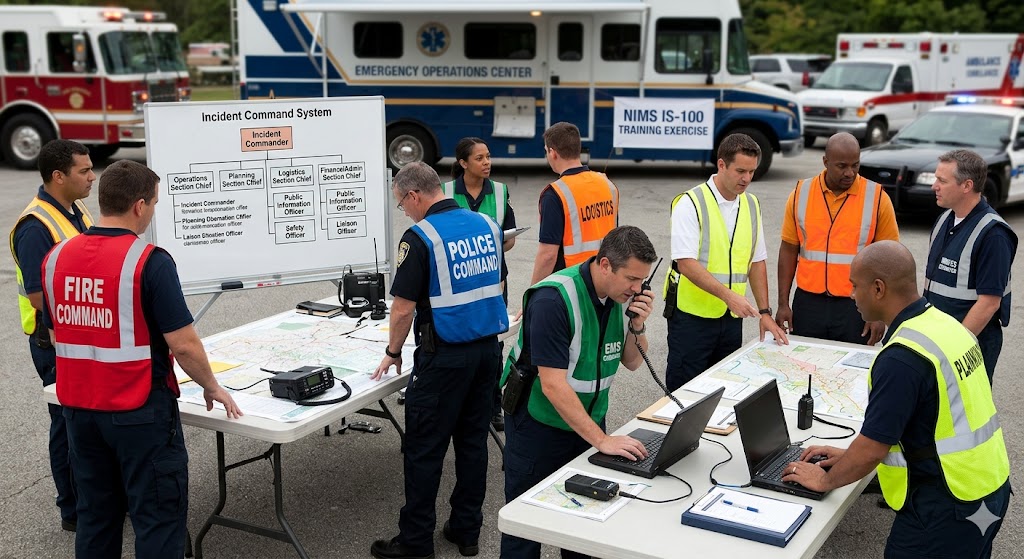
Additional Information
What the Course Entails and Exam Details
This comprehensive online course introduces the core concepts and features of the Incident Command System (ICS). Students will delve into key topics, including:
The purpose, history, and basic features of ICS.
ICS organizational structure, roles, and responsibilities, including the Command and General Staff.
Standardized terminology and the benefits of using common language across different agencies.
Incident facilities and their purposes (e.g., Incident Command Post, Staging Area, Base, Camp).
Resource management principles, from identification and ordering to mobilization and tracking.
The scalability of ICS, showing how it can expand and contract to meet the needs of any incident, from small local events to major disasters.
Incident Action Planning (IAP) basics and the importance of objectives.
The concepts of Unified Command and Unity of Command, and how they differ.
Span of Control guidelines for maintaining effective supervision.
The primary goal is to equip all personnel with a baseline understanding of how incidents are managed nationally, fostering seamless interaction and mutual support.
What to Expect in the Final Exam
While a specific NIMS IS-100 Practice Test will simulate the exam experience, understanding the actual final assessment is crucial. The final exam for IS-100 is administered online through the FEMA Emergency Management Institute (EMI) Independent Study portal. Here’s what you can generally expect:
Format: The exam typically consists of multiple-choice and potentially some true/false questions. The exact number of questions can vary (e.g., around 25-30), so a comprehensive practice test should cover all potential areas.
Time Limit: There is no strict time limit; the exam is self-paced. However, you must complete it individually.
Passing Score: The required passing score is generally 75%. Questions and answers may be scrambled each time the test is taken online to maintain exam integrity.
Open Book/Resources: Functionally, because it is an online, self-paced exam, it is considered open book, meaning you can reference course materials. However, success still requires a solid understanding of the concepts rather than relying solely on searching during the test.
Multiple Attempts: If you do not pass on your first try, you are usually allowed to retake the exam. A practice test will build your confidence and knowledge, aiming for success on the first official attempt.
How to Study and Exam Centers
Effective preparation is key to succeeding on the NIMS IS-100 final exam. Here are actionable study strategies:
Complete the Official Course: Thoroughly go through the free, self-paced online IS-100 course offered by the FEMA Emergency Management Institute (EMI). Pay close attention to all modules, videos, and interactive elements.
Review Course Materials: Download or print the course slides, summary documents, or student manual if available, and review them regularly. Highlight key definitions and organizational charts.
Take Practice Tests: Utilizing a comprehensive NIMS IS-100 Practice Test is one of the most effective ways to study. Practice tests help you become familiar with the question style, identify knowledge gaps, and build test-taking confidence in a low-stakes environment. Look for reputable sources that offer updated questions.
Focus on Key Terms: Create flashcards for critical terms and definitions, such as ICS positions, facilities, and management characteristics (e.g., Integrated Communications, Manageable Span of Control, Information Management).
Regarding exam centers, there are no physical testing centers like Pearson VUE or specific authorized schools for this exam. The final exam is taken exclusively online through the FEMA Independent Study (IS) website. To take the final exam (and receive your official certificate), you will need to register for a FEMA Student Identification (SID) number if you don't already have one, and then log in to the EMI Independent Study portal.
Job Opportunities from the Course
While NIMS IS-100 is an entry-level certification, it is a foundational requirement for numerous roles within emergency management, public safety, and related fields. Obtaining this certification can significantly boost your qualifications and open doors to various career paths and job opportunities:
Emergency Management Coordinator/Specialist: Play a central role in preparing, planning, and coordinating response efforts for emergencies.
First Responder (Firefighter, Police Officer, EMS Provider): Foundational knowledge necessary for operating effectively within the Incident Command System.
Incident Commander (at a basic level/for small incidents): Gain the fundamental understanding to potentially lead or support leadership in initial response situations.
Public Safety Personnel (Dispatch, Communications, Animal Control): Roles that require coordination with and understanding of emergency management structures.
Emergency Services Staff: Various positions involved in response, from logistics and planning to operations and safety.
Disaster Recovery Specialist: Work in post-disaster scenarios, involving logistics, resource allocation, and restoration efforts.
Event Planner (for large public events): Utilize ICS principles for effective risk assessment and coordinated safety operations.
Healthcare Emergency Preparedness Coordinator: Plan and implement emergency response strategies within healthcare facilities.
Security Professional: Enhance readiness and coordination for emergencies in corporate or public settings.
Volunteers with organizations like the Red Cross or CERT: Essential training for disaster response volunteers.
Frequently Asked Questions
Reviews
5.0
Based on 0 reviews
Leave a Review
No reviews yet. Be the first to review!