
NJ Black Seal Low Pressure Practice Exam
$69.00
- Buy to unlock unlimited access to all Quiz questions and Answers in this Quiz.
- After purchase you can print a PDF of the whole quiz at any point. The PDF will contain the questions and the correct answers.
About this Exam
The New Jersey Black Seal Low Pressure License is a mandatory requirement for professionals operating low-pressure steam or hot water heating boilers within the state.
This license is administered by the Bureau of Boiler and Pressure Vessel Compliance and is designed to ensure that those in charge of heating systems in schools, hospitals, commercial buildings, and apartment complexes understand the fundamentals of safe operation.
It is ideal for custodial staff, maintenance technicians, building superintendents, and anyone seeking to advance their career in facility maintenance and stationary engineering.
Getting licensed demonstrates competence, enhances safety protocols, and unlocks immediate career advancement opportunities.
Ready to test your knowledge?
Buy Now to Access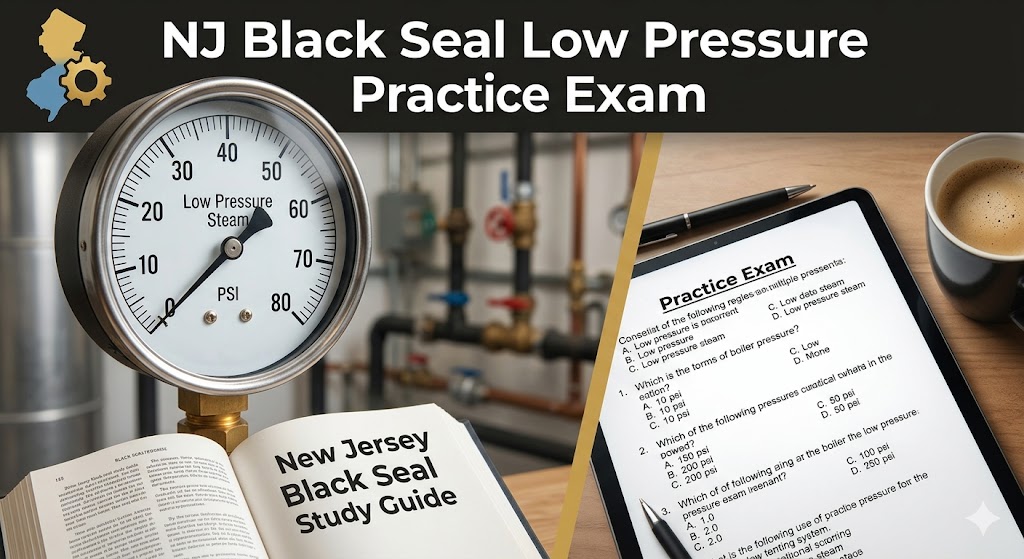
Additional Information
What the Course Entails and Exam Details
Preparation for the NJ Black Seal Low Pressure License typically requires completing a state-approved educational course before sitting for the exam.
The core curriculum of these courses covers fundamental boiler principles and operational physics.
Students will delve deeply into the different types of low-pressure boilers, their construction, and their specific applications.
Key topics include boiler appurtenances and fittings, such as safety valves, water columns, and pressure gauges, and how to test them.
You will also study feed water systems, water treatment chemicals, and different fuel types and combustion methods.
Critically, a significant portion of the syllabus is dedicated to safe operating procedures, startup and shutdown sequences, and troubleshooting common malfunctions to prevent hazardous conditions.
What to Expect in the Final Exam
The final New Jersey Black Seal Low Pressure licensure examination is a rigorous assessment of your theoretical and practical knowledge.
While the exact format can be updated by the state, the exam generally consists of multiple-choice questions designed to test your understanding of boiler operation and safety regulations.
Candidates are typically allowed a set time limit, often around 1.5 to 2 hours, to complete the test.
A passing score is generally 70% or higher.
The exam questions are drawn from a pool covering the topics mentioned in the course syllabus, including regulatory definitions and practical scenarios.
The atmosphere is professional, and strict attention to the instructions provided by the State proctors is required throughout the examination process.
How to Study and Exam Centers
Successfully passing the Black Seal exam requires a combination of classroom instruction and dedicated self-study.
The most vital step is to pay close attention to the curriculum and study guides provided during your required preparatory course.
Using a reputable NJ Black Seal Low Pressure Practice Exam is highly recommended; this helps you become familiar with the questioning style, identifies knowledge gaps, and improves your time management skills.
Create flashcards for essential terms, pressure limits, and regulatory requirements specific to New Jersey law.
Regarding exam centers, the licensing exam is typically administered directly by the New Jersey Department of Labor and Workforce Development.
After successfully completing your approved training program and submitting your application to the state, you will be notified of your scheduled exam date and specific testing location, which are typically state office buildings or approved private training facilities acting as official testing sites.
Job Opportunities from the Course
Obtaining your Black Seal Low Pressure License significantly enhances your employability and unlocks numerous career paths in the facility management sector throughout New Jersey.
Demand for certified operators is high in school systems, hospitals, residential high-rises, and commercial commercial complexes.
Here are some of the job opportunities and career paths this certification can unlock:
Boiler Operator in commercial buildings.
Building Superintendent for residential or mixed-use properties.
School Custodian with specialized boiler responsibilities (often required by NJ school districts).
Maintenance Mechanic in manufacturing or processing facilities.
Hospital Facility Technician managing heating systems.
HVAC Technician seeking to expand specialized knowledge and licensing credentials.
Stationary Engineer (an entry-level stepping stone to high-pressure licenses).
Frequently Asked Questions
Reviews
5.0
Based on 0 reviews
Leave a Review
No reviews yet. Be the first to review!