
NJROTC Academics Practice Test
$69.00
- Buy to unlock unlimited access to all Quiz questions and Answers in this Quiz.
- After purchase you can print a PDF of the whole quiz at any point. The PDF will contain the questions and the correct answers.
About this Exam
Welcome to your guide for the NJROTC Academics Practice Test. This resource is specifically designed for high school students enrolled in the Navy Junior Reserve Officers Training Corps (NJROTC) program. It is an essential tool for cadets seeking to demonstrate and solidify their understanding of the core naval science and citizenship curriculum. Mastering the content covered by this practice test is a significant step toward success in unit assessments, individual recognition, and team-based academic competitions within the program. It provides an excellent opportunity to reinforce learning, identify areas for improvement, and build confidence before facing the actual evaluations or challenges.
Ready to test your knowledge?
Buy Now to Access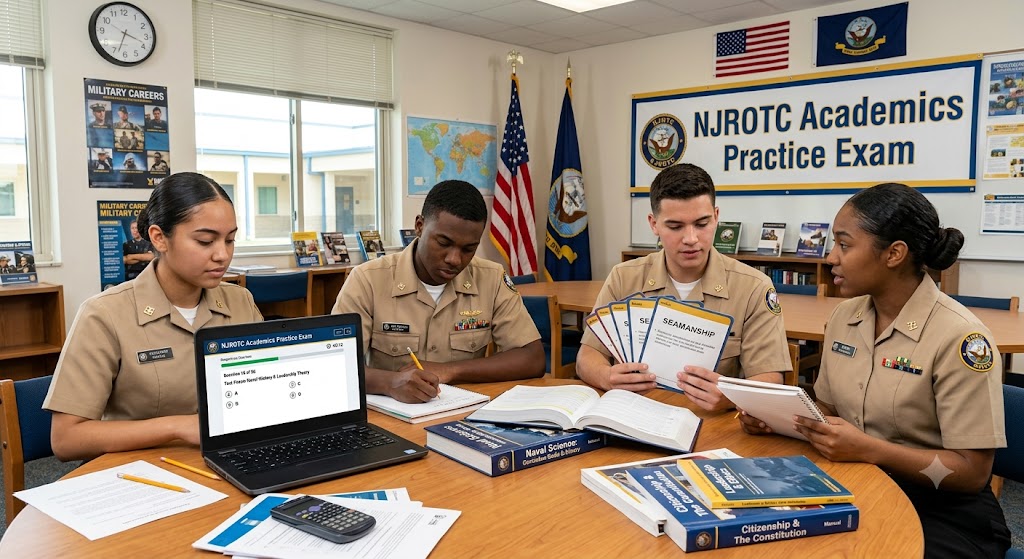
Additional Information
What the Course Entails and Exam Details
The NJROTC academics curriculum encompasses a broad range of
subjects that provide a foundational knowledge base for informed citizenship,
leadership development, and an understanding of the Navy's heritage and
function. Topics are structured over the four years of the program (Naval
Science 1 through 4) and typically include: Leadership & Ethics,
Citizenship in the United States and other countries, a comprehensive study of
U.S. Naval History from its origins to the present, Naval Orientation, Customs
& Traditions, Seamanship, Ship Handling & Naval Operations, Navigation
& Nautical Astronomy, Oceanography, Meteorology, basics of Electronics,
College & Career Readiness, and a strong emphasis on continuous Leadership
and Teamwork development. Specific practice exams and questions will be
structured to cover one or more of these areas, depending on the focus of your
studies or upcoming competition.
What to Expect in the Final Exam
While "final exam" can refer to the comprehensive
internal unit assessment at the end of a semester or year, it often refers to
the academic component of major multi-unit competitions, known as Brain Brawls
or other academic meets. These tests typically feature multiple-choice
questions designed to assess factual knowledge and understanding. The time
limits and number of questions vary depending on the specific event, but speed
and accuracy are crucial, especially in timed competitions.
In a competitive format, such as Brain Brawl, teams of
cadets work together with buzzers to answer questions quickly, requiring both
individual knowledge and seamless teamwork. In standard practice or class
tests, questions are individually answered, often on paper or a computer-based
system provided within your unit. While there is no single, standardized
"passing score" for all NJROTC academic practice tests across the
nation, high performance is expected for consideration in competition selection
and for high achievement in your Naval Science course grades, often reflected
in your unit's internal grading and rank structure. Always refer to your Naval
Science Instructor (NSI) for the specific structure, grading, and expectations
of any tests or competitions within your NJROTC unit.
How to Study and Exam Centers
Effective preparation for the NJROTC academics test involves
a structured approach and dedication. Begin by thoroughly studying your program
manuals, textbook materials (Naval Science 1-4 curriculum guides), and any
supplementary resources provided by your Naval Science Instructors. Active
learning techniques like flashcards (both physical and digital) for key dates,
terminology, and figures are highly recommended. Take advantage of official
practice tests and question banks that your NSI may provide or point you to,
which are often found on specific NJROTC program or individual unit resources.
Consider forming study groups with fellow cadets to discuss
concepts, quiz each other, and practice for team competition formats. Group
discussion can significantly enhance understanding and recall. Additionally,
keep yourself generally well-informed on current events, as global knowledge
can sometimes be tested.
Crucially, you should understand that NJROTC academic exams,
practice tests, and competitions are almost exclusively administered within
authorized high schools that host NJROTC units, in unit classrooms or
designated testing areas, or at multi-unit competition venues. These tests are
not given at commercial, independent testing centers like Pearson VUE. Your
tests and evaluations are coordinated by your Naval Science Instructors and
unit leadership, utilizing program-approved materials and systems. Any legitimate
practice resources you find will likely be distributed by your program or found
on dedicated NJROTC educational websites.
Job Opportunities from the Course
A strong performance in NJROTC, including the academics
program, lays a compelling foundation for numerous future career paths, both
within the military and the civilian world. Your dedication and acquired
skills, particularly in leadership, citizenship, and teamwork, are highly
transferable. Potential career paths and opportunities include:
Military Service (Army, Navy, Air Force, Marines, Coast
Guard) Reserve Officers' Training Corps (ROTC) Scholarships to top universities
Competitive College Admissions Advantage, demonstrating leadership and
commitment Service Academies (U.S. Naval Academy, U.S. Military Academy, etc.)
Government and Civil Service Positions Law Enforcement Public Safety Roles
Education (Potential for later career JROTC instructor positions) A wide array
of leadership and management positions in various civilian sectors Advanced
enlistment pay grade potential upon entering the military after successful
JROTC completion
Frequently Asked Questions
Reviews
5.0
Based on 0 reviews
Leave a Review
No reviews yet. Be the first to review!