
NJROTC National Academic Exam Serial No. 1461 Practice
$69.00
- Buy to unlock unlimited access to all Quiz questions and Answers in this Quiz.
- After purchase you can print a PDF of the whole quiz at any point. The PDF will contain the questions and the correct answers.
About this Exam
The NJROTC National Academic Exam is a key component of the Naval Junior Reserve Officers Training Corps program, designed to challenge cadets' knowledge across a wide spectrum of subjects essential for development into informed and responsible citizens with potential leadership qualities. This specific serial number, 1461, represents a particular iteration of the national-level practice or competition exam, administered to NJROTC cadets (typically high school students) across the country.
The primary purpose of both the actual exam and this vital practice version is to evaluate academic achievement, foster healthy competition among units and individual cadets, and encourage deep engagement with the comprehensive NJROTC curriculum. It targets motivated students within the NJROTC program who strive for academic excellence and leadership recognition.
Ready to test your knowledge?
Buy Now to Access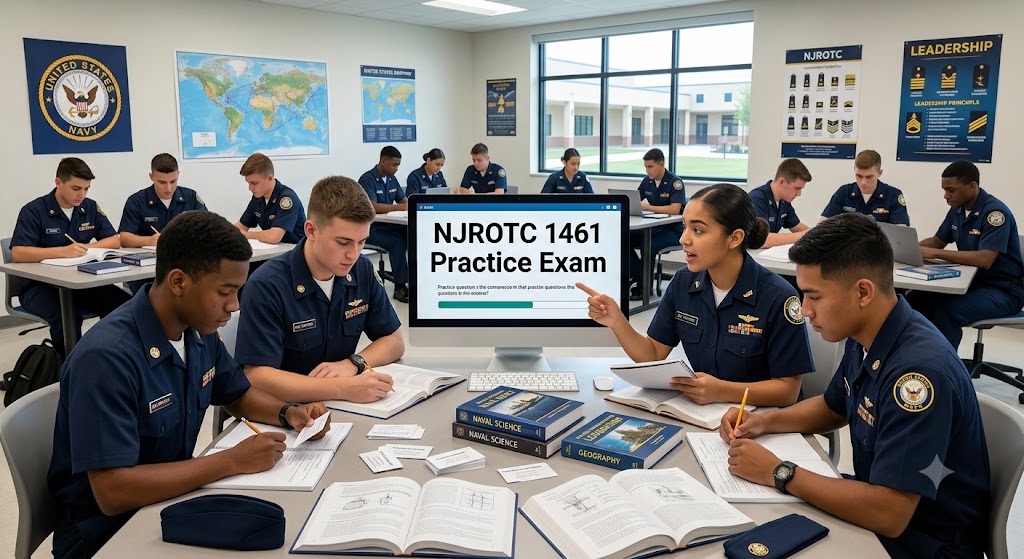
Additional Information
What the Course Entails and Exam Details
While distinct from a standard classroom course, the NJROTC
National Academic Exam comprehensively covers the four-year Naval Science
curriculum and general academic knowledge expected of cadets. Preparing for
this practice exam, and the eventual actual test, requires a solid
understanding of the following core topics:
- Naval
Science: Fundamentals of the U.S. Navy, shipboard organization,
seamanship, navigation, naval history, and the role of sea power.
- Leadership
and Citizenship: Principles of leadership, ethics, communication,
government, historical documents, and community service.
- Aviation
and Space: Basics of flight, aerospace technology, and space
exploration.
- Geography
and Oceanography: World geography, maritime geography, oceans, and
marine ecosystems.
- Meteorology:
Weather patterns, forecasting, and atmospheric science.
- Health
and Fitness: Physical fitness principles, nutrition, first aid, and
healthy lifestyle choices.
- Current
Events: Awareness of significant national and international news and
developments.
- Mathematics
and General Science: Fundamental math and science concepts applicable
in naval and everyday contexts.
The Serial No. 1461 Practice Exam is designed to mirror the
breadth and depth of these topics, providing cadets with a realistic assessment
of their readiness across the entire NJROTC academic spectrum.
What to Expect in
the Final Exam
While individual practice exam serials may have slight
variations, the final NJROTC National Academic Exam generally follows a
standardized format that cadets can prepare for:
- Format:
Typically a multiple-choice examination.
- Questions:
The exam consists of a significant number of questions (often around 100),
meticulously crafted to cover the diverse curriculum thoroughly.
- Time
Limit: Cadets will face a strict time limit, requiring both accuracy
and speed. Expect around 60-90 minutes, though official competition rules
might vary.
- Proctoring:
The actual exam, when administered for competition or official record, is
always proctored by NJROTC instructors or authorized school personnel to
ensure integrity.
- Passing
Score/Ranking: In a competitive context, there isn't a simple
"passing score" for an individual exam; rather, cadets and teams
are ranked based on their total scores. The goal is to achieve the highest
possible score relative to peers nationally. Performance on the final exam
can contribute significantly to individual and unit recognition within the
NJROTC program.
- Authorized
Materials: Generally, only standard test-taking materials like pencils
and sometimes basic calculators (if permitted by specific competition
rules) are allowed. Cell phones, textbooks, and extensive notes are
strictly prohibited during the actual test.
The practice exam serves as an excellent simulation for
these conditions, helping you gauge your pacing and recall under pressure.
How to Study and Exam Centers
Effective preparation is key to excelling in both the
practice and the actual NJROTC National Academic Exam. Here are actionable
strategies:
How to Study:
- Consistent
Review: Regularly study your Naval Science textbooks and class notes
throughout the year. Don't wait until the last minute.
- Utilize
Official Resources: Review the Cadet Reference Manual and any specific
study guides provided by your NJROTC instructors.
- Take
Practice Exams (like Serial No. 1461): This is perhaps the most
critical step. Actively work through as many practice exams and past
questions as possible, like this one, to familiarize yourself with the
question style, format, and common topics. Time yourself to build speed
and stamina.
- Form
Study Groups: Collaborating with fellow cadets allows for discussion,
peer teaching, and mutual motivation. Assign different topics to team
members and teach each other.
- Use
Flashcards: Create flashcards for key terms, historical dates, naval
ranks, and important concepts for rapid recall.
- Target
Weaknesses: After taking practice tests, identify the areas where you
consistently struggle and dedicate extra study time to those subjects. Ask
your instructors for clarification.
- Stay
Informed: Keep up with current events through reputable news sources
to answer related questions effectively.
Exam Centers:
Crucially, the NJROTC National Academic Exam (and its
practice versions) is not administered at external, commercial testing
centers like Pearson VUE.
Instead, the exam is typically conducted:
- Within
your NJROTC Unit: For regular unit-level testing and practice, the
exam is administered directly in your high school classroom or designated
NJROTC space.
- Authorized
Regional/National Competition Venues: When competing at regional or
national levels, the academic test may be held at a specific competition
site, which could be another school, a military installation, or a
convention center, all under official NJROTC supervision.
Access to the exam (both practice and official) is always
coordinated through your NJROTC command and Naval Science Instructors. They
will provide the necessary links, materials, or physical testing location
details. Ensure you are communicating effectively with your instructors for all
official test opportunities.
Job Opportunities
from the Course
While succeeding in the NJROTC program and its academic
challenges doesn't directly grant specific civilian certifications or licenses,
the knowledge, discipline, and leadership skills developed open numerous doors.
A strong performance, including on academic exams,
significantly enhances a cadet's competitiveness for various career paths,
particularly within the military and related sectors. Here are some specific
career paths and opportunities:
- U.S.
Navy Officer (Ensign and above): Through pathways like the Naval
Academy, NROTC scholarships (which academic success strongly supports), or
Officer Candidate School (OCS).
- U.S.
Marine Corps Officer: Similar pathways, with a Marine option within
NROTC.
- Enlisted
Military Service (All Branches): Excellent foundation for various
enlisted roles across the Navy, Marine Corps, Army, Air Force, Coast
Guard, and Space Force. High achievement can sometimes lead to advanced
pay grades upon entry or selection for specialized programs.
- Naval
Aviator / Flight Officer: A challenging and competitive path,
benefited by early exposure to aerospace concepts.
- Surface
Warfare Officer: Leadership on and operation of Naval ships.
- Submarine
Officer: Technical expertise for underwater naval operations.
- Special
Operations (SEALs, EOD, etc.): Highly selective roles, demanding
immense physical and mental fortitude, which NJROTC can help prepare for.
- Intelligence
Analyst: Opportunities in both military and civilian intelligence
agencies.
- Homeland
Security professional: Roles in agencies like the Department of
Homeland Security or FEMA.
- Law
Enforcement Officer (Federal, State, Local): Discipline and ethics are
highly valued.
- Emergency
Medical Technician (EMT) / Paramedic: Leveraging first aid knowledge.
- Aerospace
/ Systems Engineer: Foundation for related technical careers.
- Public
Servant / Government official: Strong understanding of citizenship and
government functions.
- High
School Naval Science Instructor: For retired military personnel
wanting to give back to the program.
- Various
leadership roles in corporate and non-profit organizations.
Frequently Asked Questions
Reviews
5.0
Based on 0 reviews
Leave a Review
No reviews yet. Be the first to review!