
NJROTC Naval Science 2 (NS-2) Practice Test
$69.00
- Buy to unlock unlimited access to all Quiz questions and Answers in this Quiz.
- After purchase you can print a PDF of the whole quiz at any point. The PDF will contain the questions and the correct answers.
About this Exam
The NJROTC Naval Science 2 (NS-2) Practice Test is an essential self-assessment tool for cadets currently enrolled in the second year of the Navy Junior Reserve Officers Training Corps program. Designed for motivated high school students, this practice exam helps individuals gauge their understanding of advanced leadership principles, maritime heritage, and core nautical sciences. It serves as a critical checkpoint, allowing cadets to identify strengths and weaknesses in their knowledge base before taking their official, comprehensive end-of-course evaluation. This practice test is a proactive step toward academic excellence and building the confidence required to succeed in the full NJROTC curriculum
Ready to test your knowledge?
Buy Now to Access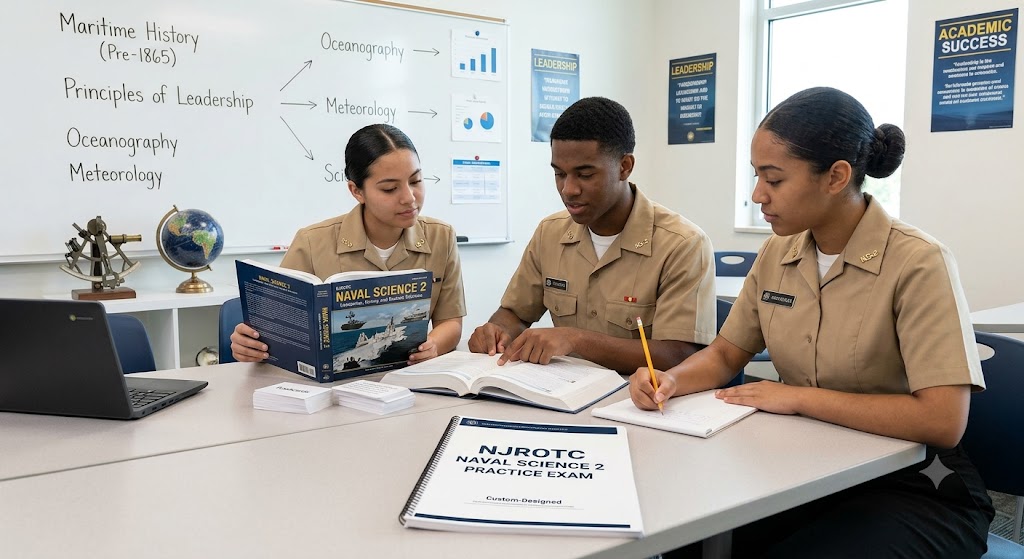
Additional Information
What the Course Entails and Exam Details
The NS-2 curriculum builds significantly upon the
foundational knowledge gained in NS-1. It is a dual-focused course, blending
academic instruction with practical leadership application. The core academic
topics covered, and subsequently tested, include an in-depth study of maritime
history, the development of sea power, and its influence on world events.
Furthermore, a substantial portion of the course is dedicated to nautical
sciences, specifically maritime geography, oceanography, meteorology, and an
introduction to astronomy and physical science as they apply to naval
operations. Leadership training in NS-2 moves from being a follower to
understanding the responsibilities of being a leader, focusing on ethics,
authority, and team dynamics. The exam itself is a comprehensive, written
assessment. The specific practice test is modeled after this structure to
provide the most realistic preparation experience possible.
What to Expect in the Final Exam
While the exact final exam is administered internally by
individual NJROTC units, cadets can typically expect a highly structured
academic test. The final assessment is primarily a written exam, often 100 or
more questions, comprising multiple-choice, true/false, matching, and
short-answer questions. It is a comprehensive test, meaning it covers all
material presented throughout the academic year. In many NJROTC units, the
final academic exam accounts for a substantial portion, often up to 20%, of the
final course grade. Time limits are set by the Senior Naval Science Instructor
(SNSI), usually aligning with standard class period lengths or slightly
extended for a final. Cadets are evaluated on academic retention, and unlike
other parts of the course, there are no practical drill or uniform components within
this specific written academic exam.
How to Study and
Exam Centers
The most effective way to study for the NS-2 exam is through
consistent, active review. Practice makes permanent. Utilize the NJROTC
Naval Science 2 (NS-2) Practice Exam repeatedly to familiarize yourself
with the question formats and time constraints. Structure your study time by
creating detailed outlines for each major unit: Maritime History, Leadership,
and Nautical Sciences. Form study groups with fellow cadets to discuss complex
topics like meteorology or leadership ethics. Make flashcards for key terms,
dates, and naval terminology. It is vital to understand that the official
end-of-course exam is not taken at a public testing center. Instead, it is
administered directly at your authorized high school under the
supervision of your Naval Science Instructor (NSI) or Senior Naval Science
Instructor (SNSI). For practice materials, consult your NSI and utilize
official NJROTC online portals and cadet reference manuals.
Job Opportunities
from the Course
Successfully completing the NJROTC Naval Science 2 course
and the broader program does not provide a direct civilian job placement.
However, it is a significant stepping stone that unlocks unique and accelerated
career paths within the United States military and creates a distinct advantage
for civilian opportunities. The skills and discipline developed are highly
sought after. Here are key career paths this course contributes to:
- Advanced
Enlistment: Completion of two or more years of NJROTC, including NS-2,
often entitles a cadet to enlist in the military at a higher pay grade
(e.g., E-2 or E-3) than enlistees without such experience.
- ROTC
Scholarship Candidate: The leadership, academic, and physical fitness
record built during NS-2 makes a cadet highly competitive for four-year
Navy, Marine Corps, Army, and Air Force ROTC scholarships.
- Service
Academy Nominee: Demonstrating excellence in the NJROTC program,
including a strong performance in NS-2, is crucial for securing a
congressional nomination to the U.S. Naval Academy, U.S. Military Academy,
or U.S. Air Force Academy.
- NROTC
(College Program) Applicant: For those not seeking a scholarship
immediately, a strong NJROTC record is a key discriminator for acceptance
into the Naval Reserve Officers Training Corps college program.
- Civilian
Leadership Roles: The program's core focus on ethics, discipline, and
complex problem-solving makes former cadets exceptional candidates for
management trainee programs and security-related roles in the civilian
sector.
Frequently Asked Questions
Reviews
5.0
Based on 0 reviews
Leave a Review
No reviews yet. Be the first to review!