
NLC Electrical Grid (eGRID) and Rigging 2 (Rig 2) Practice Test
$69.00
- Buy to unlock unlimited access to all Quiz questions and Answers in this Quiz.
- After purchase you can print a PDF of the whole quiz at any point. The PDF will contain the questions and the correct answers.
About this Exam
The NLC Electrical Grid (eGRID) and Rigging 2 certifications are crucial benchmarks within the Northwest Lineman College (NLC) curriculum and general powerline/rigging industry standards. They are designed specifically for individuals training to build, maintain, and operate the power distribution and transmission networks that sustain our modern society. The eGRID 2 portion delves into the theoretical and practical aspects of various systems and their components, while Rigging 2 equips you with advanced rigging physics, calculations, and safety protocols for safely moving and lifting heavy equipment. This certification signals to employers that you possess both the safety consciousness and the specific technical expertise required in these high-stakes fields. It is a vital step for aspiring lineworkers, substation technicians, and industrial rigging specialists.
Ready to test your knowledge?
Buy Now to Access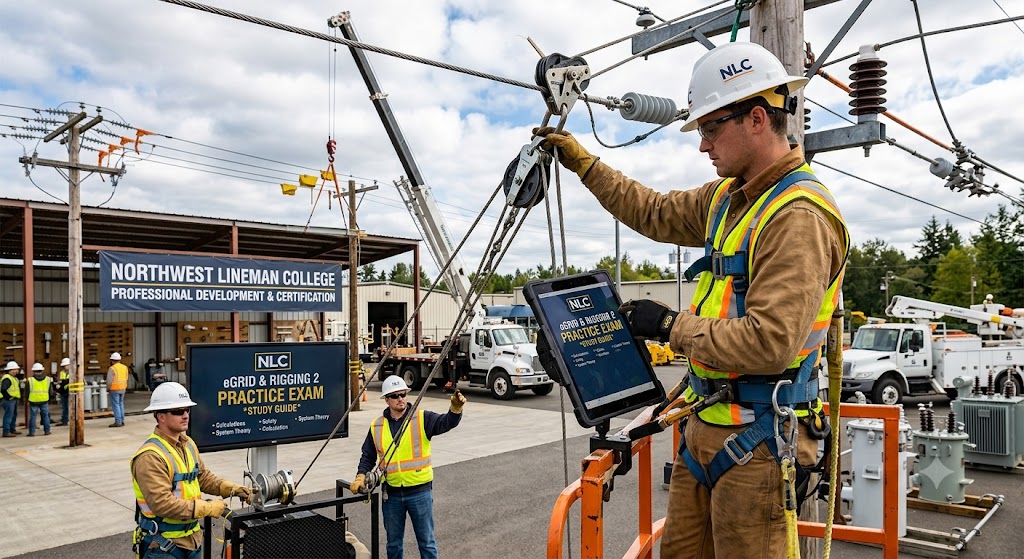
Additional Information
What the Course Entails and Exam Details
The respective courses at NLC and the exam content are
deeply integrated, covering essential and advanced concepts in electrical
theory and professional rigging.
Electrical Grid (eGRID) 2
eGRID 2 coursework builds on fundamental electrical
principles, expanding into the intricacies of:
- Power
Systems: Detailed studies of power generation (traditional and
renewable), transmission (high voltage), sub-transmission, and
distribution systems. You must understand how power is converted, stepped
up and down, and delivered across the grid.
- Circuit
Designs: Mastery of different circuit configurations, including Wye
and Delta systems, understanding how they are wired at substations and how
they function. Radial, network, and other common circuit designs are
covered.
- Transformer
Theory & Application: Deep knowledge of single-phase and
three-phase transformers, their common configurations, connections, and
calculations. Expect to answer detailed questions on typical voltages for
distribution and transmission.
- Electrical
Fundamentals: A non-negotiable understanding of fundamental laws and
formulas. Expect questions involving Ohm's Law (Voltage = Amperage x
Resistance), power calculations (Wattage), and concepts like capacitance,
voltage regulation, and the flow of alternating current. The relationship
between strength of magnets, speed of motion, and voltage generation is
critical.
- Substations:
Functions, primary components, and operation of generation, transmission,
sub-transmission, and distribution substations.
- Safety
& Industry Standards: The absolute priority is always the current
safety rules and best practices.
Rigging 2 (Rig 2)
Rig 2 focuses on the physics of moving heavy loads safely
and precisely. Key areas include:
- Calculations
& Advanced Physics: Mastery of intricate rigging calculations.
This includes determining Working Load Limits (WLL), hook strain, and
precise tension distribution in complex setups involving snatch blocks and
parted blocks at various angles. You will calculate haul line tension to
ensure no component’s WLL is exceeded.
- Equipment
Identification & Use: Detailed knowledge and proper application of
all types of rigging gear, including slings, chokers, hardware, shackles,
chain hoists, and various block and tackle systems. You must know where to
find weight and WLL ratings on shells, hooks, and slings.
- Material
Handling: Advanced techniques for lifting and moving typical powerline
components like transformers, poles, and other heavy equipment. You must
calculate component weights based on dimensions and density.
- Safety
Protocols: Comprehensive knowledge of industry safety regulations,
including inspecting rigging, identifying potential failure points (like
shock loads), and safe signaling. Sling tension calculations and the
effect of sling height/length are critical knowledge.
What to Expect in
the Final Exam
The final assessments for eGRID 2 and Rigging 2 are rigorous
and test both your theoretical knowledge and your ability to apply it in
realistic scenarios. Practice materials indicate a heavy reliance on
multiple-choice questions to assess comprehensive knowledge and require precise
calculations.
- Format:
Typically, these final quizzes are multiple-choice. You may face
assessments with 50 or more detailed questions covering the respective
modules. Some of these questions might be part of an integrated final for
an entire phase of training.
- Time:
Expect timed exams. Practice resources show questions that could be timed,
allowing as little as 30 seconds per question for theoretical concepts,
indicating the need for both deep understanding and quick recall. Rigging
exams will also require sufficient time to perform complex calculations
accurately.
- Content
Mix: The exam will contain a balance of conceptual knowledge questions
and numerous practical calculation scenarios for both electrical and
rigging topics. You will be expected to perform these without error. There
will be a strong emphasis on current industry standards and safety
regulations.
- Rules:
These exams are typically closed-book and are administered within the
formal classroom or proctored school environment, ensuring integrity and
standardizing the testing process. The required score for a passing mark
will be set at a high level to demonstrate mastery.
- Continuous
Assessment: Be aware that your progress might also be evaluated
through continuous training assessments and practical skills testing,
making full participation in the course essential.
How to Study and
Exam Centers
The challenging nature of these exams necessitates a
committed and strategic study approach. Leverage all available resources and
focus on both theoretical mastery and calculation speed.
Study Strategies
- Practice
Tests are Essential: Make full use of provided or reputable practice
tests as your user prompt suggests. Treat these practice sessions like the
real exam: time yourself, use no notes, and carefully review both correct
and incorrect answers to understand the logic. Many students find these a
crucial tool in identifying knowledge gaps and building confidence with
the test format and common question types.
- Deep
Theory Review: Fully study all NLC textbooks, provided study guides,
class notes, and diagrams. Don't just memorize; understand why
electrical rules exist and how rigging systems work. Re-draw
circuit and rigging diagrams from memory.
- Focus
on Calculations: Create or find worksheets for all types of rigging
and electrical formulas. Practice calculating and manipulating formulas
for WLL, haul line tension, hook strain, Ohm’s Law, and transformer
configurations until you can do them flawlessly and quickly.
- Engage
with Instructors and Peers: Ask your instructors for clarification on
complex topics. Utilize study groups with other students to quiz each
other and discuss tricky concepts and problems.
- Prioritize
Safety: Ensure you can cite the reason behind every safety rule.
Review all regulations until you can explain them and apply them in
context.
- Hands-on
Reinforcement: If your training includes a practical component,
actively participate. Visualizing and physically performing tasks can
significantly reinforce theoretical concepts and calculations.
Exam Centers
- NLC
Campus Administration: These specific exams are institutional and are
administered directly by Northwest Lineman College to enrolled students.
You will typically take them in a designated testing room on your specific
NLC campus (e.g., California, Idaho, Florida, Texas, or potentially other
locations).
- Official
Portals: Depending on the modern nature of the course delivery,
assessments might be conducted through NLC’s official learning management
systems or online portals. Always follow the specific instructions from
your program and campus regarding registration and assessment scheduling.
- Authorized
School Setting: The setting will be formal, standard, and secure,
ensuring consistent conditions for all students and verifying that your
knowledge is truly your own.
Job Opportunities from the Course
Earning a passing score in the NLC eGRID 2 and Rigging 2
assessments or completing the corresponding coursework demonstrates specialized
expertise that is highly valued by a range of employers in critical sectors.
These certifications and skills form a powerful combination, opening up
excellent career paths:
- Apprentice
Lineman: This is the ultimate entry point for a lucrative career in
the electrical trade. Mastery of grid theory and rigging is absolutely
foundational.
- Rigging
Technician: A specialist role in construction, heavy manufacturing,
and the utility sector, focused entirely on the safe moving of heavy,
critical equipment.
- Transmission
Specialist: Works specifically on high-voltage transmission lines,
requiring advanced knowledge of grid operations and rigging on a large
scale.
- Distribution
Specialist: Focuses on the lower-voltage distribution networks that
deliver power directly to homes and businesses, necessitating detailed
knowledge of transformers and circuit configurations.
- Substation
Operator or Technician: A crucial role in managing and maintaining the
vital substations that regulate voltage across the grid.
- Utility
Line Mechanic: A technician performing both linework and general
utility equipment maintenance, combining electrical and rigging skills.
- Construction
Rigging Lead: An advanced role planning and directing complex rigging
operations on major infrastructure and construction sites.
- Wind
Turbine Technician: Leverage your rigging and electrical knowledge in
the expanding renewable energy sector for turbine maintenance and
installation.
- Industrial
Rigging Supervisor: Plan and oversee rigging on a large scale in
manufacturing facilities, power plants, and chemical industries.
Frequently Asked Questions
Reviews
5.0
Based on 0 reviews
Leave a Review
No reviews yet. Be the first to review!