
NMSAPR071-2.0 SAPR Course Practice Exam
$69.00
- Buy to unlock unlimited access to all Quiz questions and Answers in this Quiz.
- After purchase you can print a PDF of the whole quiz at any point. The PDF will contain the questions and the correct answers.
About this Exam
Welcome to your essential study guide for the Sexual Assault Prevention and Response Course (NMSAPR071-2.0) Practice Test. This course is a cornerstone of professional training, designed primarily for military personnel, including active duty, reserve, and relevant civilian employees within the Department of Defense. It establishes a mandatory baseline of knowledge, empathy, and actionable skills required to foster a safe, respectful environment. The course and this subsequent practice test are designed for individuals across all ranks who are committed to the core values of integrity and mutual respect.
Ready to test your knowledge?
Buy Now to Access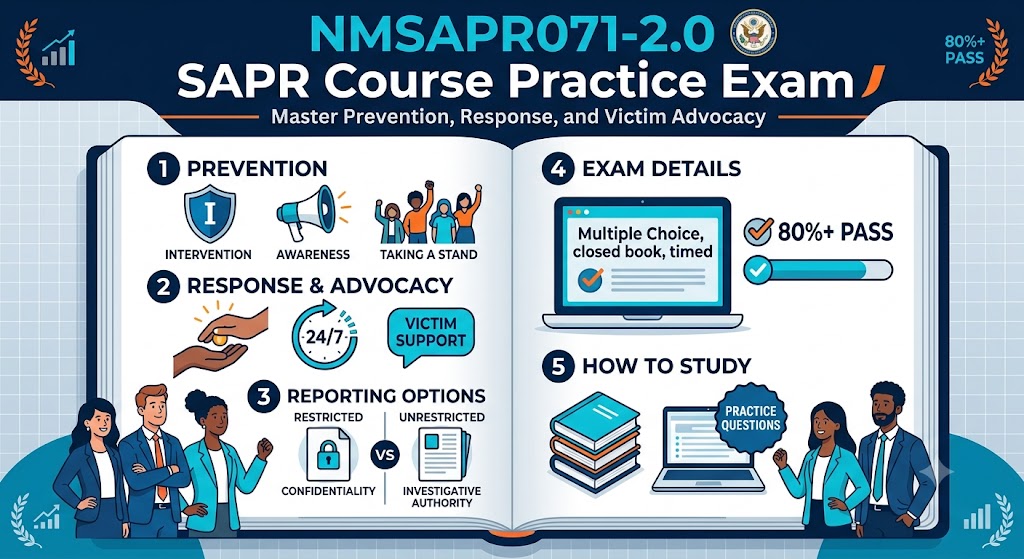
Additional Information
What the Course Entails and Exam Details
The NMSAPR071-2.0 course provides a comprehensive framework for understanding and combating sexual assault. Its core curriculum focuses on primary prevention, comprehensive response protocols, and the critical role of bystander intervention.
A successful candidate will master key areas, including:
Definitions and Dynamics: Understanding the specific definitions of sexual assault, consent, and the grooming process.
Reporting Options: Clearly distinguishing between Restricted and Unrestricted Reporting, including the implications for confidentiality, victim care, and investigation.
Bystander Intervention: Recognizing the "Bystander Effect" and learning actionable strategies to safely intervene and prevent incidents.
Victim Advocacy and Support: Familiarity with the roles of Sexual Assault Response Coordinators (SARCs), SAPR Victim Advocates (VAs), and the resources available to survivors.
Policy and Ethics: Understanding the relevant Department of Defense instructions and Navy regulations (e.g., OPNAVINST 1752.1D) that govern the program.
The subsequent exam serves as the official assessment of this knowledge.
What to Expect in the Final Exam
While a practice test is an invaluable tool for preparation, it is crucial to understand the format of the official final exam. The actual NMSAPR071-2.0 exam is typically administered online through designated learning management systems.
Here is what you can expect:
Exam Format: The test consists entirely of objective, multiple-choice questions designed to assess factual knowledge and scenario-based application.
Passing Score Requirements: To receive certification, a passing score is required, typically set at 80% or higher.
Time Limits: A specific time limit, often between 60 and 90 minutes, is enforced to simulate the pressure of real-world decision-making.
Specific Rules: The exam is typically "closed book," meaning learners cannot refer to course materials during the assessment. Completion of the full interactive curriculum is usually a prerequisite for accessing the final test.
How to Study and Exam Centers
Effective study for the NMSAPR071-2.0 practice test and final exam requires a structured approach.
Actionable Study Strategies:
Engage with the Primary Source: Do not skip the mandatory online course modules. Pay attention to the interactive scenarios, as they are a strong indicator of the types of questions you will face.
Utilize This Practice Test: Treat this practice resource as a diagnostic tool. Use it to identify specific knowledge gaps in key policies or reporting procedures. Review why wrong answers are incorrect, not just why the right answers are correct.
Understand 'Restricted vs. Unrestricted': Create a clear mental or physical chart comparing these two avenues. This is consistently one of the most heavily tested areas and has direct real-world impact.
Focus on Definitions: Ensure you can precisely differentiate terms like "sexual assault" and "sexual harassment," and know the limitations on who can accept a Restricted Report.
Where to Take the Exam: The official final exam is a digital assessment. It is not taken at physical, off-base centers like Pearson VUE. It is administered directly through the authorized online portals of your respective service branch, such as:
MyNavy Portal (MNP)
Joint Knowledge Online (JKO)
Service-specific Learning Management Systems (LMS)
Access to these materials and the final test requires your Common Access Card (CAC) and standard login credentials.
Job Opportunities from the Course
While NMSAPR071-2.0 is often a mandatory training requirement for all personnel, mastering its content is a prerequisite and powerful stepping stone to specialized career paths dedicated to prevention and advocacy.
Specific job titles and career paths this certification unlocks or supports include:
SAPR Victim Advocate (VA): A certified role providing 24/7 crisis intervention, referrals, and ongoing support to survivors. This requires an additional 40-hour basic training and subsequent D-SAACP certification.
Sexual Assault Response Coordinator (SARC): A vital program management position responsible for overseeing all SAPR victim services, training, and command support at the installation or regional level.
SARP (Sexual Assault Prevention and Response) Program Manager: A leadership role focusing on strategic planning and execution of prevention efforts.
SAPR/VA Support Specialist: Civilian roles (often NAF/APF) that work directly withSARCs to manage data, coordinate training, and provide immediate victim support.
Command SAPR Point of Contact (POC): A designated unit role, serving as a critical liaison between the command and the SARC, ensuring training compliance.
Military Unit Commander/Senior Enlisted Leader: While not a "job," proficiency in SAPR is essential for effective command, enabling a leader to foster a healthy climate and properly manage incidents.
Frequently Asked Questions
Reviews
5.0
Based on 0 reviews
Leave a Review
No reviews yet. Be the first to review!