
NOCTI Audio, Video, Technology, and Film (AVTF) COV Practice Test
$69.00
- Buy to unlock unlimited access to all Quiz questions and Answers in this Quiz.
- After purchase you can print a PDF of the whole quiz at any point. The PDF will contain the questions and the correct answers.
About this Exam
The NOCTI Audio, Video, Technology, and Film (AVTF) COV exam is a comprehensive assessment designed for students completing career and technical education (CTE) programs in media production. This industry-based certification validates a student's technical knowledge and practical skills, proving they are career-ready for entry-level positions in the dynamic fields of television, film, visual effects, and digital media.
It provides employers with a credible benchmark of capability, confirming that the certified individual possesses the foundational skills necessary to operate professional equipment and understand complex production workflows. This certification often serves as a critical bridge between a student’s academic career and their first professional role in the media industry.
Ready to test your knowledge?
Buy Now to Access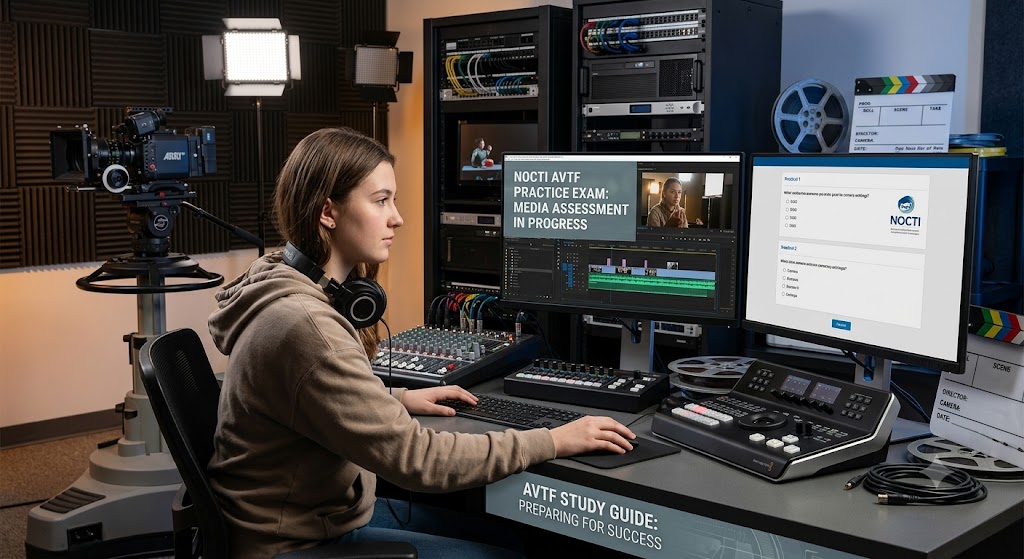
Additional Information
What the Course Entails and Exam Details
Preparing for the NOCTI AVTF COV exam requires a deep
understanding of the entire production lifecycle. While specific curricula
vary, the assessment is designed to measure proficiency across several core
domains essential for any media professional. Students are tested on both
theoretical knowledge and hands-on application.
The exam details cover a vast syllabus. Core topics
typically include:
- Pre-production:
Scriptwriting, storyboarding, location scouting, and project planning.
- Production:
Studio and field camera operation, audio recording techniques,
professional lighting setups, and directing.
- Post-production:
Video editing software, sound design, motion graphics, and exporting final
deliverables.
- Industry
Operations: Safety protocols, copyright laws, media ethics, and equipment
maintenance.
What to Expect in the Final Exam
The final NOCTI AVTF certification is not a single test but
a rigorous, multi-part assessment structured to mirror real-world industry
demands. Candidates should prepare for a comprehensive evaluation that
typically includes both a computer-based theoretical component and a
performance-based practical component.
The Written (Knowledge) Assessment: This portion
usually consists of approximately 100 multiple-choice questions administered
via a secure computer interface. Candidates are given a specific time limit,
often around two hours, to complete this section. The questions cover the
entire scope of the AVTF syllabus, testing theoretical understanding of
equipment physics, software concepts, and industry terminology. Passing scores
are determined by NOCTI and are updated periodically to maintain industry
relevance.
The Performance (Practical) Assessment: The hands-on
component is where students demonstrate their actual technical skill.
Candidates must perform specific, standard industry tasks under the observation
of a trained evaluator. This might include setting up a professional camera on
a tripod, demonstrating proper three-point lighting, synchronizing external
audio with video footage, or executing a basic edit sequence in a timeline.
This section is timed and strictly evaluated based on process, accuracy, and
adherence to safety standards.
How to Study and Exam Centers
Effective preparation is key to success on the NOCTI AVTF
exam. Students should adopt a multifaceted study strategy that combines
theoretical review with consistent practical application. Leverage every
available resource to ensure you are ready for both parts of the assessment.
Actionable Study Strategies:
- Utilize
Practice Tests: Sample assessments, like the one indicated in the
title, are invaluable. They familiarize you with the formatting and types
of questions found on the actual written exam.
- Master
the Equipment: Spend extra hours in the studio. Practice camera
setups, lighting, and audio recording until the physical process is
automatic.
- Review
Your Curriculum: Revisit your textbook, class notes, and project work.
Focus on areas where you feel less confident.
- Form
Study Groups: Collaborating with classmates allows you to teach
concepts to one another and practice practical skills together.
- Understand
the Rubrics: If available, review the performance assessment rubrics
to understand exactly how your practical skills will be scored.
Exam Centers and Registration: NOCTI exams are
typically administered at the authorized educational institution where the
student completed their AVTF program. Your school's CTE director or media
instructor will coordinate the registration process and act as the test
proctor. While some written exams may be proctored remotely under strict
guidelines, the practical assessment requires a physical studio location and
in-person evaluation. Consult your instructor early to understand the specific
testing schedule and location for your cohort.
Job Opportunities
from the Course
Earning the NOCTI AVTF certification unlocks diverse career
opportunities across the media landscape. It signals to employers that you
possess verified technical skills. Here is a list of potential career paths:
- Production
Assistant (PA)
- Video
Editor
- Camera
Operator
- Audio
Technician / Sound Mixer
- Grip
or Gaffer (Lighting Department)
- Broadcast
Technician
- Digital
Content Creator
- Social
Media Videographer
- Studio
Manager
- Master
Control Operator
Frequently Asked Questions
Reviews
5.0
Based on 0 reviews
Leave a Review
No reviews yet. Be the first to review!