
NOCTI Business Practice Practice Exam
$69.00
- Buy to unlock unlimited access to all Quiz questions and Answers in this Quiz.
- After purchase you can print a PDF of the whole quiz at any point. The PDF will contain the questions and the correct answers.
About this Exam
The National Occupational Competency Testing Institute (NOCTI) Business Practice certification is a valuable credential recognized across the United States. It is specifically designed to assess the foundational knowledge and technical skills required for entry-level roles in general business administration, office management, and clerical services. This exam is primarily tailored for high school career and technical education (CTE) students completing a multi-year business program, but it is also relevant for post-secondary students or adults entering the business field. By achieving this certification, candidates demonstrate to potential employers that they possess the necessary "Job Ready" skills needed to contribute effectively to a modern office environment from day one. It serves as powerful proof of competence in a competitive job market.
Ready to test your knowledge?
Buy Now to Access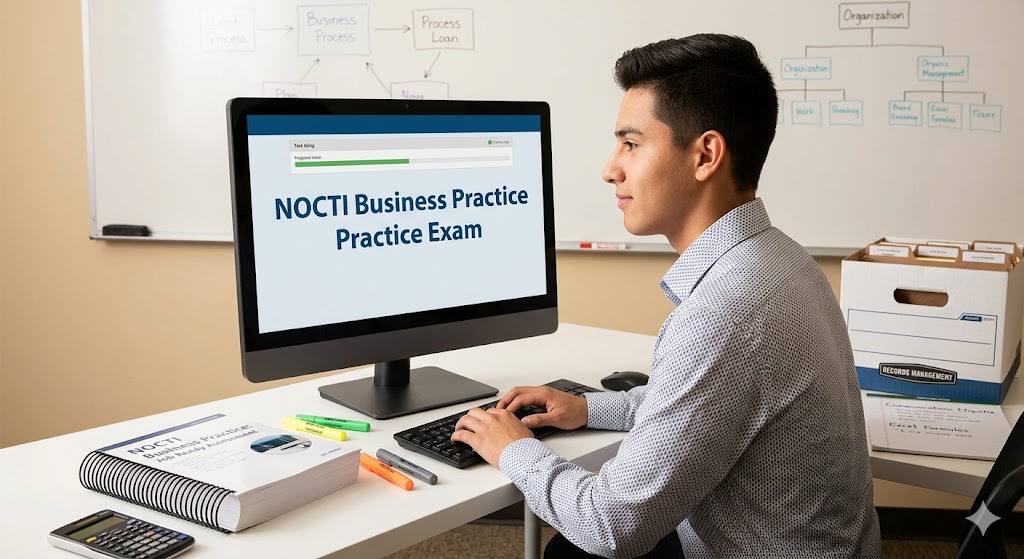
Additional Information
What the Course Entails and Exam Details
To succeed on the NOCTI Business Practice Exam, candidates must master several distinct domains of general business operations. The test is a comprehensive evaluation, drawing on curriculum standards that align with industry expectations.
The core domains assessed typically include:
1. Office Technology and Software Applications Candidates must be proficient in operating standard office hardware (copiers, scanners, phone systems) and demonstrate strong foundational skills in essential software, specifically word processing (creating memos, letters), spreadsheets (basic formatting, formulas, charts), and email systems (composition, organization, etiquette).
2. Communication Skills This section evaluates both written and verbal competence. Candidates must demonstrate proper grammar, spelling, and sentence structure for business correspondence. It also covers effective verbal communication, active listening, and appropriate customer service techniques for interacting with colleagues and clients.
3. Records Management Understanding how to organize, store, and retrieve information is crucial. This includes knowledge of physical and digital filing systems, standard indexing rules, retention schedules, and maintaining confidentiality.
4. Workplace Safety and ErgonomicsCandidates are expected to identify common office hazards, demonstrate knowledge of basic emergency procedures, and understand proper ergonomic practices to maintain health and productivity.
5. Basic Business Math and Financial Principles This involves applying mathematical operations to solve common business problems, such as calculating discounts, sales tax, percentages, and handling basic cash transactions. Some programs also include foundational bookkeeping concepts like debits and credits.
6. Employability and Ethics This covers standard workplace behavior, integrity, teamwork, time management, and understanding basic employment-related documents (resumes, job applications).
What to Expect in the Final Exam
The NOCTI Business Practice Exam is a standardized assessment administered in a secure, proctored environment.
Exam Format The assessment is split into two mandatory components:
Written Component: This consists of approximately 150 to 200 multiple-choice questions assessing theoretical knowledge across all core domains. Candidates typically have around three hours to complete this part.
Performance (Practical) Component: This unique aspect allows candidates to prove they can apply their knowledge. Students are required to complete actual office tasks using tools, materials, or software within a specified timeframe. Examples include creating a specific business document in a word processor, formatting a basic budget spreadsheet, or processing a series of customer service requests.
Administration The exam is typically delivered in a digital format via NOCTI’s secure online testing system, QuadNet™, at authorized testing centers. Both components may be taken in one day or scheduled across multiple sessions.
Passing Scores NOCTI does not establish a universal "passing score." Instead, they provide customized reports to educational institutions. Your school or district establishes the "cut score" required to earn the certification based on standard industry benchmark data. Candidates who score at least 70% on approved NOCTI Job Ready written assessments are often eligible for college credit recommendations through the National College Credit Recommendation Service (NCCRS).
How to Study and Exam Centers
Preparation is the key to confidence and success on test day.
Actionable Study Strategies
Utilize NOCTI Sample Questions: NOCTI provides study guides and sample questions on their website. Familiarizing yourself with the wording and format of the questions is crucial.
Review Classroom Materials: Treat your class textbooks, notes, worksheets, and project files as your primary study guide. Revisit units on communications, records, and software applications.
Practice Hands-On Skills: For the Performance component, you must actually use the software. Set yourself timed challenges: create a complex table in Word, format a budget in Excel using formulas, and create a multi-slide presentation.
Create Flashcards: Use flashcards for key terms, definitions (e.g., specific indexing rules), and common spreadsheet formulas.
Focus on Weak Areas: Review your performance on class tests to identify topics where you struggle. Dedicate extra time to mastering these concepts.
Exam Centers and Registration
Candidates do not typically register for NOCTI exams independently through public testing centers like Pearson VUE. Instead, the exams are organized through the career and technical education (CTE) program where the student is enrolled.
The actual testing centers are usually:
High schools or vocational/technical schools with authorized business programs.
Community or technical colleges that offer vocational pathways.
Registration and payment are handled by your school's NOCTI Site Coordinator, usually your business teacher or program administrator. They will provide you with specific instructions, login credentials for the online system, and schedule your exam date.
Job Opportunities from the Course
Earning the NOCTI Business Practice certification demonstrates to employers that you are "Job Ready" for essential foundational roles.
It opens doors to numerous career paths, including:
Office Assistant
Receptionist
Administrative Clerk
Data Entry Operator
Records Clerk or Technician
Customer Service Representative
Junior Bookkeeper or Accounting Clerk
Human Resources (HR) Assistant
Frequently Asked Questions
Reviews
5.0
Based on 0 reviews
Leave a Review
No reviews yet. Be the first to review!