
NOCTI Culinary Prep Cook Practice Test
$69.00
- Buy to unlock unlimited access to all Quiz questions and Answers in this Quiz.
- After purchase you can print a PDF of the whole quiz at any point. The PDF will contain the questions and the correct answers.
About this Exam
The NOCTI Culinary Prep Cook assessment is an industry-recognized certification designed to evaluate and validate the knowledge and skills required for entry-level culinary positions. It is part of NOCTI's (National Occupational Competency Testing Institute) range of assessments for career and technical education (CTE) programs. This certification is ideal for students in secondary or post-secondary culinary programs, as well as individuals already in the workforce seeking official recognition of their foundational competencies. Achieving this certification demonstrates your mastery of core culinary techniques and understanding of essential kitchen operations.
Ready to test your knowledge?
Buy Now to Access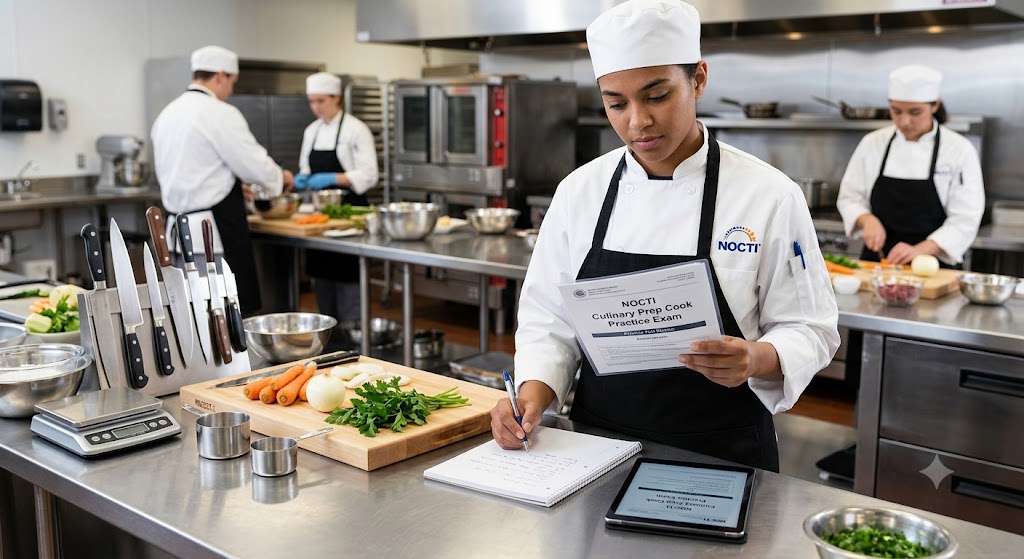
Additional Information
What the Course
Entails and Exam Details
The NOCTI Culinary Prep Cook assessment covers a
comprehensive range of topics fundamental to the roles and responsibilities in
a professional kitchen. The standard "Job Ready" assessment (e.g.,
Level 1 Prep Cook) typical of this path consists of both a written
(theoretical knowledge) and a performance (practical application) component,
demanding competence across multiple domains.
Core topics and skill areas typically covered include:
- Sanitation
and Safety: This is paramount, covering proper personal hygiene, safe
food handling practices, nationally recognized sanitation protocols (like
ServSafe® guidelines), workplace injury prevention, fire safety, allergen
awareness, and proper food storage. Knowledge of HACCP (Hazard Analysis
Critical Control Point) principles is often a key element.
- Knife
Skills: Identification and appropriate use of various knife types,
demonstration of proper sharpening techniques, and mastery of safe knife
usage for diverse standard cuts.
- Kitchen
Equipment: Identification, proper operation, maintenance, and safe
handling of both small and large kitchen appliances and measuring devices.
- Food
Preparation: General food prep knowledge (mise en place), reading and
following standard recipes, and specific skills for preparing a wide range
of items, including salads and dressings, soups and appetizers, fruits and
vegetables, pasta, grains, legumes, meats and poultry, fish and seafood,
and basic bakery products.
- Stocks
and Sauces: Foundational knowledge of preparing mother sauces and
various types of stocks and soups.
- Culinary
Nutrition: Understanding basic food groups, dietary guidelines, and
healthy cooking techniques.
- Culinary
Math: Practical application of mathematical concepts to kitchen tasks,
such as standardizing recipes, unit conversions, food cost calculations,
and inventory management.
- Employment
Skills: Professional behavior, appearance, and fundamental
understanding of the chain of command in a kitchen.
What to Expect in the Final Exam
You must be prepared to demonstrate both your theoretical
knowledge and your practical application in a multi-part exam structure.
Written Assessment:
- Format:
This component generally features multiple-choice questions assessing
factual and theoretical knowledge in all key topic areas.
- Example
Length: Assessments can be extensive, sometimes involving over 150
questions (e.g., around 170 for Level 1).
- Time
Limit: Expect a significant time allocation, potentially up to 3
hours, which may be split into one, two, or three sessions for
administration.
- Administration:
Delivered in either an online or a paper/pencil format, depending on the
testing center.
Performance (Practical) Assessment:
- Format:
This hands-on part requires you to complete actual jobs using typical
tools, materials, machines, and equipment under observation by qualified
proctors or instructors.
- Example
Details: This usually involves completing multiple, specific tasks or
"jobs" (e.g., around 7 for Level 1), which could include a
comprehensive skills segment, equipment and food identification, knife
sharpening, mise en place preparation, and preparing specific dishes
(e.g., sautéed chicken, rice pilaf, vegetables, salads, etc.).
- Time
Limit: Expect an allocation of over 2 hours for the performance
component (e.g., around 2 hours and 5 minutes for Level 1).
- Criteria:
Participants are scored on their ability to work efficiently and safely,
adhere to all sanitation procedures, organize equipment effectively,
correctly use tools, and, in task execution, achieve correct taste,
texture, and appearance.
Overall Expectations:
- Passing
Scores: Both the written and performance assessments typically have
individual minimum passing score requirements (often around 70% for
written and 75% for performance, but this can vary and should be
confirmed). Achieving certification often requires passing both
components.
- Rules
& Procedures: Expect strict adherence to all safety, sanitation,
and professional protocols. Cell phones and unauthorized materials are not
allowed.
- How
to Study and Exam Centers
Effective preparation is key to success. Combine academic
study with hands-on practice.
Actionable Study Strategies:
- Official
NOCTI Resources: Access any practice tests, study guides, and test
blueprints offered directly by NOCTI or associated partners. Review the
official list of covered standards and jobs.
- Online
Practice Tests: Seek out and take online practice tests for the NOCTI
Culinary Prep Cook assessment. These simulate the test format and provide
valuable insights into potential question styles. Analyze incorrect
answers.
- Culinary
Textbooks and Guides: Thoroughly review comprehensive culinary
textbooks used in culinary programs. Key areas to focus on are sanitation,
knife skills, professional techniques, and culinary math.
- Hands-on
Kitchen Practice: This is essential for the performance component.
Regularly practice knife cuts, mise en place, and preparing standard
dishes (poultry, rice, vegetables, sauces, salads). Seek feedback from
instructors or mentors in a real or simulated professional kitchen
environment.
- Flashcards:
Create flashcards for critical information like culinary terminology, safe
temperatures, sanitation codes, knife cuts, and common conversions.
- Review
Sanitation Guidelines: Dedicate time specifically to mastering
nationally recognized sanitation and food safety protocols (like the
latest FDA Food Code/ServSafe® principles).
- Practice
Culinary Math: Refresh your math skills for recipe conversion and food
cost calculations.
- Simulate
Test Conditions: Take practice tests under timed conditions to improve
speed and comfort level.
Exam Centers and Registration:
The NOCTI Culinary Prep Cook exam is typically administered
through educational institutions and technical career centers.
- Authorized
Locations: Exams are primarily taken at physical locations such as
high schools, career and technical education centers, vocational schools,
community colleges, and post-secondary institutions authorized as NOCTI
test sites.
- Registration
Process: Registration is generally handled by the testing site. If you
are enrolled in a program, your school will typically organize and
register students. Individuals not in a program should contact NOCTI
directly or look for an authorized independent testing center in their
area.
- Remote
Proctoring: While physical centers are standard for performance exams,
some NOCTI written assessments may offer a remote proctoring option for an
additional fee. Check specific details for your assessment and chosen
testing site. Remote proctoring typically requires specific technological
equipment and a secure environment. The performance component always
requires a physical kitchen setting.
- Fees:
Testing fees can apply, with potential added costs for additional services
or retesting. Confirm current pricing through your testing center or
NOCTI.
Job Opportunities
from the Course
A NOCTI Culinary Prep Cook certification provides you with a
tangible industry standard to highlight your qualifications. This certification
can significantly boost your employability in numerous entry-level positions
and open doors to diverse career paths in the bustling culinary industry. While
a degree offers broader options, this certification focuses specifically on
critical foundational skills.
Specific Job Titles and Career Paths Unlocked:
- Prep
Cook
- Kitchen
Assistant
- Commis
Chef (entry-level rank in some professional kitchens)
- Dishwasher/Prep
Cook combination roles
- Banquet
Kitchen Prep
- Catering
Prep Assistant
- Line
Cook (often starts at a slightly lower entry level or can quickly advance
with demonstrated experience and this certification)
- Institutional
Cook (e.g., hospitals, schools, corporate dining)
- Deli/Food
Counter Attendant (in settings with food preparation)
- Junior
Line Cook
Frequently Asked Questions
Reviews
5.0
Based on 0 reviews
Leave a Review
No reviews yet. Be the first to review!