
NOCTI Graphic Design Practice Exam
$69.00
- Buy to unlock unlimited access to all Quiz questions and Answers in this Quiz.
- After purchase you can print a PDF of the whole quiz at any point. The PDF will contain the questions and the correct answers.
About this Exam
Welcome to your comprehensive guide to the NOCTI Graphic Design Exam, one of the key gateways for aspiring graphic designers and students. NOCTI, the National Occupational Competency Testing Institute, provides industry-based credentials across many technical fields.
Ready to test your knowledge?
Buy Now to Access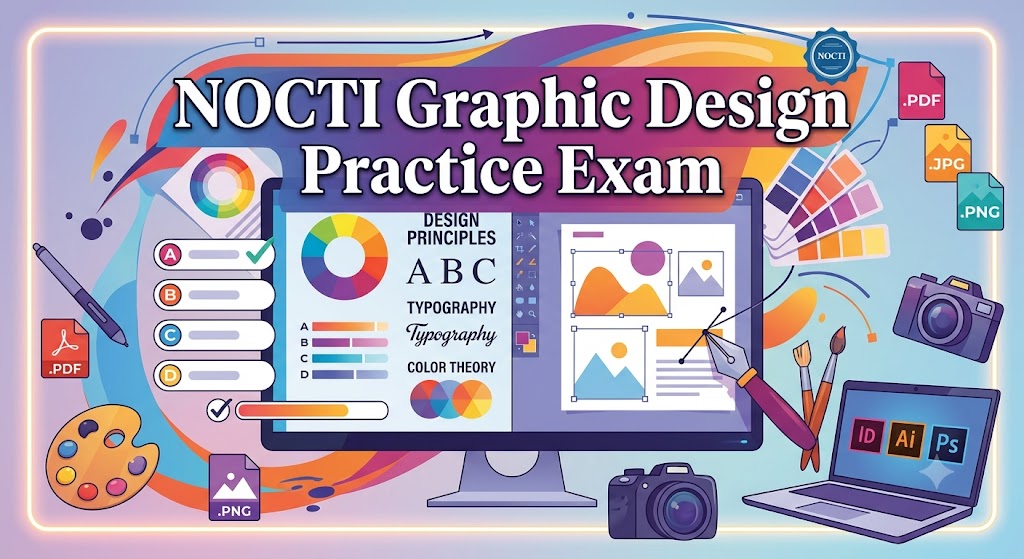
Additional Information
What the Course Entails and Exam Details
This examination is not just about raw artistic talent; it
validates the technical knowledge and practical skills that form the foundation
of a modern graphic designer’s toolkit. The assessment content is built upon
industry standards and typically covers a diverse range of critical areas.
Expect to demonstrate comprehensive knowledge and practical application skills
across the following core competencies, typically found on both the practice
and final NOCTI exams:
- Design
Principles & Elements: Understanding of balance, hierarchy,
contrast, unity, proximity, rhythm, space, line, form, color, texture, and
value, and how to apply them effectively in a visual composition.
- Typography:
Comprehensive knowledge of type terminology, anatomy, classifications
(serif, sans-serif, script, etc.), measurement systems, tracking, kerning,
leading, readability, and appropriate font usage for different audiences
and media.
- Color
Theory: Mastery of color terminology, the color wheel, various color
schemes (analogous, complementary, triadic, etc.), tints, shades,
neutrals, and the distinct application of RGB (for digital display)
and CMYK (for print) color models.
- Software
Proficiency: Practical, hands-on skill in using industry-standard
design software (most commonly the Adobe Creative Cloud suite, including
InDesign for layout, Illustrator for vector graphics, and Photoshop for
image manipulation) to perform real-world design tasks. This can include
setting up documents, manipulating vector paths, masking, creating
gradients, and managing files for different outputs.
- Production
& Printing: Familiarity with the end-to-end design process, file
management conventions, pre-flighting, output resolution requirements,
diverse print techniques, paper specifications, and basic safe practices
within a design and production environment.
- Multimedia
& Photography Basics: An understanding of digital images, file
formats, and sometimes basic camera operation and post-production
concepts.
- Professional
Practices: Knowledge of design workflows, client communication,
marketing fundamentals, ethical considerations, and copyright laws.
What to Expect in the Final Exam
The actual NOCTI Graphic Design Exam is a significant
assessment and is typically comprised of two main components:
Multiple-Choice (Written)
Exam: This section tests your theoretical knowledge across all the key
subject areas discussed above. Be prepared to answer questions on color theory
definitions, typography terminology, safety protocols, and general design
principles. The number of questions and exact time limit can vary by version,
but a common multiple-choice component consists of around 100 questions with a
time limit of several hours.
Performance (Practical) Exam:
This is where you put your technical skills to the test. This segment often
requires candidates to utilize specific software (like InDesign, Illustrator,
or Photoshop) to complete defined practical jobs within a set period. You might
be asked to create a logo, design a layout for a brochure, or manipulate an
image according to specific instructions. The performance component also has an
administration time, and usually consists of two or three practical jobs.
Passing Score & Rules: To earn your NOCTI Graphic
Design certification, you must achieve a specific minimum "cut score"
on both the multiple-choice and the performance assessments. NOCTI
establishes these benchmarks based on what industry experts determine to be a
baseline level of competent skill. The official passing scores are typically
detailed in the current year’s assessment blueprints, which you should consult
directly through the NOCTI website or your educational institution. You should
check the current guidelines to understand what constitutes a passing score and
the retake policies. The exact requirements might slightly differ based on your
testing version. In the real exam, specific tools like personal calculators may
be restricted or provided within the test interface. Taking a robust
practice exam beforehand is the best way to familiarize yourself with the
content, format, and time constraints of both of these critical parts,
and to identify areas for focused study. The practice tests provided can mimic
this two-part structure, ensuring your preparation is targeted and realistic.
How to Study and Exam Centers
Preparation is the absolute key to success on the NOCTI
Graphic Design exam. Here are actionable strategies to elevate your study plan
and prepare with confidence:
Leverage Practice Exams: This
is your single most valuable resource. Seek out the most relevant practice
tests and use them repeatedly. Practice exams help you identify specific
knowledge gaps, familiarize yourself with the question styles, and build
stamina and time management skills.
Master the Software: Don't
just understand the software’s functions in theory; practice using the Adobe
Creative Cloud (InDesign, Illustrator, Photoshop) to replicate real-world
design tasks. Attempt to create diverse projects—logos, multi-page layouts,
photo composites—mirroring the types of assignments you might face in the
performance exam.
Review Core Concepts:
Study your design and art education textbooks, class notes, and official NOCTI
content outlines. Focus particularly on typography, color theory, design
principles, file management, and production/printing processes. Create
flashcards or comprehensive summary sheets for quick review.
Understand the Exam Blueprint:
Go to the official NOCTI website or check with your school's testing
coordinator for the current assessment blueprint. This document provides a
detailed breakdown of the exact topics, weighting, question numbers, and
practical jobs you can expect.
Simulate Exam Conditions:
When taking practice tests or practicing practical tasks, simulate the real
exam environment as closely as possible. Set a timer, minimize distractions,
and follow all instructions to build comfort and focus.
Seek Feedback: If
possible, have your completed design projects or practical test results
reviewed by a teacher, mentor, or experienced designer to receive constructive,
professional feedback on your technique, execution, and understanding of the
brief.
Taking the Exam (Centers): NOCTI assessments are
typically administered within an educational institution (like a high school,
vocational school, or community college) that is an authorized NOCTI test site.
Your school or institution will designate a Site Coordinator who
oversees the entire testing process.
- Schools
& Vocational Centers: This is the most common route for students.
Your testing will be coordinated by your instructor or the designated
administrator at your institution.
- Authorized
Test Sites: If you are not an active student, you may need to locate
an authorized public NOCTI test site. You can check the NOCTI website for
lists of test centers or contact the organization for assistance.
- Remote
Proctored Online Testing: NOCTI increasingly offers remote proctored
options for the multiple-choice component of many exams, allowing
candidates to test online from home or another suitable location under
strict monitoring conditions. This choice often has specific technical requirements.
In all cases, you must register and schedule your exam
through your educational site or an authorized center, and there may be
specific deadlines and fees associated with registration. Practice exams are
often available through the same institutional or online portals used for the
final test.
Job Opportunities from the Course
A NOCTI Graphic Design certification is a highly valuable
credential that validates your technical competence and professional knowledge
to potential employers. While not always a mandatory requirement, this
certification significantly enhances your resume, demonstrates initiative, and
shows that you have met recognized industry benchmarks. It can unlock a wide
range of career paths across numerous sectors:
- Entry-Level
Graphic Designer
- Layout
Artist
- Graphic
Artist
- Multimedia
Specialist
- Visual
Communications Associate
- Digital
Image Editor
- Production
Artist
- Brand
Identity Design Assistant
- Freelance
Graphic Designer
- In-house
Designer (across various industries)
- Social
Media Content Creator / Visuals Specialist
- Print
Shop / Prepress Specialist
Frequently Asked Questions
Reviews
5.0
Based on 0 reviews
Leave a Review
No reviews yet. Be the first to review!