
Non-Destructive Testing NDT Practice Exam
$69.00
- Buy to unlock unlimited access to all Quiz questions and Answers in this Quiz.
- After purchase you can print a PDF of the whole quiz at any point. The PDF will contain the questions and the correct answers.
About this Exam
The Non-Destructive Testing (NDT) Practice Exam is an essential preparatory tool designed for professionals striving to achieve certification in the critical field of materials testing. Whether you are aiming for ASNT Level I, II, or III, or another industry standard, this simulated test is engineered to mirror the actual exam environment. It provides candidates with a realistic assessment of their understanding and readiness, building the confidence and stamina needed for success.
This guide is specifically tailored for individuals working as NDT technicians, quality control inspectors, welding engineers, or manufacturing specialists across diverse sectors such as aerospace, oil and gas, construction, and power generation.
It offers a low-stakes platform to identify knowledge gaps and sharpen recall of vital NDT principles and procedures.
Ready to test your knowledge?
Buy Now to Access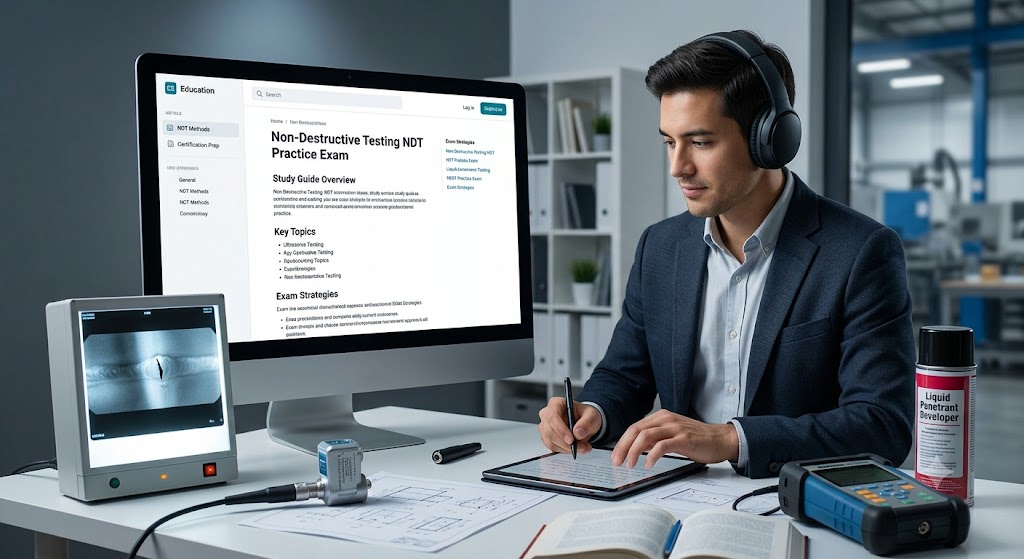
Additional Information
What the Course Entails and Exam Details
The practice exam rigorously assesses knowledge across the primary NDT methods and general practices required for industry proficiency.
It is structured to evaluate your competency in foundational theory, practical application, and the relevant safety and coding standards. Key methods covered include:
Ultrasonic Testing (UT): Sound propagation, transducer theory, and discontinuity detection.
Radiographic Testing (RT): X-ray and gamma-ray physics, safety, film imaging, and digital techniques.
Magnetic Particle Testing (MT): Magnetic fields, testing media, and surface/sub-surface detection.
Liquid Penetrant Testing (PT): Capillary action, developers, and surface inspection techniques.
Visual Testing (VT): Principles of lighting, optical aids, and direct/remote examination.
Eddy Current Testing (ET): Electromagnetic induction, conductivity, and defect sizing.
Candidates will face questions detailing procedural requirements, equipment calibration, the interpretation and evaluation of indications, and compliance with industry codes such as ASME, ASTM, and AWS.
What to Expect in the Final Exam
While the practice exam is designed for self-assessment, the actual certification examinations are formalized assessments structured by certifying bodies.
Format: Certification exams are generally multiple-choice. For Level II certification in each method, you should expect separate exams: a General examination covering basic knowledge of the method, and a Specific examination covering procedures, standards, and acceptance criteria applicable to your job. Some certifications also require a Practical exam to demonstrate hands-on competence.
Time Limit: Certification tests are typically timed. The number of questions and the time allocated vary depending on the method and level. Practice exams help candidates develop efficient time management strategies to complete all sections.
Scoring: A minimum passing score (e.g., 70% or 80%) is required for each examination section (General, Specific, Practical). Your practice test results provide an invaluable diagnostic score to gauge your exam readiness and pinpoint areas requiring focused study.
Environment: The actual exams must be taken at accredited facilities or approved online portals under proctored conditions. The use of reference material (if allowed) is strictly controlled.
How to Study and Exam Centers
Preparation is paramount for mastering the complexities of NDT.
Actionable Study Strategies:
Simulated Practice: Utilize this practice test repeatedly. Treat it as a full-dress rehearsal, simulating the timed conditions and format of the final exam to build recall speed and stamina.
Study Authority Materials: Base your preparation on the primary NDT handbooks, method manuals, and technical texts, particularly those published by ASNT (American Society for Non-Destructive Testing).
Review Codes and Standards: Become familiar with the relevant API, AWS, and ASME codes. The specific exam focuses heavily on your ability to apply these standards to specific scenarios.
Hands-on Review: If preparing for Level II, physically practicing with calibration blocks and the relevant equipment is highly beneficial, even if the written test is the primary hurdle.
Focus on Weak Points: Use the feedback from your practice test to create a structured study plan, allocating extra time to the methods or theories where you scored lowest.
Exam Centers: It is important to remember that this is a practice test. The official certification examinations (such as ASNT NDT Level I, II, or III) are administered through recognized testing facilities, physical exam centers, or approved physical training institutions. Many industries use authorized third-party proctors or training centers to deliver these high-stakes assessments. Always verify the location with your specific certifying body.
Job Opportunities from the Course
Earning an NDT certification opens dynamic career pathways in industries that demand high-level quality assurance and materials integrity. Successfully passing your final exam can qualify you for roles such as:
NDT Technician (Level I or Level II)
Quality Control Inspector
Materials Testing Specialist
Quality Assurance Coordinator
Welding Inspector
Maintenance Inspector (Refineries, Pipelines, Power Plants)
Aerospace Component Inspector
NDT Laboratory Supervisor
NDT Training Instructor
Quality Manager
Frequently Asked Questions
Reviews
5.0
Based on 0 reviews
Leave a Review
No reviews yet. Be the first to review!