
Non-radar CKT 1 Practice Exam
$69.00
- Buy to unlock unlimited access to all Quiz questions and Answers in this Quiz.
- After purchase you can print a PDF of the whole quiz at any point. The PDF will contain the questions and the correct answers.
About this Exam
The Non-radar Controller Knowledge Test (CKT) 1 is a foundational assessment designed for aspiring air traffic controllers (ATC). It specifically evaluates a candidate's understanding of air traffic control procedures used in environments where radar service is not available or unusable. This exam is a critical step for students and trainees seeking to master the complex logic and visualization skills required for manual procedural separation. It is primarily designed for individuals enrolled in recognized air traffic control training programs, collegiate aviation courses, or those preparing for entry into an official ATC academy.
Ready to test your knowledge?
Buy Now to Access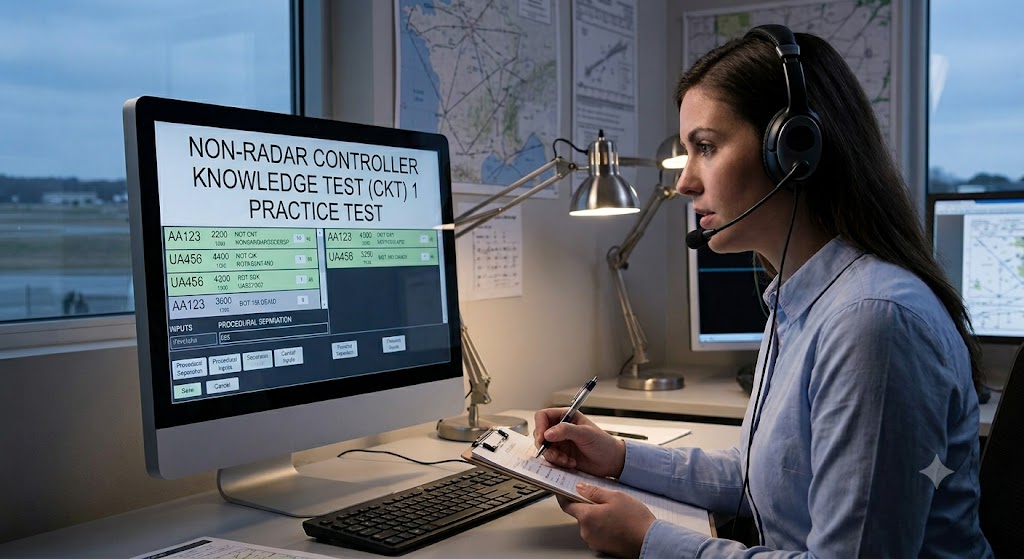
Additional Information
What the Course Entails and Exam Details
This examination focuses on the core principles of procedural, non-radar air traffic separation. Candidates must demonstrate the ability to visualize traffic flow in three dimensions based solely on pilot reports and navigational aid information. The study material covers a wide spectrum of critical ATC knowledge.
Key topics included are:
Vertical Separation Minimums: Understanding the standard altitude buffers required between aircraft based on direction of flight and aircraft type.
Longitudinal Separation: Mastering the complex calculations of separation based on time or distance, utilizing standard reporting points and pilot estimates.
Lateral Separation: Applying procedures for separating aircraft on differing courses, radials, and airways.
Navigational Aid Application: Utilizing VOR, NDB, and GPS reporting to establish aircraft positions.
Holding Procedures: Knowledge of non-radar holding entry procedures and separation within holding patterns.
Standard Instrument Departures and Arrivals: Understanding the rules governing aircraft entering and exiting the terminal environment without radar.
ATC Communications: Demonstrating proficiency in clear, concise, and standardized phraseology.
What to Expect in the Final Exam
The CKT 1 Practice Exam is typically structured as a computer-based, multiple-choice assessment. The test is designed to be rigorous, requiring not just theoretical knowledge but also the rapid, practical application of separation standards.
Candidates should expect a format similar to the following:
Question Format: Multiple-choice questions. A significant portion of the test uses scenario-based problems, where the candidate is provided with pilot position reports (e.g., "Aircraft A over VOR at 1410, Flight Level 230") and must calculate necessary separation actions or identify potential conflicts.
Time Limit: Exams are strictly timed, often allowing approximately 60 to 90 minutes to complete. Speed and accuracy are both tested, as controllers must make quick decisions in real-world scenarios.
Passing Score: While specific institutional requirements vary, a high passing grade—frequently 80% or greater—is generally required to demonstrate the necessary proficiency.
Rules: The exam is typically "closed-book." Candidates are generally provided with scratch paper to draw "mental picture" diagrams of traffic scenarios, but they may not use external references like separation manuals during the test.
How to Study and Exam Centers
Preparation for the CKT 1 must be diligent and structured, focusing heavily on mental visualization.
Here are actionable study strategies:
Create Scenarios: Practice by drawing aircraft positions on blank charts based on hypothetical pilot reports. This builds crucial spatial awareness.
Rote Memorization: Memorize standard vertical separation minimums (e.g., 1,000 feet vs. 2,000 feet) and minimum time requirements for longitudinal separation (e.g., 10 minutes vs. 5 minutes).
Utilize Authorized Materials: Focus your studies on the official air traffic control manuals (such as FAA Order 7110.65 or international equivalents) and any training materials provided by your institution.
Practice phraseology: Read pilot reports and control instructions aloud to improve familiarity and communication speed.
Regarding exam locations, this specific knowledge test is institutional. Because the CKT 1 is usually an internal qualification exam rather than a standardized public test (like an FAA Airman Knowledge Test), it is not typically taken at public centers like Pearson VUE. Instead, you will take the exam at the specific location mandated by your training provider. This is usually at authorized Air Traffic Control training academies, partnered aviation universities, or official government training facilities. You must register directly through your training institution or program coordinator.
Job Opportunities from the Course
Successfully passing the CKT 1 is a necessary milestone to proving your competence in foundational air traffic control principles. The qualification achieved after further practical training opens several pathways within the aviation industry.
Specific career paths and job titles this certification unlocks include:
Air Traffic Control Specialist (ATCS) - Enroute (Center)
Air Traffic Control Specialist (ATCS) - Terminal (Tower/TRACON)
Contract Air Traffic Controller (Domestic or International)
Air Traffic Control Simulation Specialist/Instructor
Flight Service Specialist
Airline Dispatcher (Non-radar logic is highly valuable)
Frequently Asked Questions
Reviews
5.0
Based on 0 reviews
Leave a Review
No reviews yet. Be the first to review!