
Non-Restricted Firearms Course Practice Exam
$69.00
- Buy to unlock unlimited access to all Quiz questions and Answers in this Quiz.
- After purchase you can print a PDF of the whole quiz at any point. The PDF will contain the questions and the correct answers.
About this Exam
Welcome to your essential first step towards responsible and legal non-restricted firearm ownership in Canada.
This comprehensive course, often known as the Canadian Firearms Safety Course (CFSC), is designed for individuals seeking to acquire their Possession and Acquisition Licence (PAL) for non-restricted firearms.
These typically include most common hunting rifles and shotguns.
The course is crafted for anyone, from aspiring hunters and sports shooters to collectors and workplace safety professionals, who wants to understand and practice the fundamentals of firearm safety.
It is a vital foundation for a lifetime of safe and enjoyable participation in firearms-related activities.
By taking this course and successfully completing the practice tests and final exams, you are committing to a culture of safety and responsibility within the firearms community.
Our practice materials are designed to boost your confidence, reinforce key concepts, and prepare you for success.
Ready to test your knowledge?
Buy Now to Access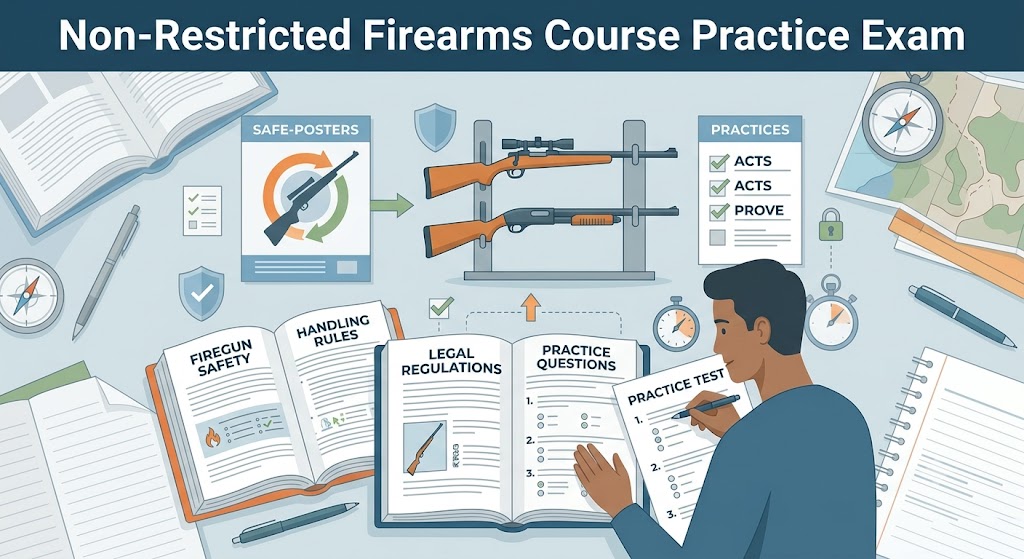
Additional Information
What the Course Entails and Exam Details
This course goes far beyond simply teaching you how to shoot.
The primary focus is strictly on safety, legal compliance, and practical knowledge.
You will delve into the history and development of firearms, understand the classification of non-restricted firearms, and learn to identify various types and actions.
A significant portion is dedicated to the proper and safe handling of firearms in diverse situations – from storage and transport to actual use at the range or in the field.
You will learn the fundamental safety rules, often summarized by principles like ACTS (Assume every firearm is loaded, Control muzzle direction, Trigger finger off trigger/guard, See that the firearm is unloaded) and PROVE (Point muzzle in safe direction, Remove ammunition, Observe the chamber, Verify the feed path, Examine the bore), which become second nature through practice.
The course covers crucial information about different types of ammunition, how to select and handle it safely, and what to look for when inspecting ammunition.
Furthermore, you will gain a clear understanding of federal and provincial laws and regulations concerning firearms ownership, storage, transport, and displaying, ensuring you operate within the legal framework.
You’ll also learn essential maintenance and cleaning procedures to keep your firearms functioning safely and reliably.
The course material is presented through a combination of engaging lectures, visual aids, hands-on practical demonstrations, and supervised practice with deactivated firearms.
Understanding the mechanisms, safety features, and appropriate procedures is key, and the practice exams mirror this comprehensive approach.
What to Expect in the Final Exam
The final certification exam typically consists of two distinct components, both of which must be passed successfully.
The first part is a written examination.
This test usually comprises around 50 multiple-choice and true/false questions.
These questions assess your theoretical knowledge of firearm types, actions, ammunition, safe handling procedures, storage/transport regulations, and relevant laws covered throughout the course.
You will need to demonstrate a comprehensive understanding, with a passing grade, often quite high (frequently around 80%), required.
The written exam has a reasonable time limit, typically allowing you sufficient time to carefully read and answer each question.
Following the successful completion of the written portion, you will proceed to the practical examination.
This hands-on assessment is critical, focusing solely on your ability to demonstrate safe firearm handling.
Under the direct supervision of a certified instructor, you will be required to perform a series of safe handling scenarios using deactivated firearms.
This might involve demonstrating the safe way to pick up a firearm, checking its status, loading and unloading (using dummy ammunition), proving it safe, carrying it in different ways, and demonstrating safe practices for crossing obstacles.
You will also be asked questions during the practical exam to explain your actions or identify components and safety features.
Safety is paramount during the practical exam; any unsafe action or handling can result in an immediate failure of this component, even if you answered all other aspects correctly.
Specific minimum scores (often 100% on certain critical safety steps) are common for the practical part.
Both parts are typically completed in person at a designated training facility.
Be prepared to follow all instructions carefully, listen attentively to the examiner, and demonstrate every action deliberately and safely.
The atmosphere is encouraging, but standards are strict, reflecting the serious nature of firearm safety.
How to Study and Exam Centers
Preparation is key to success on both the written and practical portions of your exam.
Here are some effective study strategies:
Attend the full course: Ensure you participate actively in all lectures and practical sessions.
Take thorough notes: Write down key points, rules, and procedures explained by your instructor.
Review the course manual: The official study guide is your ultimate resource. Read it cover to cover, highlighting important sections.
Practice with deactivated firearms: If possible, and only under the guidance of a qualified instructor, safely practice the handling procedures you learn. If actual deactivated firearms are unavailable for independent practice, visually rehearse the steps. Mentally go through the ACTS and PROVE processes repeatedly.
Utilize practice tests: This is where non-restricted firearms course practice tests, like the ones offered on our platform, are invaluable. They familiarize you with the question format, identify areas where you need more study, and build your test-taking confidence. Simulate exam conditions by timing yourself and answering without referencing materials.
Create flashcards: Make flashcards for key definitions, firearm parts, safety rules, ammunition details, and relevant regulations.
Study with a partner: Discussing concepts and practicing safe handling procedures (visual or with proper props/instruction) with someone else can reinforce your learning.
Get plenty of rest: Ensure you are well-rested on the day of your exam for maximum focus and recall.
For locating exam centers and officially taking the course and exam:
Search officially: Look for certified firearms safety instructors and courses approved by the Chief Firearms Officer (CFO) of your province or territory. The Royal Canadian Mounted Police (RCMP) website is an excellent starting point for information and links to regional CFO contacts.
Contact local clubs and retailers: Hunting stores, sports shooting ranges, and community colleges often host or can direct you to approved courses and instructors.
Confirm certification: Always verify that the instructor and course you choose are officially recognized for PAL licensing purposes.
Register early: Courses can fill up quickly, so register as soon as you find a suitable option.
Exams are in-person: Currently, both the written and practical exams must be taken in person with a certified instructor/examiner at a physical testing location. Online testing is not available for these specific firearms safety certifications.
Job Opportunities from the Course
Successfully completing the Non-Restricted Firearms Course and obtaining your Possession and Acquisition Licence (PAL) opens doors to several rewarding career paths and supplementary roles.
Some of the job opportunities unlocked or enhanced by this certification include:
Hunting Guide: Leading and instructing hunters on safe and ethical hunting practices.
Outfitter Assistant/Camp Staff: Assisting with hunting operations and wilderness excursions, often requiring firearm handling for safety and support.
Security Personnel (in specific contexts): Certain security roles, particularly in remote areas or involving asset protection, may require a PAL and specialized training (note: this course is often not the only requirement for armed security).
Conservation Officer/Park Ranger Support: Assisting with wildlife management and enforcement activities, where non-restricted firearms are sometimes utilized for predator control or other operational needs.
Range Safety Officer: Supervising activities at firearms ranges to ensure adherence to safety rules and protocols.
Firearms Retail and Sales: Understanding firearms and safety regulations is crucial for selling firearms responsibly.
Pest Control (Specific to certain animal types/licenses): Some pest management scenarios might utilize non-restricted firearms within legal guidelines.
Workplace Safety Roles: Companies operating in areas with wildlife risks may require personnel trained in firearms safety for predator defense support.
Collector/Historian Support: Working with or managing collections of historical non-restricted firearms safely.
Wilderness Guides/Instructors: Individuals leading groups in bear-country may have or provide support involving firearms for safety.
Frequently Asked Questions
Reviews
5.0
Based on 0 reviews
Leave a Review
No reviews yet. Be the first to review!