
NORAC Operating Rules Practice
$69.00
- Buy to unlock unlimited access to all Quiz questions and Answers in this Quiz.
- After purchase you can print a PDF of the whole quiz at any point. The PDF will contain the questions and the correct answers.
About this Exam
The NORAC Operating Rules Practice Exam is an indispensable study tool designed for railroad professionals in the Northeastern United States seeking qualification in the Northeast Operating Rules Advisory Committee (NORAC) ruleset. The NORAC rules are a standardized set of operating procedures used by major railroads, including Amtrak, CSX, Norfolk Southern, NJ Transit, and SEPTA, among others. A single set of rules ensures safe, efficient, and consistent operations across member railroads. This certification, and the practice exam to prepare for it, is designed for locomotive engineers, conductors, train dispatchers, yardmasters, and any other employee whose duties involve the movement of trains or the protection of track. Mastery of these rules is not just a job requirement; it is the cornerstone of safety in the railroad industry.
Ready to test your knowledge?
Buy Now to Access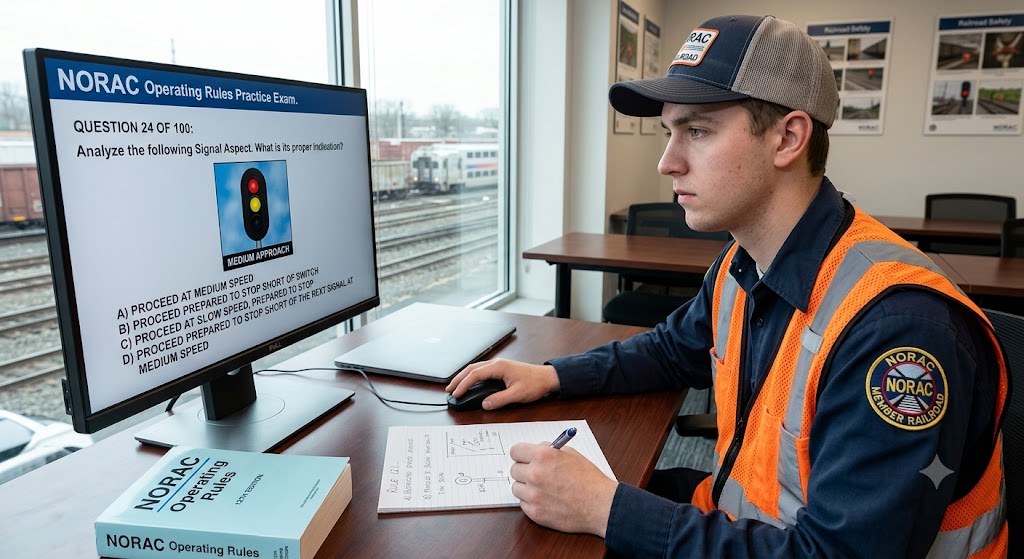
Additional Information
What the Course Entails and Exam Details
The underlying course and this practice exam cover the full
spectrum of the comprehensive NORAC Operating Rules rulebook. You will
delve into the precise definitions, procedures, and responsibilities that
govern every aspect of a railroad's operation. Core topics include the
intricate Signal Systems—from Automatic Block Signals (ABS) and Direct
Control Systems (DCS) to advanced Positive Train Control (PTC) operations. A
critical section details Signal Aspects and Indications, requiring
students to identify every signal type and understand the exact movement
permitted. The exam rigorously tests your understanding of Speed
Restrictions, distinguishing between Normal, Limited, Medium, Slow, and
Restricted speeds and where they apply. You will be tested on Horn and
Whistle Signals, Hand Signals, and the critical Radio and
Telephone Communications protocols. Other key areas include the issuance
and use of Form D movement authorities, Protection of Trains and
workers, and the non-negotiable safety protocols like Rule G, which
prohibits the use of alcohol and drugs.
What to Expect in the Final Exam
The official, final NORAC qualification exam is typically a
proctored, written examination, often administered via a computer-based testing
system. The format consists of multiple-choice questions, which may include
scenario-based questions where you must apply the correct rule to a given
situation. A strong emphasis is placed on precision, as rule compliance is
critical. To pass and receive your certification, a high minimum score is
required, often around 80% to 85%, reflecting the high-stakes nature of
the content. A time limit will be enforced, and students are generally not
allowed to access the actual rulebook or notes during the test, making pre-exam
preparation crucial.
How to Study and Exam Centers
Effectiveness in mastering NORAC relies on a multi-faceted
approach. First, you must obtain and study the current, official NORAC
Operating Rules rulebook and any railroad-specific special instructions.
Use this NORAC Operating Rules Practice Exam as your primary gauge of
readiness. Do not just find the correct answer; make sure you understand the
'why' behind each rule. Create visual aids like flashcards for signal aspects
and indications, which are often the most complex section. Many experienced
railroaders recommend creating scenarios and applying the rules to them. When
studying with others, practice the exact wording of job briefings and radio
communications. The final, proctored examination is typically held at
authorized railroad training centers, company offices, or occasionally at
approved third-party testing centers. You must coordinate with your employer to
schedule your test date. For employees of major railroads, this process is
integrated into their standard training and qualification cycle.
Job Opportunities
from the Course
Obtaining a NORAC Operating Rules certification is a key
requirement for many well-paying and rewarding careers within the railroad
industry across the Northeastern United States. This qualification is a direct
path to, and often a condition of, the following roles with NORAC member
railroads:
- Locomotive
Engineer
- Conductor
and Assistant Conductor
- Train
Dispatcher and Control Operator
- Yardmaster
and Assistant Yardmaster
- Track
Foreman and Maintainer
- Signal
Maintainer and Electrician
- Railroad
Safety Inspector
- Railroad
Management Roles
Frequently Asked Questions
Reviews
5.0
Based on 0 reviews
Leave a Review
No reviews yet. Be the first to review!