
North Carolina Envirothon Forestry Practice Exam
$69.00
- Buy to unlock unlimited access to all Quiz questions and Answers in this Quiz.
- After purchase you can print a PDF of the whole quiz at any point. The PDF will contain the questions and the correct answers.
About this Exam
The North Carolina Envirothon Forestry section is an integral component of the largest high school environmental education competition in the state. Designed specifically for middle and high school students, this program challenges young minds to dive deep into natural resource management. While not a professional certification, mastery of this section proves advanced knowledge in tree identification, forest ecology, and silviculture, preparing students for leadership roles in environmental science and conservation.
Ready to test your knowledge?
Buy Now to Access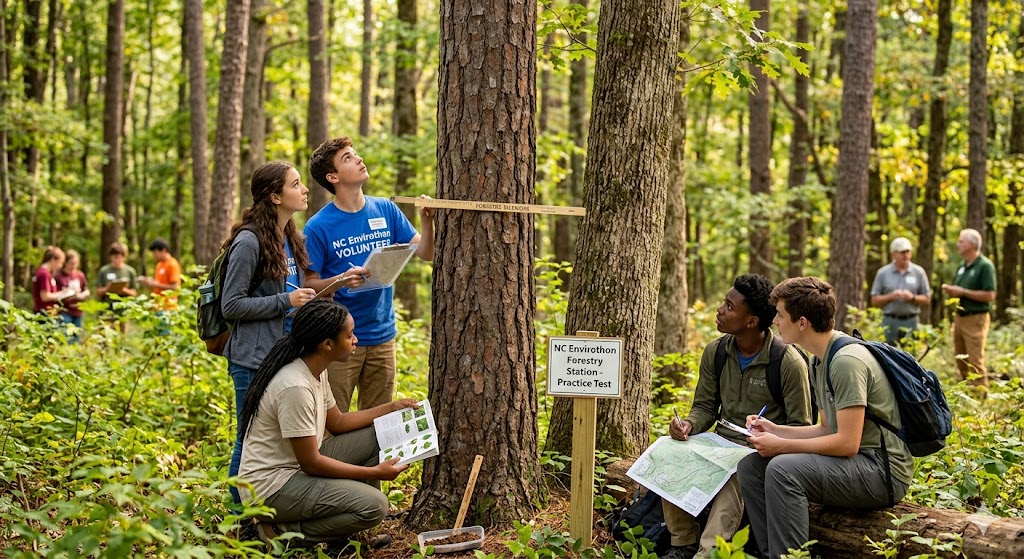
Additional Information
What the Course Entails and Exam Details
To excel in the NC Envirothon Forestry section, students must master both theoretical concepts and practical field skills specific to North Carolina’s diverse ecosystems.
The core syllabus encompasses the fundamental principles of dendrology, requiring students to identify dozens of native tree species by their leaves, bark, fruit, and twigs. Beyond identification, the course covers complex forest ecology, including natural successional stages, the role of fire in forest health, and symbiotic relationships within the ecosystem.
Participants will learn sustainable forest management practices (silviculture), such as varied harvesting methods and the economic aspects of timber production. Crucially, the section emphasizes practical skills, including the proper use of forestry tools like Biltmore sticks, diameter tapes, and clinometers to measure tree height and volume.
What to Expect in the Final Exam
The final Forestry station test is a high-energy, collaborative assessment taken in a natural, outdoor field setting. Students must work as a team, usually in groups of three to five, to solve complex natural resource problems.
The exam format is a hybrid model. It includes written multiple-choice questions that test theoretical knowledge and ecological principles. However, the most critical part is the hands-on, practical component. Students are required to visit designated locations in the forest and demonstrate their skills in real-time.
For example, a group may have to identify five live trees on-site, measure the diameter at breast height (DBH) of a specific pine using a diameter tape, and estimate the marketable timber volume of another standing tree using a Biltmore stick. There may also be scenario-based problems concerning best management practices for water quality in a working forest. The exact scoring and time limits vary based on whether it is a area or state-level competition, but focus and practical accuracy are paramount.
How to Study and Exam Centers
Effective preparation for the NC Envirothon Forestry station requires a blend of focused book study and extensive field practice. Students should begin by thoroughly reviewing the official NC Envirothon forestry curriculum and study guides provided by the North Carolina Association of Soil and Water Conservation Districts. These resources contain the definitive lists of tree species and key forestry concepts relevant to the competition.
However, textbook knowledge is not enough. Spend significant time in varied NC forests (coastal plain, piedmont, and mountain regions if possible). Practice tree identification at different times of the year. Build a complete collection of forestry tools and use them repeatedly until measurements become natural and accurate. Utilize online flashcards for tree ID and silviculture terms.
Unlike standardized computer-based tests at professional centers, the Envirothon Forestry exam is held specifically at outdoor field locations designated by the Envirothon organizers for regional and state competitions. These testing "centers" are actual forests, parks, or conservation areas, chosen to provide a challenging and relevant environment for testing field skills.
Job Opportunities from the Course
While this competition is for students, excelling in the Forestry section develops the foundational skills, field experience, and passion necessary for several critical career paths in the natural resources sector. It serves as a powerful stepping stone to college degrees in forestry and related fields, making candidates highly attractive to academic programs and future employers. Potential career paths include:
Forester (State or Private Sector)
Forestry Technician
Urban Forester
Wildland Firefighter
Conservation Scientist
Natural Resource Manager
Wildlife Biologist
Extension Agent (Agriculture and Natural Resources)
Silviculturist
Frequently Asked Questions
Reviews
5.0
Based on 0 reviews
Leave a Review
No reviews yet. Be the first to review!