
North Carolina Foundations of Reading Practice Exam
$69.00
- Buy to unlock unlimited access to all Quiz questions and Answers in this Quiz.
- After purchase you can print a PDF of the whole quiz at any point. The PDF will contain the questions and the correct answers.
About this Exam
The North Carolina Foundations of Reading exam is a critical milestone for aspiring educators seeking licensure in the state of North Carolina. This rigorous assessment is designed specifically for candidates entering elementary education (K-6) and special education roles. It measures whether potential teachers possess the essential, research-based knowledge required to provide effective reading instruction to students. Passing this test demonstrates your understanding of the "Science of Reading"—the collection of evidence-based practices that explain how children learn to read and how to help those who struggle.
Ready to test your knowledge?
Buy Now to Access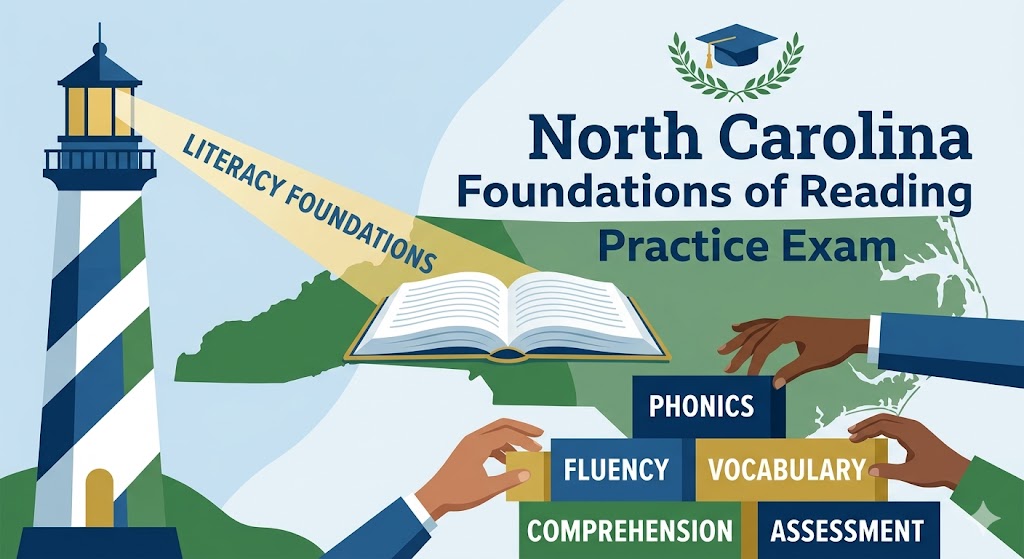
Additional Information
What the Course Entails and Exam Details
This examination does not cover general teaching pedagogy; rather, it focuses intensely on the specific competencies needed to build a strong reading foundation. The content is deeply rooted in scientifically based reading research. The core topics covered in the syllabus include:
Foundations of Reading Development: This includes an in-depth understanding of phonological and phonemic awareness, concepts of print, the alphabetic principle, phonics, and morphology.
Development of Reading Comprehension: Candidates must demonstrate knowledge of vocabulary development, reading fluency, and explicit strategies for facilitating comprehension of both narrative and expository texts.
Reading Assessment and Instruction: This area focuses on using formal and informal assessments to diagnose reading difficulties and plan effective, differentiated instruction.
What to Expect in the Final Exam
The final North Carolina Foundations of Reading exam is a computer-based assessment. Candidates should be prepared for a multi-format testing experience.
Format: The test consists of 100 multiple-choice questions and 2 open-response (written) assignments.
Open-Response Questions: These require you to analyze clinical data or student work samples to identify specific reading strengths and weaknesses, then recommend effective instructional strategies based on your analysis.
Passing Score: The benchmark for passing is a scaled score of at least 233.
Time Limit: You are generally allowed 4 hours for the testing appointment, which includes time for a tutorial and the nondisclosure agreement.
Rules: Standardized testing rules apply. You will need to present valid identification at the testing center or meet strict system requirements if taking the exam remotely.
How to Study and Exam Centers
Preparation is the absolute key to success on this challenging exam. Relying solely on general teaching knowledge will not suffice. We recommend a structured, multi-faceted study approach.
Actionable Strategies:
Utilize Official Resources: Your first stop should always be the official study guides and practice tests provided by the North Carolina Licensure Assessments website.
Master Key Vocabulary: The exam relies heavily on precise terminology. Create flashcards for concepts like "morpheme," "phoneme," "systematic phonics," and "digraph."
Practice Open-Responses: Do not ignore the written section. Practice outlining your answers, using diagnostic data to support your claims, and recommending specific, research-based instructional interventions.
Simulate Test Conditions: Take full-length practice exams under timed conditions to improve your pacing and build stamina.
Exam Centers: The exam is administered by Pearson VUE. Candidates have two main options for taking the test:
Physical Testing Centers: You can schedule an appointment at authorized Pearson VUE testing centers located throughout North Carolina and nationwide.
Online Proctoring (OnVUE): This option allows you to take the exam from the comfort of your home or office, provided you meet specific technological and environment requirements.
Job Opportunities from the Course
Successfully passing the North Carolina Foundations of Reading exam is a necessary step to obtaining licensure for several key educational roles within the state. Unlocking your professional teaching license opens doors to a variety of meaningful career paths, including:
Elementary School Teacher (Grades K-6)
Special Education Teacher (General Curriculum and Adapted Curriculum)
Reading Interventionist
Literacy Coach (Typically requires experience and advanced certification, but this is the first foundational step)
Academic Specialist (Reading/Language Arts focus)
Title I Reading Teacher
Educational Tutor (Specializing in foundational literacy)
Frequently Asked Questions
Reviews
5.0
Based on 0 reviews
Leave a Review
No reviews yet. Be the first to review!