
North Carolina General Contractors Practice Exam
$69.00
- Buy to unlock unlimited access to all Quiz questions and Answers in this Quiz.
- After purchase you can print a PDF of the whole quiz at any point. The PDF will contain the questions and the correct answers.
About this Exam
The North Carolina General Contractors License is a crucial credential for anyone looking to manage or bid on significant construction projects within the state. This license, overseen by the North Carolina Licensing Board for General Contractors, is required for projects exceeding $30,000. It signifies that a contractor has met the rigorous standards of knowledge, experience, and financial stability necessary to operate professionally and safely. This certification is designed for aspiring project managers, superintendents, and construction business owners who are serious about advancing their careers and legalizing their operations in North Carolina's booming construction industry. Successfully passing the associated exam is the cornerstone of unlocking these professional opportunities.
Ready to test your knowledge?
Buy Now to Access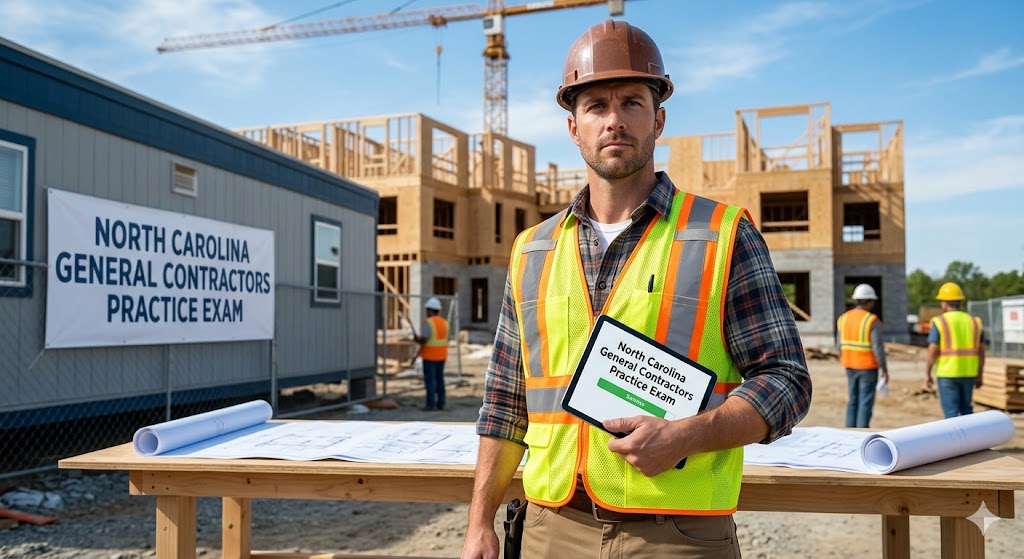
Additional Information
What the Course Entails and Exam Details
Preparing for the North Carolina General Contractors exam requires a deep understanding of several core areas vital to safe and legal construction operations. A comprehensive study course will not only review the essential technical knowledge but also teach you how to efficiently navigate the allowed reference materials.
The examination content typically covers the following key areas:
North Carolina Administrative Code and Law: This includes understanding the specific statutes governing general contracting in NC, license classifications (Limited, Intermediate, Unlimited), and the rules of the Licensing Board.
Business and Finance: You will need to demonstrate knowledge of sound business practices, including financial management, accounting, lien laws, payroll taxes, and employment regulations.
Safety Regulations: A strong command of OSHA (Occupational Safety and Health Administration) standards is critical for ensuring job site safety and passing the exam.
Project Management: This section covers the lifecycle of a construction project, including contracts, estimating, bidding, scheduling, and subcontractor management.
Technical Provisions: Depending on the specific license classification (e.g., Building, Residential, Highway), this involves knowledge of codes, materials, and construction methods.
What to Expect in the Final Exam
The actual licensing exam is administered by PSI Services, a third-party testing provider, on behalf of the state board. Knowing what to expect on test day can significantly reduce anxiety and improve your performance.
Exam Format: The test is composed entirely of multiple-choice questions. It is important to note that this is an open-book examination. This means you are permitted to bring specific, approved reference books into the testing center. The key to success is not memorizing every detail but knowing exactly where to find the information quickly and accurately.
Passing Score Requirements: Candidates must achieve a scaled score of at least 70% to pass the exam. You will receive your official score report immediately after completing the test.
Time Limits: The time allowed varies slightly depending on the specific exam classification, but generally, you will have between 3 to 4 hours to complete the test. Managing your time effectively between looking up references and answering questions is essential.
Specific Rules: Only approved, permanently bound reference materials are allowed. You may highlight, underline, or index your books with permanent tabs before the exam, but no hand-written notes or loose papers are permitted inside the books during the test.
How to Study and Exam Centers
Effective preparation for an open-book exam focuses on familiarity with the reference materials rather than rote memorization.
Actionable Study Strategies:
Obtain the Official Reference List: First, identify the exact editions of the books approved by PSI for your specific exam. These often include the NC Code of Ordinances, OSHA regulations, and NASCLA contractors’ guides.
Organize Your References: This is the most crucial step. Use permanent, commercial tabs to index key sections, chapters, and frequently used charts (like safety tables or lien law deadlines). Highlight and underline important passages. Your goal is to be able to flip to any major topic within seconds.
Take Practice Exams: Utilize a dedicated NC General Contractors practice exam. This will help you become familiar with the phrasing of the questions and, more importantly, give you practice in quickly navigating your reference books under timed conditions.
Simulate Exam Conditions: When taking practice tests, time yourself and use only your tabbed reference books to mimic the actual testing experience.
Exam Centers and Registration:
The North Carolina General Contractors licensing exams are administered by PSI at various professional testing centers throughout the state. You cannot simply walk in; you must pre-register and schedule an appointment.
Online Portals: The most convenient way to register is through the PSI website. You will first need to submit an application to the North Carolina Licensing Board for General Contractors and receive approval before you can schedule your exam with PSI.
Physical Testing Centers: PSI operates testing centers in major North Carolina cities, including, but not limited to, Charlotte, Raleigh, Greensboro, Wilmington, and Asheville. Specific address details will be provided during the registration process.
Job Opportunities from the Course
Earning your North Carolina General Contractors License opens the door to numerous lucractive and fulfilling career paths in the construction industry. Below are specific job titles and paths this certification unlocks:
Licensed General Contractor/Business Owner: You can legally bid on, manage, and execute construction projects over $30,000.
Construction Project Manager: Lead and oversee all aspects of large-scale commercial or residential projects.
Construction Superintendent: Manage daily on-site operations, coordinating subcontractors and ensuring work proceeds according to schedule and code.
Commercial Developer: Oversee the development of commercial real estate properties.
Residential Builder: Focus specifically on the construction and renovation of single-family or multi-family homes.
Specialty Contractor (License Classification Dependent): Focus on specific sectors such as Highway construction, Public Utilities, or specialty trades.
Frequently Asked Questions
Reviews
5.0
Based on 0 reviews
Leave a Review
No reviews yet. Be the first to review!