
North Carolina Plumbing Practice Exam
$69.00
- Buy to unlock unlimited access to all Quiz questions and Answers in this Quiz.
- After purchase you can print a PDF of the whole quiz at any point. The PDF will contain the questions and the correct answers.
About this Exam
Embarking on a career as a licensed plumber in North Carolina requires dedication, technical skill, and successful navigation of the state’s rigorous testing process. The North Carolina State Board of Examiners of Plumbing, Heating, and Fire Sprinkler Contractors mandates comprehensive examinations for licensure, covering various classifications such as Plumbing Class I (Commercial) and Class II (Residential). A North Carolina Plumbing Practice Exam is an essential tool designed to bridge the gap between classroom learning or apprenticeships and the actual testing environment. It provides aspiring plumbers with a simulated exam experience, allowing them to assess their knowledge, identify critical areas for improvement, and become familiar with the format of the state-administered test. By utilizing a practice exam, candidates significantly increase their chances of passing the licensing examination on their first attempt, accelerating their path to professional licensure.
Ready to test your knowledge?
Buy Now to Access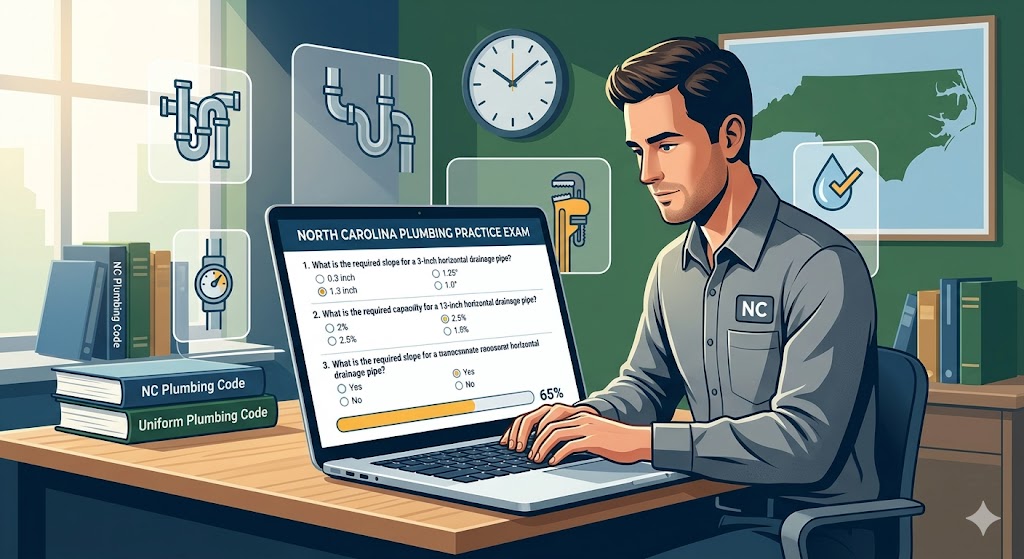
Additional Information
What the Course Entails and Exam Details
Preparing for the North Carolina plumbing license involves understanding a vast array of technical subjects and regulatory requirements. The content covered in prep courses and practice exams is meticulously aligned with the North Carolina State Plumbing Code and relevant business and law sections. Candidates must master a diverse range of topics to demonstrate competency.
The core domains generally include:
North Carolina Plumbing Code: This is the most significant section, covering general regulations, materials, joints, and connections.
Fixtures, Faucets, and Fittings: Understanding installation requirements, accessibility, and water-conserving fixtures.
Hangers and Supports: Knowing the proper spacing and materials for supporting piping.
Water Supply and Distribution: Learning requirements for water service piping, hot water supply systems, and backflow prevention.
Sanitary Drainage: Understanding drain, waste, and vent (DWV) systems, including sizing, installation, and materials.
Vents and Venting Systems: Mastering different venting methods (individual, common, wet venting) and their required sizing.
Traps, Interceptors, and Separators: Knowing the specific requirements for different types of traps and wastewater treatment components.
Indirect/Special Waste: Regulations concerning waste from equipment like dishwashers and food service facilities.
System Testing: Procedures for testing water supply and drainage systems for leaks.
Calculations and Plans: Ability to interpret plumbing isometric drawings, plan specifications, and perform relevant mathematical calculations (e.g., volume, slope, pressure).
Fuel Gas (if applicable/required for license type): Regulations regarding gas piping installation and appliances.
Business and Law: Basic knowledge of North Carolina laws, regulations, and business practices relevant to contractors (required for full licensure, often a separate part of the exam process).
What to Expect in the Final Exam
While a practice exam is a simulation, the actual North Carolina licensing examinations are high-stakes assessments with specific formats. The examinations are administered under strict conditions to ensure integrity.
Candidates should expect the following for the official state licensing exam:
Format: The exam consists of multiple-choice questions. It is typically divided into two main components: a "Trade" (technical plumbing knowledge) portion and a "Business, Law, and Project Management" portion.
Open Book Status: Many North Carolina plumbing exams are "open book," allowing candidates to use specific, authorized reference materials during the test, such as the North Carolina State Plumbing Code. Knowing how to quickly navigate these references is as crucial as memorizing the content.
Scoring: Candidates generally need a minimum score of 70% on each required part of the examination to pass. Passing the Business and Law portion may be prerequisite for the Trade section in some cases, or they may be taken together.
Time Limit: Each portion of the exam is strictly timed. The specific duration depends on the classification (e.g., Class I or II), but candidates should be prepared for several hours of focused testing per section. Effective time management during the exam is critical.
Administration: The examinations are currently administered by PSI Services LLC on behalf of the North Carolina State Board of Examiners.
How to Study and Exam Centers
Preparation is the key to success on the North Carolina Plumbing Exam. Candidates are encouraged to adopt a structured and active study plan rather than passive reading.
Effective study strategies include:
Prioritize the Code: Since the exam is largely open-book, your primary study objective should be to learn the structure and index of the North Carolina Plumbing Code. Practice looking up answers efficiently rather than trying to memorize every detail.
Utilize Practice Exams: Take multiple timed practice exams, such as the North Carolina Plumbing Practice Exam, under simulated test conditions (e.g., quiet room, no phone, using only authorized references). This builds testing stamina and familiarizes you with question phrasing.
Analyze Practice Results: Do not just look at your score. Review every answer, especially the incorrect ones, and look up the correct answer in the code book. Understanding why you got a question wrong is more valuable than getting it right.
Focus on Key Tables and Formulas: Create cheat sheets (for study purposes only) of common tables, charts, and mathematical formulas you might need (e.g., pipe sizing tables, slope calculations).
Consider a Prep Course: Many private training providers and technical colleges in North Carolina offer plumbing exam preparation courses that review the code, teach navigation strategies, and provide targeted practice.
Regarding exam locations, the official state licensing examinations (administered by PSI) are not available through generic online portals or everyday test platforms. Instead, candidates must register through PSI after receiving approval from the North Carolina State Board. PSI operates a network of computer-based testing centers.
Current PSI testing centers in North Carolina often include locations in:
Raleigh (or surrounding areas like Cary/Durham)
Charlotte
Greensboro
Fayetteville
Wilmington
Asheville
(Candidates should always verify current testing center locations during the registration process with PSI.)
Job Opportunities from the Course
Successfully passing the licensing examination opens the door to numerous lucrative and stable career opportunities in the plumbing industry across North Carolina. Licensure is not just a regulatory requirement; it is a mark of professional competence that enhances employability and earning potential.
Upon earning a North Carolina Plumbing License (depending on classification), individuals are qualified for the following career paths and job titles:
Licensed Plumbing Contractor (Class I or Class II)
Master Plumber / Journeyman Plumber (depending on specific local/contractual designations post-licensure)
Plumbing Service Technician (Residential and Commercial)
Project Manager (Plumbing Projects)
Plumbing Inspector (for Municipalities/Counties)
Plumbing Business Owner
Maintenance Plumber (for Large Facilities/Institutions)
Pipefitter (in relevant contexts)
Medical Gas Installer (requires additional specific certification, often built upon a basic license)
Frequently Asked Questions
Reviews
5.0
Based on 0 reviews
Leave a Review
No reviews yet. Be the first to review!