
North Carolina SLP-Assistant Practice Exam
$69.00
- Buy to unlock unlimited access to all Quiz questions and Answers in this Quiz.
- After purchase you can print a PDF of the whole quiz at any point. The PDF will contain the questions and the correct answers.
About this Exam
The North Carolina SLP-Assistant certification is a vital credential for individuals dedicated to supporting speech-language pathologists (SLPs) and making a difference in the lives of clients with communication disorders. This designation is designed for paraprofessionals who want to work directly under the supervision of a licensed SLP to deliver therapeutic services in various settings, including schools, hospitals, and private clinics. Passing the approved competency exam is a critical step towards full registration in North Carolina. The North Carolina SLP-Assistant Practice Exam is a comprehensive study tool designed to help you prepare effectively for the actual licensure test, ensuring you have the knowledge and confidence to succeed.
Ready to test your knowledge?
Buy Now to Access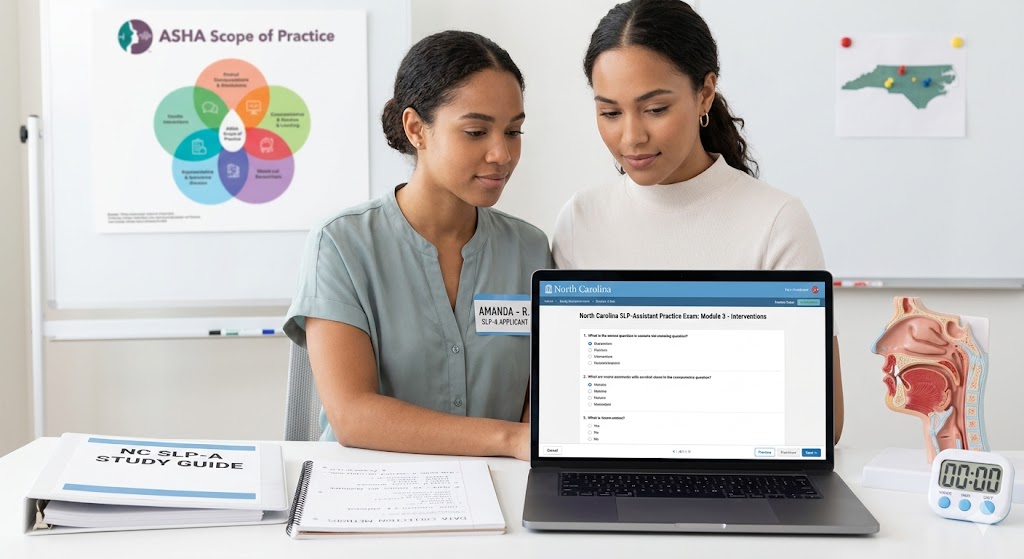
Additional Information
What the Course Entails and Exam Details
Preparing for the North Carolina SLP-Assistant exam requires a thorough understanding of the core concepts, clinical procedures, and ethical standards required in the field. A typical preparation course and the subsequent exam cover a wide range of essential topics developed to align with both national standards and specific state regulations set by the North Carolina Board of Examiners for Speech-Language Pathologists and Audiologists.
Core content areas include:
Foundations of Speech-Language Pathology: A basic overview of human communication, typical development of speech and language, and the anatomy and physiology of speech and hearing mechanisms.
Speech and Language Disorders: Understanding the characteristics of various conditions, including articulation and phonology disorders, language delays, fluency (stuttering), voice disorders, and pragmatic language challenges.
Intervention and Treatment: Learning evidence-based therapy techniques, implementation strategies, and appropriate elicitation procedures under the direction of a supervising SLP.
Scope of Practice: Clearly defining the authorized tasks an SLP-Assistant can perform and understanding the limitations of the role to ensure ethical and legal compliance in North Carolina.
Data Collection and Documentation: Mastering objective measurement tools, record-keeping, and progress reporting to maintain accurate and compliant clinical records.
Ethical and Professional Behavior: Adhering to the ASHA Code of Ethics, confidentiality laws (HIPAA), and professional conduct standards.
What to Expect in the Final Exam
The actual North Carolina SLP-Assistant licensure exam is designed to objectively measure your readiness to practice. While a "Practice Exam" is a study simulation, the final exam you take for licensure has specific characteristics. In North Carolina, the Board of Examiners approves the specific competency exam required for registration. It is generally not the national Praxis Speech-Language Pathology exam, which is for independent SLP practice, but rather a targeted assessment for assistants.
You should anticipate an exam with the following structure and rules:
Format: The exam typically consists of multiple-choice questions designed to test both your recall of factual information and your ability to apply concepts to real-world clinical scenarios.
Content Weighting: Questions are distributed across key domains, focusing heavily on the scope of practice, therapy implementation, and data collection.
Passing Score: The North Carolina Board establishes the passing threshold. You must achieve this score to be eligible for registration.
Time Limit: There is a strict time limit to complete the exam.
Scenario-Based Questions: Be prepared for questions that describe a client case and ask you to identify the correct action, therapy technique, or documentation entry, applying your understanding of North Carolina regulations.
How to Study and Exam Centers
Effective preparation for the North Carolina SLP-Assistant exam requires a dedicated and systematic approach. To maximize your chances of success, you should utilize diverse study methods that simulate the actual testing environment.
Actionable study strategies include:
Utilize Comprehensive Practice Exams: Take multiple North Carolina SLP-Assistant Practice Exams to familiarize yourself with the question format, identify content weaknesses, and improve your time management skills.
Focus on Scope of Practice: Study the official North Carolina administrative code to memorize exactly what you can and cannot do as an SLP-Assistant in the state.
Analyze Clinical Scenarios: Practice applying your knowledge to case studies. Read scenario questions carefully, focusing on objective facts rather than making assumptions.
Create Flashcards: Use flashcards for medical terminology, the names of speech sounds and disorders, data collection methods, and legal/ethical terms.
Review Core Textbooks: Revisit the material from your Associate's degree or specified community college coursework.
The real licensure exam is administered or authorized by the North Carolina Board of Examiners for Speech-Language Pathologists and Audiologists (NCBOESLPA). Registration and scheduling details are provided through their official portal. Depending on the current Board policy, the exam may be offered at physical testing centers within North Carolina, through authorized educational institutions, or increasingly, via secure online proctoring platforms.
Job Opportunities from the Course
Earning your North Carolina SLP-Assistant registration unlocks a clear career path with significant demand. This credential allows you to provide direct patient services under the required supervision. The specific job titles this certification unlocks include:
Speech-Language Pathology Assistant (SLPA)
Registered SLP-Assistant
Speech Therapy Assistant
Communication Disorders Assistant
Frequently Asked Questions
Reviews
5.0
Based on 0 reviews
Leave a Review
No reviews yet. Be the first to review!