
North Dakota MPJE Practice Exam
$69.00
- Buy to unlock unlimited access to all Quiz questions and Answers in this Quiz.
- After purchase you can print a PDF of the whole quiz at any point. The PDF will contain the questions and the correct answers.
About this Exam
Navigating the landscape of pharmacy law can be a daunting challenge for aspiring pharmacists.
The North Dakota Multistate Pharmacy Jurisprudence Examination (MPJE) is a required, state-specific licensing test designed to evaluate a candidate’s understanding of the specific statutes, rules, and regulations governing the practice of pharmacy in the state of North Dakota.
This examination ensures that newly licensed pharmacists possess the critical legal knowledge necessary to practice safely and ethically, protecting the health and well-being of the North Dakota public.
A North Dakota MPJE Practice Exam is a vital educational resource specifically engineered for graduating pharmacy students and out-of-state pharmacists seeking reciprocity.
It serves as a realistic simulation tool, mirroring the format and complexity of the actual test, allowing candidates to assess their readiness and build confidence.
By utilizing a practice exam, candidates can identify specific weak areas in their legal knowledge and focus their final study efforts effectively.
Ready to test your knowledge?
Buy Now to Access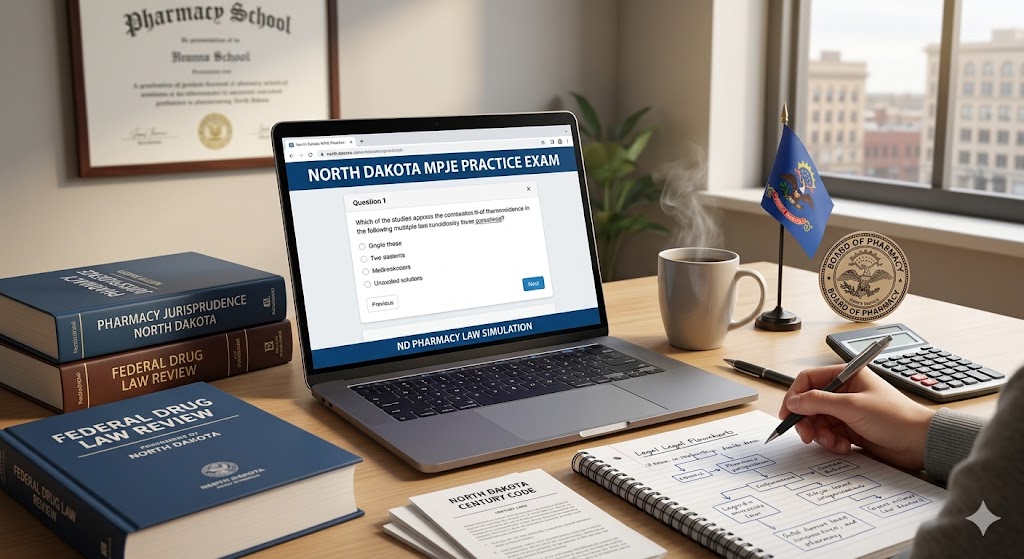
Additional Information
What the Course Entails and Exam Details
This North Dakota MPJE Practice Exam simulates a comprehensive educational assessment.
It goes beyond just asking questions; it helps the student synthesize and apply complex legal concepts to real-world pharmacy scenarios they will encounter in North Dakota practice.
The core domains covered by the content within the practice exam are aligned with the official MPJE competency statements, ensuring maximum relevance. These topics include:
Pharmacy Practice: This encompasses North Dakota-specific laws regarding the pharmacist-in-charge (PIC), pharmacist licensing requirements, pharmacy technician registration and duties, pharmacy license renewals, and required equipment and reference materials.
Licensure and Registration: Detailing the specific eligibility, fees, and procedures required by the North Dakota Board of Pharmacy for all levels of pharmacy staff, from interns to established pharmacists.
Controlled Substances: Covering the detailed regulations on scheduling, storing, inventorying, ordering, prescribing, and dispensing controlled substances in compliance with both federal and strict North Dakota regulations.
Prescription and Labeling Requirements: Mastering North Dakota laws on electronic prescribing, prescription transfers, required label components for various prescription types, and rules regarding emergency refills.
General Pharmacy Operations: Including specific regulations on patient counseling requirements, generic substitution protocols, reporting of adverse events, and maintaining pharmacy security and patient privacy (HIPAA) within a state context.
Disciplinary Actions and Boards: Understanding the composition, powers, and procedures of the North Dakota Board of Pharmacy, as well as the potential penalties and processes involved in professional disciplinary actions.
The practice exam serves as a direct mirror of the expected official syllabus, covering 20% to
What to Expect in the Final Exam
While the practice exam details may vary depending on the provider, it is designed to prepare you for the official MPJEadministered by the National Association of Boards of Pharmacy (NABP).
Here is a clear breakdown of what you must expect during the actual high-stakes licensure examination:
Exam Format: The MPJE is a computer-adaptive test (CAT). This means the difficulty of the questions adjusts based on your previous answers. The exam consists entirely of multiple-choice questions, many of which use "K-type" formatting (multiple statements where you must select the correct combination, such as A and B only, B and C only, etc.).
Total Questions: You will encounter 120 multiple-choice questions during the exam. Of these, 100 questions are used to calculate your score, while 20 are pretest questions being evaluated for potential future use (these will not count toward your final score).
Passing Score: The North Dakota Board of Pharmacy, via the NABP, uses a scale to report scores. A scaled score of 75 or higher is required to pass. A scaled score is not a straight percentage; it is a normalized calculation that accounts for variations in question difficulty.
Time Limit: Candidates are provided exactly 2.5 hours (150 minutes) to complete the entire examination. This time includes an initial tutorial but not the mandatory security check or post-exam survey. Efficient time management is critical, as unanswered questions are marked as incorrect.
Specific Rules: On exam day, you must present two forms of valid, non-expired ID (one must be government-issued photo ID). All personal items, including phones and watches, must be stored in a secure locker. No reference materials are permitted during the examination. The exam center will provide a small whiteboard and marker for any
How to Study and Exam Centers
Successfully passing the North Dakota MPJE requires a strategic combination of resource review and active practice.
This is a legal exam, meaning the difference between a passing and failing grade often rests on understanding nuanced wording in the statutes and rules.
Here are actionable study strategies and essential information on where to test:
Proven Study Strategies:
Primary Source Review is Non-Negotiable: Begin your studying by thoroughly reviewing the source material. The North Dakota Board of Pharmacy website hosts the North Dakota Century Code Chapter 43-15 (Pharmacists) and the North Dakota Administrative Code Title 61 (Board of Pharmacy Rules). You must study these documents directly.
Focus on State and Federal Differences: The most common source of confusion on the MPJE is identifying where North Dakota law is stricter or different from Federal Law. For example, memorize North Dakota’s specific prescription expiration rules for controlled substances versus non-controlled substances.
Utilize the Practice Exam Correctively: Treat the North Dakota MPJE Practice Exam as a diagnostic tool, not just a final test. Take the practice exam early in your study phase to identify your specific weak areas. For any questions missed, return to the North Dakota legal statutes to understand the specific legal code section you misinterpreted.
Engage with Comprehensive Study Guides: Utilize third-party, state-specific MPJE study guides that summarize and explain the North Dakota statutes in an easier-to-digest format. These are valuable for organizing complex information.
Exam Centers and Registration:
Where to Take the Practice Exam: Practice exams, including the official Pre-MPJE offered by the NABP, are taken online. They are accessible from your personal computer through an online portal after purchasing access.
Where and How to Take the Final, Official Exam: The actual North Dakota MPJE is administered via computer-adaptive testing at authorized Pearson VUE testing centers. These centers are located professionally across the United States.
Registration Process: To register for the final exam, you must first create an account and apply for licensure on the official NABP website. Once the North Dakota Board of Pharmacy confirms your eligibility, you will receive an Authorization to Test (ATT) letter. Only after receiving the ATT can you schedule your specific exam date, time, and location through the Pearson VUE website.
Job Opportunities from the Course
Successfully passing the North Dakota MPJE Practice Exam—and subsequently the official MPJE—is a mandatory requirement for obtaining your North Dakota pharmacist license. This licensure unlocks immediate career opportunities and significantly enhances professional mobility.
Upon becoming a licensed pharmacist in North Dakota, numerous distinct career paths become available. Potential roles and opportunities include:
Community Pharmacist (Retail): Practicing in major chains, independent pharmacies, and grocery store pharmacies throughout the state.
Clinical Pharmacist (Hospital/Health System): Working directly with physicians and patients in hospitals like Sanford Health, Essentia Health, or Trinity Health, contributing to medication therapy management and patient care teams.
Clinical Staff Pharmacist: Practicing in specialized clinic settings, including community health centers or IHS (Indian Health Service) facilities.
Pharmacist-in-Charge (PIC): Stepping into a required leadership role responsible for the legal and operational compliance of an entire pharmacy practice site.
Consultant Pharmacist: Providing legal and clinical expertise to long-term care facilities, nursing homes, and other healthcare institutions on North Dakota regulation compliance.
Specialty Pharmacist: Managing complex medication therapies for conditions like oncology or auto-immune diseases.
State Pharmacy Board Staff or Inspector: Working for the North Dakota Board of Pharmacy to enforce regulations and uphold professional standards.
Frequently Asked Questions
Reviews
5.0
Based on 0 reviews
Leave a Review
No reviews yet. Be the first to review!