
Nova Scotia Driving Test Practice Exam: A Comprehensive Study Guide
$69.00
- Buy to unlock unlimited access to all Quiz questions and Answers in this Quiz.
- After purchase you can print a PDF of the whole quiz at any point. The PDF will contain the questions and the correct answers.
About this Exam
The Nova Scotia Driving Test is the essential gateway for any resident seeking to obtain a valid driver’s licence within the province. This rigorous assessment process is designed to ensure all new drivers, whether they are teenagers eager for independence or adults securing a vital life skill, possess the necessary knowledge and practical skills to operate a vehicle safely and responsibly. Achieving this certification isn’t just about legality; it's about mastering the "Rules of the Road" and demonstrating defensive driving techniques that protect yourself and other road users in Nova Scotia's varied environments. Passing this test transforms an aspiring learner into a confident, newly licensed driver ready for the open road.
Ready to test your knowledge?
Buy Now to Access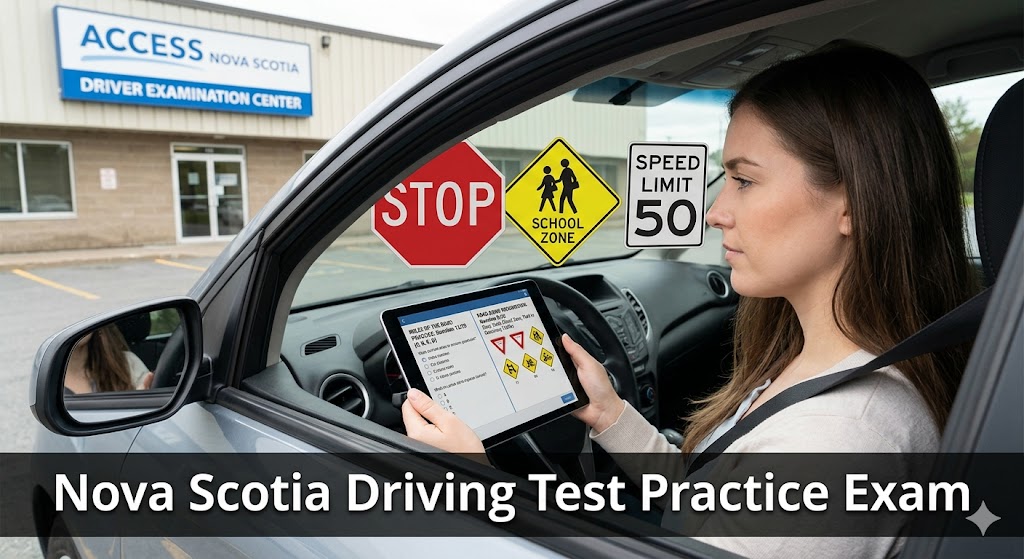
Additional Information
What the Course Entails and Exam Details
Preparing for the Nova Scotia Driving Test is a two-part process: comprehensive self-study of the official curriculum and extensive behind-the-wheel practice. The core syllabus is detailed in The Nova Scotia Driver’s Handbook, which serves as the ultimate resource for all material covered in the assessments. Candidates must master four fundamental areas:
Traffic Signs and Signals: Recognizing and understanding the meaning of all regulatory, warning, information, and construction signs, as well as traffic light signals.
Rules of the Road: Learning laws regarding right-of-way, speed limits (including special zones like school areas), lane positioning, passing procedures, and parallel parking regulations.
Safe Driving Practices: Understanding defensive driving concepts, maintaining safe following distances, handling adverse weather conditions (rain, snow, fog), and sharing the road safely with cyclists and pedestrians.
Licensing and GDL Rules: Familiarizing yourself with Nova Scotia’s Graduated Driver Licence (GDL) program, including the specific restrictions on Class 7 (Learner) and Class 5N (Newly Licensed) permits.
The "course" is effectively your dedication to studying this material and accumulating supervised driving hours before attempting the formal evaluations.
What to Expect in the Final Exam
The official Nova Scotia Driving Test consists of two mandatory components taken in sequence: the Knowledge Test and the Road Test. You must pass the Knowledge Test first to be eligible to book the Road Test.
1. The Knowledge Test (Written Exam)
The Knowledge Test assesses your understanding of the theoretical rules of the road. It is often conducted digitally at Access Nova Scotia centers.
Format: The exam is divided into two parts: a "Road Rules" section and a "Road Signs" section. Both are multiple-choice.
Number of Questions: Each part typically contains 20 multiple-choice questions, totaling 40.
Passing Score: You must achieve a minimum score of 16/20 (80%) on each part independently. If you fail one part, you must retake both parts.
Time Limit: You usually have 30 minutes to complete each of the two sections.
Retake Rules: If you do not pass, there is a minimum one-day waiting period before you can attempt the test again, and you must pay a new testing fee.
2. The Road Test (Practical Evaluation)
After passing the vision screening and the Knowledge Test, you are issued a Class 7 Learner's Licence. Following a mandatory practice period (12 months, or 9 months with an approved driver’s education course), you can take the Road Test.
Format: This is a one-on-one practical examination conducted in your own properly registered and insured vehicle. An official Driver Enhancement Officer will accompany you.
Passing Requirements: There is no numerical score. The examiner evaluates your performance based on a checklist of essential driving skills and safety habits. A passing result means you demonstrated competent and safe operation throughout the test. Immediate failure may occur for dangerous acts, traffic law violations, or accumulation of too many minor errors.
Core Skills Tested: Pre-trip vehicle inspection, smooth stopping and starting (including on hills), backing up in a straight line, parallel parking, changing lanes, proper use of signals, navigating intersections, and obeying speed limits.
Duration: The Road Test itself typically lasts between 20 and 30 minutes.
How to Study and Exam Centers
Effective preparation is the single biggest factor in success. Here is a proven study strategy for acing both parts of the Nova Scotia Driving Test:
Study the Handbook Cover-to-Cover: The Nova Scotia Driver’s Handbook is your textbook. Read it multiple times. Do not skip the introduction or appendices, as regulations can appear anywhere.
Utilize Nova Scotia Driving Test Practice Exams: Take advantage of online interactive practice quizzes. These simulation exams use real-world question formats and subject matter, helping you identify weak points and reinforce memory through active recall. Aim to consistently score 90% or higher before booking your official date.
Focus on Specific Numbers: Many students struggle with precise figures. Memorize key speeds (e.g., 30 km/h in school zones when children are present), distance rules (e.g., the two-second rule for following), and reporting thresholds.
Master the Signs: Sign identification is a frequent reason for failure. Use flashcards to learn every shape, color, and symbol combination.
Get Diverse In-Car Practice: The more scenarios you encounter with your supervisor, the more prepared you will be for the Road Test. Practice during the day and night, in quiet residential areas, on busy multi-lane roads, and on the highway. Focus intensely on smooth operation, shoulder checking, and observational skills.
Exam Centers and Booking
The official knowledge and road tests are administered by the Registry of Motor Vehicles at specific Access Nova Scotia centers across the province. You can find the nearest Access Nova Scotia location and book both your Knowledge Test and Road Test appointments online through the official Government of Nova Scotia website or by calling central booking. The practice exams (digital simulations) can be accessed from any device with an internet connection at your convenience.
Job Opportunities from the Course
Successfully obtaining your Nova Scotia driver’s licence significantly expands your career horizons. For many industries, a valid Class 5 licence is an absolute prerequisite, making this certification a highly valuable professional asset. Below is a clear list of specific job titles and career paths this achievement unlocks:
Delivery Driver (Catering, Food, Parcels)
Courier
Taxi or Rideshare (Uber, Lyft) Driver
Tow Truck Operator
Bus Driver (e.g., School or Transit, after acquiring Class 2 or 4)
Long-Haul Truck Driver (requires advanced license after initial Class 5)
Service Technician / Field Service Representative (HVAC, Telecom, Plumbing)
Construction Worker / General Labourer (required for travel to changing job sites)
Sales Representative (Field Sales)
Real Estate Agent
Home Healthcare Aide / Personal Care Worker (requires visiting clients in their homes)
Landscaper / Groundskeeping Worker
Event Coordinator / Catering Coordinator
Security Guard (Patrol services)
Frequently Asked Questions
Reviews
5.0
Based on 0 reviews
Leave a Review
No reviews yet. Be the first to review!