
Nova Scotia Road Rules Practice Exam
$69.00
- Buy to unlock unlimited access to all Quiz questions and Answers in this Quiz.
- After purchase you can print a PDF of the whole quiz at any point. The PDF will contain the questions and the correct answers.
About this Exam
The Nova Scotia Road Rules Practice Exam serves as the essential stepping stone for anyone wishing to obtain their driver’s licence in Nova Scotia.
This is the very first critical gate in the province's Graduated Driver Licensing (GDL) program.
It is designed primarily for prospective drivers who are preparing to take the official Class 7 Learner’s Knowledge Test.
This includes teenagers celebrating their 16th birthday, newcomers to the province, and any driver seeking a refresh on the official driving laws of Nova Scotia.
By using this comprehensive practice tool, candidates validate their theoretical knowledge, build immense confidence, and significantly increase their chances of passing the actual official exam on their first attempt.
It ensures that before a new driver physically starts practicing behind the wheel, they thoroughly possess the foundational knowledge required to navigate the roads safely, respectfully, and legally.
Ready to test your knowledge?
Buy Now to Access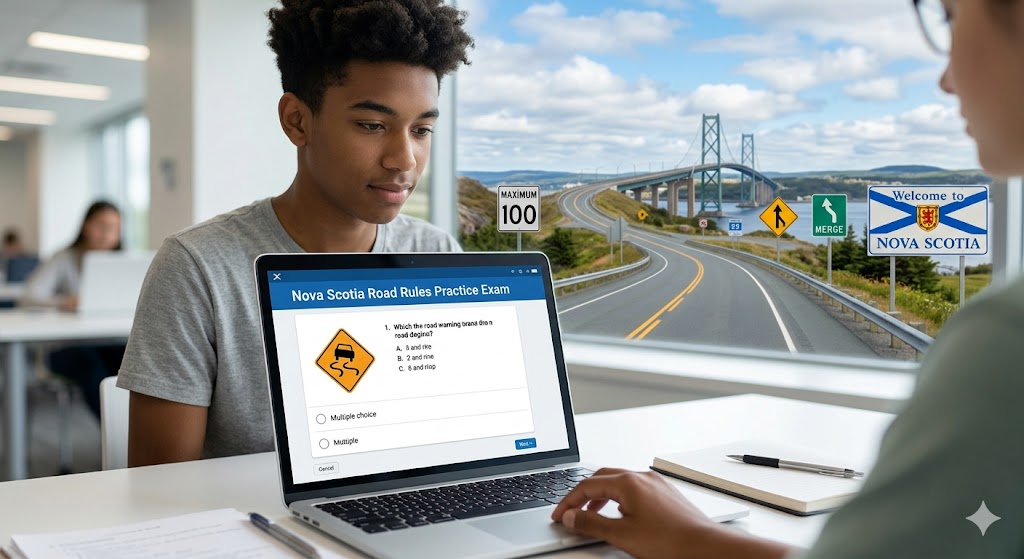
Additional Information
What the Course Entails and Exam Details
The ultimate syllabus for this practice exam is the official Nova Scotia Driver’s Handbook, which is published by the Registry of Motor Vehicles.
A thorough study course, including this comprehensive practice exam, covers the following core domains, which together compose the province’s theoretical driving curriculum:
Traffic Signs and Signals Candidates must master the identification and meaning of hundreds of traffic signs, including regulatory, warning, information, and guide signs. This includes understanding shape and color coding, traffic signal light sequences, flashing signals, and the specific rules governing pavement markings, crosswalks, and active work zones.
Rules of the Road and Right-of-Way This section is the core of driving law. It entails understanding strict right-of-way rules at uncontrolled intersections, two-way stops, and four-way stops. Candidates must know the laws concerning speed limits in various zones (including residential and school zones), proper lane positioning, legal merging procedures, overtaking procedures, and the specific protocols for navigating roundabouts.
Safe Driving Practices Beyond the letter of the law, candidates must understand safe driving theory. This includes defensive driving concepts, maintaining proper following distance (such as the 'two-second rule'), recognizing and mitigating blind spots, and adjusting driving style for adverse weather conditions like heavy rain, snow, fog, and black ice.
Special Road Users and Hazards This section teaches drivers how to respectfully and safely share the road. It includes identifying special hazards and understanding the specific rules for sharing the road with cyclists, pedestrians, heavy commercial vehicles, emergency vehicles (the “Move Over” law), and strictly adhering to rules when approaching school buses with flashing red lights.
Alcohol and Drug Impairment Laws Nova Scotia has a strict approach to impaired driving. Candidates must possess detailed knowledge of the Motor Vehicle Act regarding alcohol and drug tolerance levels, with a specific emphasis on the Zero Tolerance policy for all learners and newly licensed drivers in the graduated system, alongside the severe penalties for violations.
What to Expect in the Final Exam
When you are ready to take the official final knowledge test at an authorized testing location, you can expect a computer-based examination that mirrors the content of this practice resource.
The final exam is not a single test; rather, it is divided into two distinct, essential parts:
The Road Sign Recognition Test
The Rules of the Road Test
Each of these two parts consists of 20 multiple-choice questions, making a combined total of 40 questions for the full exam.
The questions are sourced directly from the concepts and details presented in the Nova Scotia Driver’s Handbook.
The passing requirement is high to ensure safety; candidates must achieve a score of at least 80% on EACH part to pass the knowledge test.
Specifically, this means you must answer at least 16 of the 20 questions correctly on the Sign Recognition part, and another 16 of the 20 questions correctly on the Rules of the Road part.
If you fail one section but pass the other, you are typically permitted to retake only the failed section on a subsequent attempt, depending on the current policy at the testing center.
While individual time limits may vary based on specific testing center protocols, you should expect the overall appointment to take approximately 30 to 45 minutes to complete both sections, including administrative procedures and the mandatory on-site vision screening.
How to Study and Exam Centers
Preparation is the absolute key to success on the Nova Scotia knowledge test.
Your successful study journey should begin with a comprehensive, diligent reading of the entire official Nova Scotia Driver’s Handbook from front to back.
Once you have a general understanding, integrate active recall methods; do not just passively re-read the material.
Use comprehensive tools like this Nova Scotia Road Rules Practice Exam.
Candidates who take multiple practice tests, analyze their mistakes, and ensure they understand the why behind every correct answer generally enjoy much higher success rates on the actual exam day.
Focus significant effort on areas where you are weakest; many students find complex right-of-way scenarios and specific penalty details require repeated review.
When you are confident in your practice test scores, you must decide how to take your final official exam. Nova Scotia currently offers two options:
In-Person Testing Centers Knowledge tests are administered in person at any authorized Access Nova Scotia office or specialized Registry of Motor Vehicles office located across the province. You are strongly advised to visit the official Government of Nova Scotia website to check current availability, book a specific appointment time, and verify current test fees, which are payable on-site. When arriving for an in-person test, you must bring proper proof of identity (documenting your age and legal name), proof of Nova Scotia residency, and parental/guardian consent if you are 16 or 17 years old. A quick vision screening is also conducted on-site before the exam begins.
Online Portal Option The Government of Nova Scotia may offer an option to complete the written knowledge test online through a secure, proctored portal. You will need to access the official province of Nova Scotia services website to register, pay the required fee, and follow the instructions to access the test. Online tests are strictly monitored, and special requirements regarding your computer equipment, camera, microphone, and a quiet, private testing environment will apply.
Job Opportunities from the Course
Successfully passing the Nova Scotia Road Rules Practice Exam and obtaining your Class 7 Learner's Licence does not provide immediate job certification by itself.
However, it is the fundamental, mandatory gate you must pass to enter the licensing world.
It is the necessary first domino to eventually earn your Class 5 licence (and eventually, commercial classes), which is a prerequisite for a massive array of careers that require transportation.
Achieving a valid driver’s licence dramatically increases your employability across many sectors in Nova Scotia, including:
Courier and Delivery Driver (e.g., mail services, food delivery, Amazon fulfillment)
Local Distribution Driver (transporting goods between local businesses)
Outside Sales and Field Services Representative (requiring travel to clients)
Merchandiser and Inventory Associate (moving between multiple retail locations)
Construction and Skilled Trades (where transporting tools or driving to job sites is essential)
Home Health Aide and Mobile Personal Care Provider (visiting multiple patients daily)
Property Maintenance and Landscaping Worker
Airport Ground Crew and Shuttle Bus Operator
Vehicle Rental Agent and Detailing Specialist
Security Patrol Officer
Rideshare Operator (when fully licensed to Class 5 and meeting platform age/experience rules)
Frequently Asked Questions
Reviews
5.0
Based on 0 reviews
Leave a Review
No reviews yet. Be the first to review!