
NPMA Certified Professional Property Specialist (CPPS) Certification Practice Test
$69.00
- Buy to unlock unlimited access to all Quiz questions and Answers in this Quiz.
- After purchase you can print a PDF of the whole quiz at any point. The PDF will contain the questions and the correct answers.
About this Exam
The Certified Professional Property Specialist (CPPS) designation, awarded by the National Property Management Association (NPMA), is a fundamental-level certification designed for individuals beginning their career in property and asset management, or those who need to validate their foundational knowledge in this specific field.
Ready to test your knowledge?
Buy Now to Access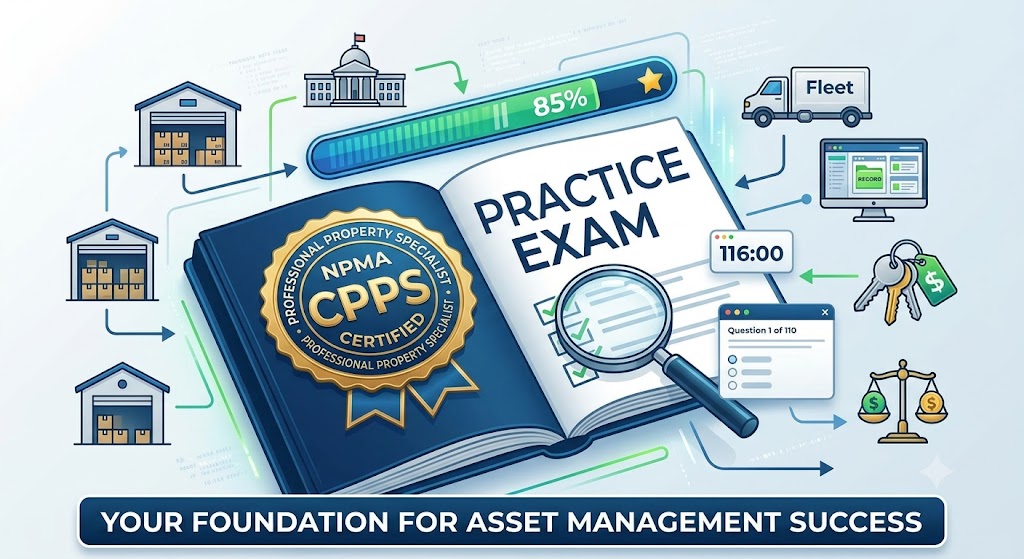
Additional Information
What the Course
Entails and Exam Details
The CPPS certification focuses on the comprehensive life
cycle of personal property and asset management, ensuring candidates understand
the core functions and best practices. The body of knowledge is extensive,
encompassing the following domains and key concepts:
Property Management Business Requirements (15%):
Covers the framework, planning, and implementation of property management
systems, including the necessity for internal controls and compliance.
Control: Ownership, Responsibility, Accountability (33%):
Explores the spectrum of property control from acquisition, receiving, and
identification through movement, transfers, consumption, utilization,
maintenance, fleet management, reporting, and risk management. This domain is
crucial for defining and maintaining a clear chain of custody.
Records (12%): Focuses on the importance of accurate,
verifiable records, both physical and digital, and the computer systems used to
manage them.
Property Accounting (10%): Introduces fundamental
concepts of accounting, valuation methods, and financial implications of
property transactions.
Inventory Management (16%): Details the methodologies
for physical inventory, storage, and warehousing.
Life Cycle Management (9%): Touches upon
environmental considerations, audits, and contracts.
Disposition (15%): Outlines the processes for
identifying and screening excess/surplus property, disposal, and retirement,
ensuring compliant and responsible asset end-of-life management.
The CPPS exam is a single, integrated test that validates
your grasp of these combined areas. It consists of multiple-choice questions,
and you will be allocated a standard time to complete it. The exact details can
vary, but generally, expect an experience that requires a thorough, confident
command of the material.
What to Expect in the Final Exam
While the exact structure can be subject to periodic updates
from the NPMA, candidates can typically expect the following format for the
Certified Professional Property Specialist (CPPS) exam:
- Format:
The exam consists exclusively of multiple-choice questions. These
questions are designed not only to test rote memorization of terms but
also the application of principles to real-world scenarios.
- Number
of Questions: The final exam usually includes around 110
multiple-choice questions. It's important to note that a portion of these
(often around 10) may be unscored pretest items used for statistical
purposes and will not affect your final score.
- Time
Limit: You will have approximately 116 to 120 minutes (about 2 hours)
to complete the entire examination. This requires good time management, as
you must answer each question carefully but efficiently.
- Passing
Score: The NPMA does not publicly disclose a fixed passing percentage.
Instead, they utilize a "scaled score" methodology, which means
the difficulty of the individual exam version is accounted for in the
final score. However, typical passing scores for similar computer-based
professional exams are often set in the range of 70% to 75%.
- Exam
Integrity: The exam is proctored, either in person or online, to
maintain the highest standard of academic and professional integrity. The
rules are strict, and cheating, or the attempt thereof, will result in
immediate failure and potential loss of eligibility for future testing.
Candidates will only receive official score notification after the exam
has been properly processed.
How to Study and
Exam Centers
Effective preparation for the CPPS exam requires a
structured approach. Here is an actionable guide for success:
Step 1: Master the Official NPMA Materials Your
primary study resource is the NPMA's Fundamentals of Personal Property
Management textbook. It's comprehensive and covers every domain of the
exam. Purchase the official CPPS Study Guide, which provides structured review
and practice questions that directly align with the test content. These tools
are the foundation of your preparation.
Step 2: Leverage Additional Learning Tools Consider
enrolling in an NPMA CPPS Review Course. These are offered in various formats,
including online (virtual) or in-person workshops, and provide expert
instruction and interactive learning. Use flashcards for key terms and
concepts, as this is proven to enhance retention and recall.
Step 3: Utilize Practice ExamsPractice tests are
crucial for diagnosing your weak areas and understanding the cadence of the
actual test. Take advantage of practice exams available through NPMA or other
reputable providers. Focus on not just identifying the correct answer but
understanding why other options are incorrect, which solidifies your
knowledge.
Step 4: Register and Schedule your ExamThe NPMA
Certified Professional Property Specialist (CPPS) exam is administered via Kryterion,
a third-party testing service. To schedule, you must first have an active NPMA
membership, apply for certification, and purchase the exam, at which point NPMA
will provide a voucher number.
You have two options for taking the test:
- Kryterion
Testing Centers: Schedule your exam at any of the authorized physical
locations worldwide. These centers provide a controlled, proctored
environment.
- Online
Proctored Testing (Kryterion's OLP): Take the exam from your own home
or office, provided your system meets strict technical and environmental
requirements and is live-proctored via webcam. Caution: Verify your
computer's compatibility and avoid employer-issued computers, which often
have firewalls that can prevent exam access.
- Job
Opportunities from the Course
Earning your CPPS certification opens doors to a wide range
of career opportunities across various industries, including government
agencies, defense contractors, educational institutions, healthcare systems,
and large corporations. This foundational credential demonstrates to potential
employers that you have the validated knowledge to responsibly manage their
valuable assets and personal property.
Here are some specific job titles and career paths this
certification unlocks:
- Property
Specialist
- Property
Administrator
- Property
Control Manager
- Government
Property Manager
- Contract
Property Administrator
- Asset
Manager
- Inventory
Control Specialist
- Logistics
Specialist
- Warehouse
Supervisor / Manager
- Procurement
/ Purchasing Agent
- Operations
Manager
- Compliance
Officer
- Fleet
Manager
- Disposition
Officer / Surplus Property Manager
Frequently Asked Questions
Reviews
5.0
Based on 0 reviews
Leave a Review
No reviews yet. Be the first to review!