
NPTE Cranial Nerves Practice Test
$69.00
- Buy to unlock unlimited access to all Quiz questions and Answers in this Quiz.
- After purchase you can print a PDF of the whole quiz at any point. The PDF will contain the questions and the correct answers.
About this Exam
Mastering the cranial nerves is a pivotal component for success in the National Physical Therapy Examination (NPTE) for both Physical Therapist (PT) and Physical Therapist Assistant (PTA) candidates. This focused [NPTE Cranial Nerves Practice Test] is not a formal certification itself, but an invaluable study tool meticulously designed to help students refine their understanding of this critical topic within the neurological systems assessment. It provides targeted practice, reinforcing your ability to identify, assess, and understand the practical implications of all 12 pairs of cranial nerves. Whether you are aiming to be a licensed PT or PTA, excelling in the neuromuscular section is essential, and this practice resource ensures you approach those specific questions with confidence and precision. This guide is your gateway to mastering this vital area of patient care and examination preparation.
Ready to test your knowledge?
Buy Now to Access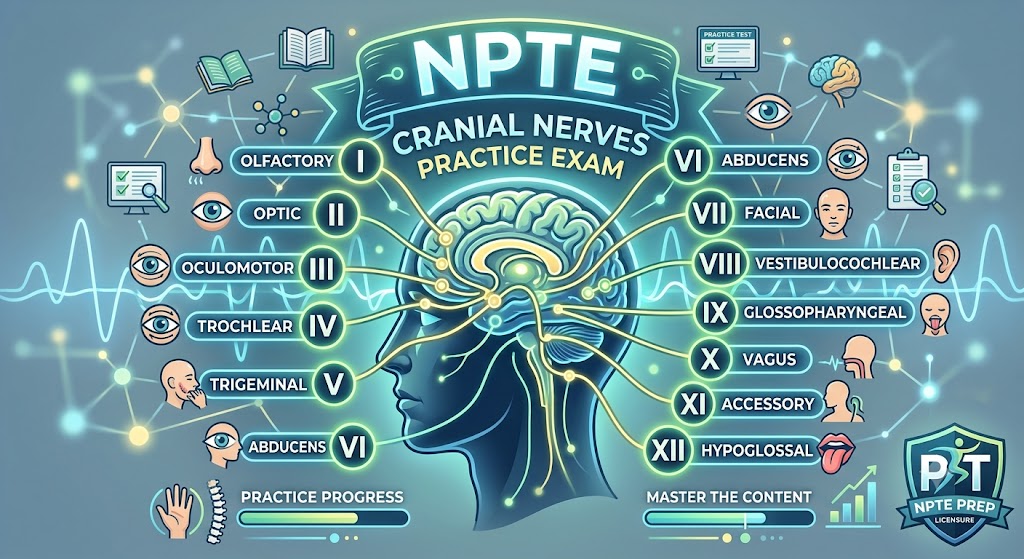
Additional Information
What the Course
Entails and Exam Details
This comprehensive practice experience is designed to
simulate the focused knowledge and analytical skills required for cranial
nerve-related questions on the actual NPTE. While not a structured
"course" with a formal syllabus, the content you will be testing
yourself on encapsulates the entire spectrum of entry-level competency in
cranial nerves:
- Comprehensive
Nerve Identification: Deep dive into all 12 pairs of cranial nerves
(CN I-XII), including their names, numbers, major functions (sensory,
motor, or mixed), and their parasympathetic contributions.
- Clinical
Assessment Techniques: The practice questions will challenge your
ability to determine appropriate testing procedures for each nerve—from
simple sensory tests to complex motor and reflex examinations (like
pupillary light and accommodation reflexes).
- Differential
Diagnosis and Pathologies: Enhance your understanding of common
neurological conditions and their distinct cranial nerve manifestations,
enabling you to interpret patient presentations effectively.
- Application
to Care Plans: The test will often present clinical scenarios,
requiring you to apply your knowledge to determine appropriate physical
therapy interventions and modifications based on potential or confirmed
cranial nerve involvement.
- Exam
Simulation: The practice test consists of objective, multiple-choice
questions, many of which are case-based to replicate the style and rigour
of NPTE questions. This structure helps you manage time effectively and
practice clinical reasoning under simulated exam conditions.
What to Expect in the Final Exam
It is crucial to remember that this practice test prepares
you for the neuromuscular system section of the broader NPTE. While
specific scoring and rules vary slightly between the practice module and the
official licensing exam, here is what you can generally expect when facing
cranial nerve questions on the actual NPTE:
- Format:
The actual NPTE (both PT and PTA versions) consists entirely of
multiple-choice questions, with four options and one correct answer. These
will include standalone questions and scenario-based questions where
several items refer to the same clinical case. Cranial nerve topics can be
found in both formats within the neurological system sections.
- Overall
Exam Structure:
- NPTE
for PTs: Comprises 5 sections of 45 questions each, totaling 225
questions over a block of 5 hours, with a scheduled 15-minute break.
- NPTE
for PTAs: Comprises 4 sections of 45 questions each, totaling 180
questions over a block of 4 hours, with a scheduled 15-minute break.
- Scoring
& Difficulty: The NPTE is a pass/fail exam, with raw scores
converted to scaled scores ranging from 200 to 800. A scaled score of 600
or higher is required to pass in all jurisdictions. Cranial nerve
questions contribute to your overall score within the weighted neurological
section.
- Specific
Rules: On test day at a Prometric center, you will undergo rigorous
security, can only bring limited items, and have both scheduled and
optional (counted against time) breaks.
How to Study and Exam Centers
Preparation for the NPTE, and particularly a focused topic
like cranial nerves, requires a multi-faceted approach. Use this practice test
as a key component of your study plan:
- Master
the Anatomy and Physiology: Start with visual aids. Study detailed
brain and nerve diagrams. Use mnemonics to remember the names, order, and
sensory/motor functions (e.g., "Oh, Oh, Oh, To Touch And
Feel...").
- Review
Clinical Assessment: Watch clinical assessment videos and read
textbook chapters detailing how to test each specific nerve. Practice
these techniques on classmates, friends, or family if possible.
- Utilize
Flashcards and Active Recall: Create flashcards for each nerve,
covering function, testing, and potential pathologies. Regularly quiz
yourself using active recall methods.
- Take
Many Practice Tests: Beyond this [NPTE Cranial Nerves Practice Test],
utilize other reliable resources like PEAT (Practice Exam and Assessment
Tool) and third-party prep materials to expose yourself to a variety of
question styles and scenarios. The more you practice, the more familiar
and confident you will become.
- Understand
the Real Exam Environment: The official NPTE is administered at
Prometric testing centers throughout the United States. You must register
through the Federation of State Boards of Physical Therapy (FSBPT) and
schedule your appointment with Prometric directly. Physical testing centers
are not applicable for the practice test, which is typically accessed
through online portals and educational platforms. Ensure you take your
practice tests under timed conditions to simulate the real exam pressure.
Job Opportunities
from the Course
Successfully passing the NPTE and obtaining your license as
a Physical Therapist or Physical Therapist Assistant is the mandatory
requirement to practice in the United States. While this focused cranial nerve
guide is a preparation tool, mastering this critical topic significantly
enhances your clinical proficiency and career prospects in various specialized
settings:
- Licensed
Physical Therapist:
- Outpatient
Neurological Physical Therapist (Specializing in conditions like stroke,
TBI, or multiple sclerosis)
- Acute
Care Physical Therapist (Working in hospitals with neurologically
involved patients)
- Inpatient
Rehabilitation Specialist (Providing intense rehab in dedicated
facilities)
- Clinical
Educator / University Instructor (Teaching neuro-anatomy and assessment)
- Licensed
Physical Therapist Assistant:
- Neurological
Rehabilitation PTA (Implementing treatment plans in diverse neuro
settings)
- Hospital-Based
PTA (Assisting with inpatient care, including acute neurological cases)
- Skilled
Nursing Facility PTA (Working with older adults who may have multi-system
impairments, including cranial nerve involvement)
- Specialty
Clinic PTA (Focusing on specific conditions like Parkinson’s disease or
vestibular disorders)
Licensure in physical therapy opens doors to a vast range of
clinical and non-clinical roles. A strong foundation in neurological
assessment, including cranial nerves, is essential for providing effective
patient care and can lead to fulfilling career paths in diverse healthcare
environments. Let this study tool be your guide to confidence, competence, and
a successful career in physical therapy.
Frequently Asked Questions
Reviews
5.0
Based on 0 reviews
Leave a Review
No reviews yet. Be the first to review!