
NPTE Modalities Practice Exam Study Guide
$69.00
- Buy to unlock unlimited access to all Quiz questions and Answers in this Quiz.
- After purchase you can print a PDF of the whole quiz at any point. The PDF will contain the questions and the correct answers.
About this Exam
The National Physical Therapy Examination (NPTE) Modalities Practice Exam is a critical preparation tool for physical therapy students and graduates aiming for professional licensure.
This assessment is specifically designed for candidates preparing to sit for the full NPTE, which is the board exam required to practice as a Physical Therapist (PT) or Physical Therapist Assistant (PTA) in the United States.
Because the "Modalities" section—which covers thermal agents, ultrasound, electrotherapy, traction, and compression—is a high-yield area, this practice exam provides a targeted focus to ensure you master the physics, clinical indications, and safety protocols required to pass.
Whether you are a final-year DPT student or a candidate retaking the exam, this practice tool offers the rigorous simulation necessary to build confidence in your clinical reasoning skills.
Ready to test your knowledge?
Buy Now to Access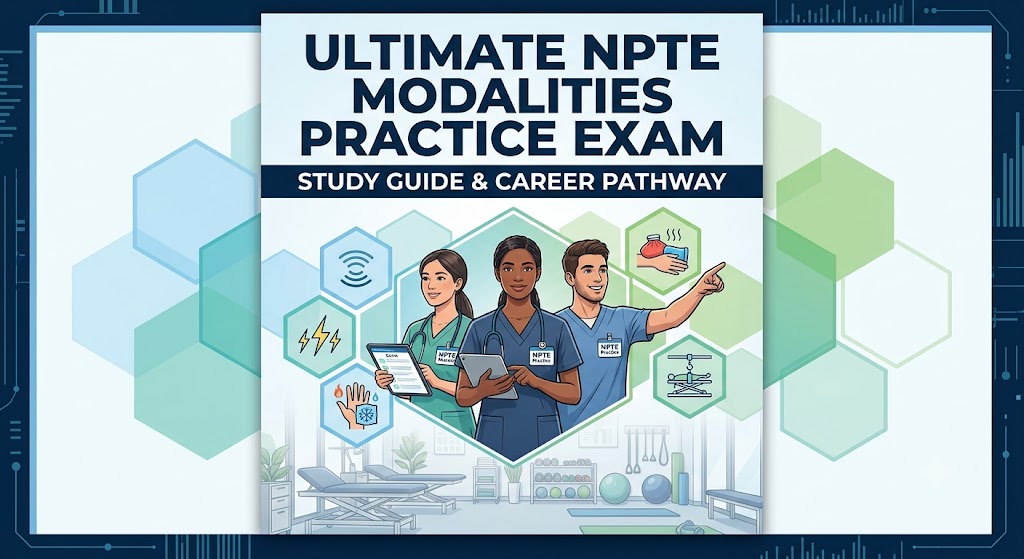
Additional Information
What the Course Entails and Exam Details
This practice experience is meticulously curated to mirror the content blueprint established by the Federation of State Boards of Physical Therapy (FSBPT).
The curriculum focuses on the application of physical agents to reduce pain, increase circulation, and improve tissue healing.
Core topics covered in the exam include:
Therapeutic Heat and Cold (Cryotherapy and Thermotherapy): Understanding the physiological response to temperature changes and determining appropriate dosages.
Ultrasound and Diathermy: Mastering the physics of deep heating agents, transducer sizing, frequency settings, and duty cycles.
Electrotherapy: This is a heavily tested area. You will be challenged on waveforms, pulse duration, frequency, electrode placement, and clinical contraindications for various currents (TENS, NMES, IFC).
Mechanical Traction and Compression: Learning the appropriate force parameters for cervical and lumbar traction and the compression levels for lymphedema management.
Safety and Contraindications: A primary focus on ensuring that you can identify when a modality is inappropriate for a patient based on their medical history (e.g., active cancer, pregnancy, or DVT).
What to Expect in the Final Exam
Taking an NPTE practice exam is the most effective way to normalize the testing environment.
The official NPTE is a computer-based examination that tests your ability to apply knowledge to clinical scenarios.
Format: The full NPTE consists of 250 multiple-choice questions. While your practice exam may be shorter, it will utilize the same "best-answer" style questions where you must select the most clinically appropriate choice from four options.
Time Limits: You should practice pacing yourself. On the actual exam day, you will be allotted five hours to complete the test.
Passing Requirements: The NPTE is a standardized test with a scaled score. You need a score of 600 or higher to pass.
Testing Environment: The exam is strictly proctored. You will not be allowed to bring personal belongings, phones, or notes into the testing room. Familiarizing yourself with the interface of a practice exam helps reduce anxiety regarding the "Next/Previous" navigation and the "flag for review" feature.
How to Study and Exam Centers
Effective study for the NPTE requires more than just memorization; it requires active recall and practice.
Actionable Study Strategies:
Use the "Why" Method: When taking your practice exam, do not just memorize the correct answer. Ask yourself why the other three choices were incorrect. This builds clinical reasoning.
Focus on Weak Areas: Use the analytics from your practice exam to identify patterns. Are you consistently missing electrotherapy questions? Dedicate two days to reviewing the physics of waveforms before attempting another practice block.
Simulate Test Day: Find a quiet location, silence your phone, and complete a full block of questions without breaks to build your mental stamina.
Where to Take the Exam:
Practice exams are typically accessed through online portals provided by the FSBPT or reputable third-party NPTE preparation platforms.
The official NPTE is administered at Prometric testing centers. You must register through the FSBPT website and obtain your Authorization to Test (ATT) letter before you can schedule your appointment at an official testing center.
Always verify your registration status well in advance of your desired test date to ensure center availability.
Job Opportunities from the Course
Passing the NPTE is the gateway to a rewarding career in healthcare.
Earning your license through this process unlocks the following professional paths:
Licensed Physical Therapist (PT): The standard path for DPT graduates working in hospitals, outpatient clinics, or private practices.
Physical Therapist Assistant (PTA): The essential partner in patient care, often working in skilled nursing facilities, home health, and outpatient settings.
Specialty Clinic Director: With experience, therapists can manage outpatient orthopedic or neurological rehabilitation centers.
Travel Physical Therapist: A high-demand role that allows licensed professionals to take short-term contracts in various locations across the country.
Pediatric or Geriatric Specialist: Working in specialized clinics focused on early intervention or senior wellness.
Sports Performance Consultant: Working with athletic teams or high-performance training centers to implement modality-based recovery protocols.
Clinical Instructor: Providing mentorship and guidance to students who are currently in the position you are in now, helping the next generation pass their boards.
Frequently Asked Questions
Reviews
5.0
Based on 0 reviews
Leave a Review
No reviews yet. Be the first to review!