
NREMT Airway, Respiration, and Ventilation Practice Test
$69.00
- Buy to unlock unlimited access to all Quiz questions and Answers in this Quiz.
- After purchase you can print a PDF of the whole quiz at any point. The PDF will contain the questions and the correct answers.
About this Exam
Welcome to your essential study guide for the NREMT Airway, Respiration, and Ventilation Practice Test.
This test is not a standalone certification but rather a focused assessment on a critical content area that makes up approximately 17-21% of the National Registry of Emergency Medical Technicians (NREMT) cognitive exam.
Mastering this module is vital for every aspiring Emergency Medical Technician (EMT), Advanced EMT (AEMT), and Paramedic.
The content covers the fundamental "A" and "B" of emergency medical care: maintaining a patent airway and ensuring adequate breathing.
This practice test is designed to evaluate your knowledge, critical thinking, and ability to apply pre-hospital emergency care standards to adult, pediatric, and geriatric patients facing respiratory compromise.
Passing this section on the comprehensive NREMT cognitive exam is non-negotiable for obtaining your national EMS certification.
Ready to test your knowledge?
Buy Now to Access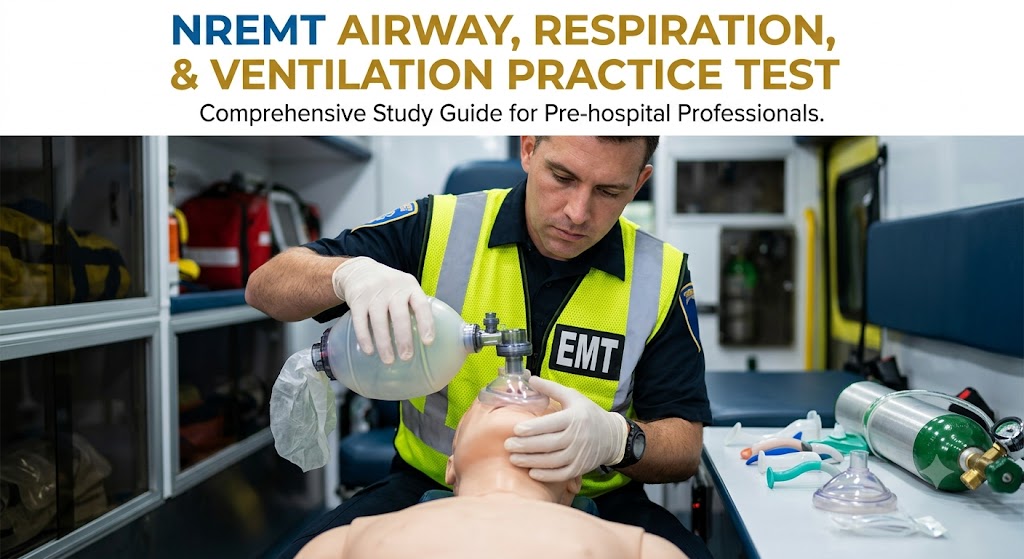
Additional Information
What the Course Entails and Exam Details
This module requires comprehensive knowledge of both basic
and advanced airway management skills, tailored to your level of licensure
(EMT, AEMT, or Paramedic).
The practice test focuses on evaluating your understanding
of a diverse range of topics, ensuring you are prepared for real-world
scenarios.
You will encounter detailed questions regarding the anatomy
and physiology of the upper and lower respiratory tracts in both adult and
pediatric populations.
The core syllabus encompasses:
- Comprehensive
airway assessment, identifying signs of adequate and inadequate breathing.
- Manual
airway maneuvers, including the head-tilt/chin-lift and jaw-thrust
techniques.
- The
indications, contraindications, and correct measurement for airway
adjuncts like Oropharyngeal Airways (OPA) and Nasopharyngeal Airways
(NPA).
- The
principles and application of oxygen therapy, including various delivery
devices and flow rates.
- The
correct procedure for positive pressure ventilation using a Bag-Valve-Mask
(BVM).
- Suctioning
techniques for clearing the airway of obstructions.
- Pathophysiology,
signs, and symptoms of common respiratory emergencies, such as asthma,
COPD, and trauma.
For advanced levels (AEMT/Paramedic), this section will also
integrate knowledge of advanced procedures, including supraglottic airways and
potentially endotracheal intubation, along with pharmacological interventions.
What to Expect in the Final Exam
It is crucial to understand that while you are preparing
with this focused "NREMT Airway, Respiration, and Ventilation Practice
Test," your "final exam" will be the comprehensive NREMT
cognitive exam for your level of licensure.
The content you are studying is one major area within that
larger exam.
The NREMT cognitive exam is a Computer Adaptive Test (CAT).
This means the exam dynamic adjusts the difficulty of
subsequent questions based on your performance on previous ones.
The goal is to determine your ability to meet a defined
standard, rather than just achieving a specific percentage score.
For EMT candidates, the exam generally ranges from 70 to 120
questions, and you have two hours to complete it.
The Airway, Respiration, and Ventilation section consists of
multiple-choice questions that often require you to prioritize care based on
patient assessment (e.g., "What is the EMT's first action?").
You will receive a single pass/fail result for the entire
cognitive exam upon completion; you must achieve a passing level across all
content areas.
How to Study and
Exam Centers
Effective preparation for this critical NREMT content area
requires a multi-faceted study strategy beyond just reviewing a textbook.
First, utilize high-quality practice tests and quizzes that
mimic the structure and complexity of NREMT questions.
Practice actively: create flashcards for anatomy and key
terms, and explain complex physiological concepts aloud to a study partner to
reinforce your understanding.
One of the most effective methods is to review and practice
the official NREMT practical skill sheets, as the steps for procedures like BVM
ventilation directly inform the multiple-choice questions you will face on the
cognitive test.
Focus particularly on the order of operations in assessment
and treatment protocols.
To take the actual final NREMT cognitive exam, you must
first successfully complete an authorized EMT or Paramedic training course that
meets the National EMS Education Standards.
Once course requirements are met and verified by your
instructor, you can register and pay for the exam through the NREMT's online
portal.
The exam itself must be scheduled and taken in a proctored
environment at an authorized testing center, which is most often a Pearson VUE
testing location.
Job Opportunities
from the Course
A strong performance on this practice test is a powerful
predictor of success on the NREMT cognitive exam.
Obtaining your National Registry Certification is the
primary credential required by nearly all states and employers in the United
States to begin a rewarding career in emergency medicine.
Mastery of airway and ventilation management is foundational
to every role in the field, unlocking multiple diverse career paths.
Here are some specific job opportunities that require NREMT
certification and expert knowledge of the skills covered in this study guide:
- Emergency
Medical Technician (EMT)
- Advanced
EMT (AEMT)
- Paramedic
- Emergency
Room Technician / ER Tech
- Flight
Paramedic / Flight Medic
- Critical
Care Transport Paramedic
- Industrial
or Corporate EMT
- Tactical
Paramedic / Tactical Medic
- Ocean
Rescue/Lifeguard Medic
Frequently Asked Questions
Reviews
5.0
Based on 0 reviews
Leave a Review
No reviews yet. Be the first to review!