
NREMT Cardiology & Resuscitation Practice Test
$69.00
- Buy to unlock unlimited access to all Quiz questions and Answers in this Quiz.
- After purchase you can print a PDF of the whole quiz at any point. The PDF will contain the questions and the correct answers.
About this Exam
The NREMT Cardiology & Resuscitation Practice Test is a crucial preparation tool designed specifically for aspiring Emergency Medical Technicians (EMTs) at all levels, including EMT-Basic, Advanced EMT (AEMT), and Paramedic candidates. Its primary purpose is to help students evaluate their readiness for the critical cardiovascular domain of the official NREMT cognitive exam. This comprehensive practice resource accurately assesses an individual's understanding of key concepts, dynamic resuscitation protocols, and decision-making skills required for successful emergency medical response to cardiac events.
Ready to test your knowledge?
Buy Now to Access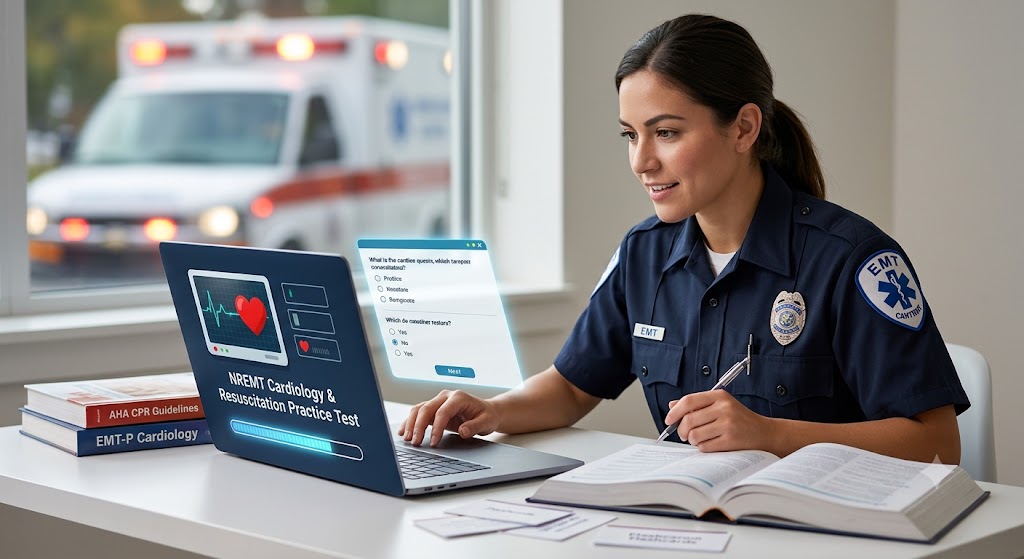
Additional Information
What the Course Entails and Exam Details
While often utilized within larger EMT or Paramedic training
programs, this dedicated practice exam concentrates exclusively on the
Cardiology & Resuscitation domain. It systematically covers fundamental and
advanced principles that directly align with the most current American Heart
Association (AHA) guidelines. Key topics typically included in the test pool
are: identification and management of acute coronary syndrome; stroke
recognition and care; dynamic management of various dysrhythmias including
ventricular fibrillation and pulseless ventricular tachycardia; cardiac
pharmacology and medication administration; and mastering advanced airway and
ventilation techniques during resuscitation efforts. The practice exam itself
generally consists of hundreds of multiple-choice questions structured to
mirror the difficulty and format of the official NREMT questions.
What to Expect in the Final Exam
The NREMT Cardiology & Resuscitation Practice Test is
generally administered through online education platforms and specialized
commercial study services. It common features hundreds of multiple-choice
questions, many containing detailed scenarios where you must select the most
appropriate next step in care. Practice tests usually offer comprehensive
performance feedback, including a breakdown of correct and incorrect answers
with robust rationales to explain the medical logic behind each answer choice.
While these practice assessments are typically untimed, many platforms include
a "simulation mode" with a countdown timer to build necessary stamina
and speed for the actual NREMT cognitive exam, which is computer-adaptive and
strictly timed (ranging from 2 to 2.5 hours depending on certification level).
How to Study and Exam Centers
A strategic approach to studying is essential for mastering
the complex material in the Cardiology & Resuscitation domain. Effective
techniques include creating interactive flashcards for cardiac pharmacology and
ECG rhythm identification, and utilizing practice tests iteratively to pinpoint
weak knowledge areas. Group study sessions focusing on dynamic scenario
discussions with peers can also reinforce practical application skills. For
the official NREMT Cognitive Exam, testing is conducted worldwide at
authorized Pearson VUE testing centers. After completing your accredited
education and receiving an Authorization To Test (ATT) letter from the NREMT,
you can schedule your exam at a convenient location through the Pearson VUE
website. Ensure you review the center’s specific requirements well in advance.
Job Opportunities from the Course
Successfully mastering the NREMT Cardiology &
Resuscitation domain and achieving your desired level of NREMT certification
unlocks numerous professional opportunities in the dynamic field of emergency
medical services.
- Emergency
Medical Technician (EMT-Basic)
- Advanced
EMT (AEMT)
- Paramedic
- Firefighter/EMT
(Combined role)
- Critical
Care Transport Paramedic
- Flight
Paramedic/Flight Nurse (requires additional training)
- Emergency
Department Technician
- Wilderness/Tactical
Medic
Frequently Asked Questions
Reviews
5.0
Based on 0 reviews
Leave a Review
No reviews yet. Be the first to review!