
NSW Ambulance Pharmacology Practice Exam
$69.00
- Buy to unlock unlimited access to all Quiz questions and Answers in this Quiz.
- After purchase you can print a PDF of the whole quiz at any point. The PDF will contain the questions and the correct answers.
About this Exam
The New South Wales Ambulance Pharmacology Practice Exam is a critical assessment component for pre-hospital emergency care clinicians within the NSW health system.
It is specifically designed for student paramedics, qualified paramedics looking to upskill, and interstate or international recruits seeking recognition of prior learning.
This exam ensures that all clinicians responsible for administering medications possess the precise, high-level knowledge required to deliver safe and effective patient care in dynamic emergency environments.
Ready to test your knowledge?
Buy Now to Access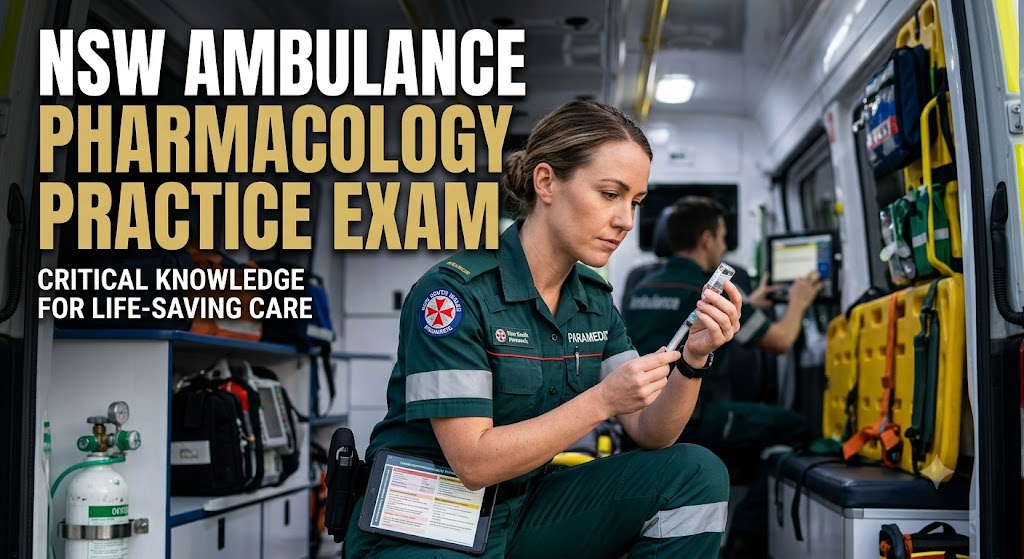
Additional Information
. What the Course Entails and Exam Details
This examination focuses intensively on clinical pharmacology as it applies directly to the NSW Ambulance clinical practice guidelines (CPGs) and drug protocols.
Candidates are expected to demonstrate comprehensive knowledge across several core domains:
Pharmacokinetics and Pharmacodynamics: Understanding how the body processes emergency medications and how those drugs affect physiological systems.
Authorized Medications: Detailed knowledge of the mechanisms of action, indications, and appropriate dosages for all drugs within the specific scope of practice.
Contraindications and Precautions: Critical awareness of scenarios where specific medications must not be administered or must be used with extreme caution.
Adverse Reactions and Interactions: Identification of potential side effects and dangerous drug-to-drug interactions.
Dosage Calculations: Rapid and accurate mathematical calculation of drug volumes based on patient weight or required infusion rates.
What to Expect in the Final Exam
The actual pharmacology exam is rigorous and reflects the high-pressure nature of emergency medicine.
It is typically delivered in a computerized format, often utilizing multiple-choice questions (MCQs), although short-answer or calculation-specific questions may also be included.
Candidates are strictly timed, emphasizing the need for quick and accurate recall, much like in the field.
A very high passing score is required—often 90% or higher, and sometimes 100% in critical calculation sections—reflecting the zero-tolerance policy for medication errors in clinical practice.
How to Study and Exam Centers
Effective preparation requires a combination of rote learning and practical application.
Study Strategies:
Master the CPGs: The primary study resource must be the official NSW Ambulance Clinical Practice Guidelines and Drug Protocols.
Flashcards: Use digital or physical flashcards to memorize indications, contraindications, and dosages for every drug in your scope.
Calculation Practice: Regularly practice dosage calculations, especially under timed conditions.
Simulation: Apply your knowledge during scenario-based training.
Exam Centers:
This exam is typically managed internally by NSW Ambulance or accredited training partners.
Assessments may be held at physical training headquarters in Sydney or regional education hubs.
In some instances, especially for recruits, the exam may be proctored through secure online portals or recognized testing centers like Pearson VUE.
Job Opportunities from the Course
Successfully navigating pharmacology assessments is non-negotiable for anyone wishing to practice as a clinician within NSW Ambulance.
Mastery of this content is essential for securing and advancing in the following roles:
Trainee Paramedic
Qualified Paramedic (P1 & P2)
Intensive Care Paramedic (ICP)
Extended Care Paramedic (ECP)
Flight Paramedic / Critical Care Paramedic
Paramedic Educator / Clinical Training Officer (CTO)
Clinical Manager
Frequently Asked Questions
Reviews
5.0
Based on 0 reviews
Leave a Review
No reviews yet. Be the first to review!