
NSW Civil Practice & Procedure Practice Exam
$69.00
- Buy to unlock unlimited access to all Quiz questions and Answers in this Quiz.
- After purchase you can print a PDF of the whole quiz at any point. The PDF will contain the questions and the correct answers.
About this Exam
This comprehensive study guide is designed for legal professionals, law students, and individuals preparing for the New South Wales (NSW) Civil Practice & Procedure examination. This assessment is pivotal for those seeking to demonstrate competency in the procedural rules and substantive laws governing civil litigation within the NSW court system. It validates your ability to navigate complex legal frameworks, manage client matters effectively, and adhere to the highest ethical standards required in civil practice.
Ready to test your knowledge?
Buy Now to Access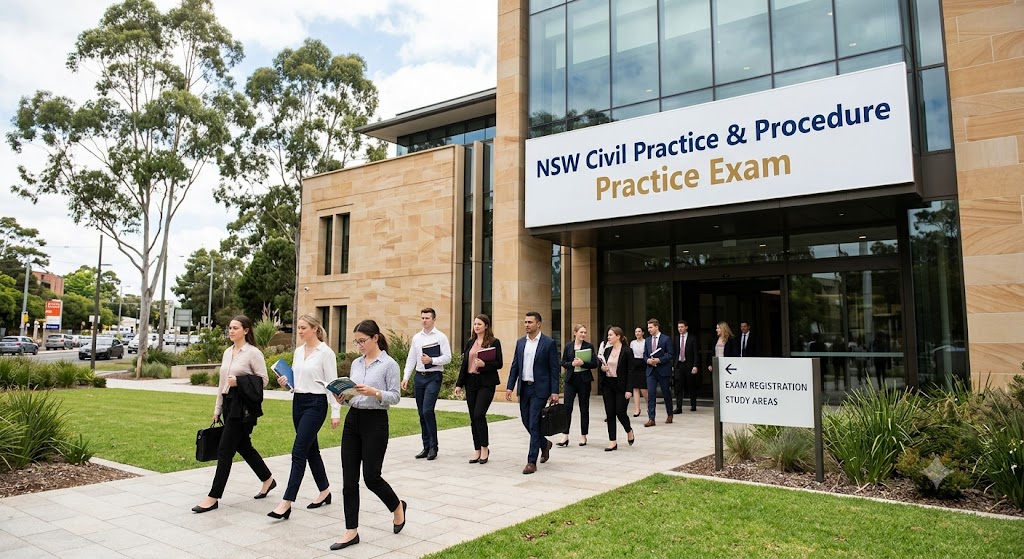
Additional Information
What the Course Entails and Exam Details
The study material and subsequent exam focus on the Civil Procedure Act 2005 (NSW) and the Uniform Civil Procedure Rules 2005 (NSW). The curriculum dives deep into the lifecycle of a civil dispute, ensuring candidates understand both the theoretical and practical aspects of litigation.
Key topics covered in this guide include:
Case Management: Understanding the overriding purpose of facilitating the just, quick, and cheap resolution of the real issues in the proceedings.
Commencing Proceedings: The mechanics of originating process, including statements of claim and summonses.
Pleadings and Particulars: Rules governing the drafting, service, and amendment of pleadings.
Service: Methods of personal and ordinary service, including service outside the jurisdiction.
Discovery and Inspection: The process of disclosing and accessing relevant documents.
Interlocutory Applications: Procedures for seeking interim orders, injunctions, and summary disposal.
Evidence: The intersection of procedural rules with the Evidence Act 1995 (NSW) in a civil context.
Trial and Judgment: Preparation for trial, the conduct of hearings, and the entry of orders.
Costs: Rules regarding the security for costs and the assessment of costs.
What to Expect in the Final Exam
While specific providers may vary, the standard professional evaluation usually consists of a rigorous examination that assesses both recall of the rules and the ability to apply them to factual scenarios.
Format: The exam typically utilizes a mix of complex multiple-choice questions and scenario-based problem questions requiring brief written responses.
Time Limit: Candidates are generally allotted 2 to 3 hours to complete the assessment.
Passing Score: A passing score of 70% or higher is commonly required to demonstrate proficiency.
Resources: This is often an "open book" style examination, allowing access to the relevant legislation, emphasizing the need for familiarity and navigation skills rather than rote memorization.
How to Study and Exam Centers
Effective Study Strategies:
Successful preparation requires a structured approach. Do not rely solely on passive reading.
Tab Your Legislation: Since the exam often allows access to materials, tab your copy of the Civil Procedure Act and UCPR logically. Knowing exactly where to find a specific rule quickly is essential for time management.
Practice Scenario Applications: The exam will test your ability to apply rules. Practice converting factual scenarios into procedural steps (e.g., "Given these facts, what is the deadline for filing the defense?").
Utilize Mock Exams: Take timed practice tests to familiarize yourself with the question style and manage your pacing. Review incorrect answers thoroughly to understand the nuance of the rules.
Create Flowcharts: Visualize the litigation timeline. Create charts for complex procedures like discovery, joining parties, or enforcing judgments.
Exam Centers:
Depending on whether you are taking this as part of a university course or professional accreditation, testing may be available online via proctored platforms or in person at authorized testing facilities in major centers like Sydney, Newcastle, or Wollongong. Check with your specific provider (e.g., the Law Society of NSW or your university) for exact booking details.
Job Opportunities from the Course
Mastering civil practice and procedure is a foundational skill that unlocks a wide range of legal career paths within New South Wales. Demonstrating expertise in this area is highly attractive to employers across the legal sector.
Key roles that utilize this knowledge include:
Solicitor (Litigation/Dispute Resolution): Representing clients in court proceedings, drafting pleadings, and managing the discovery process.
Paralegal: Supporting litigation teams by preparing court documents, tabbing legislation, and summarizing evidence.
Judge’s Associate: Assisting members of the judiciary with legal research and courtroom procedure.
Practice Manager: Overseeing the operations of a litigation practice, ensuring compliance with court rules and deadlines.
Legal Officer (Government): Handling civil matters for government departments or regulatory bodies.
Frequently Asked Questions
Reviews
5.0
Based on 0 reviews
Leave a Review
No reviews yet. Be the first to review!