
Nuclear Gauge Testing Practice Exam
$69.00
- Buy to unlock unlimited access to all Quiz questions and Answers in this Quiz.
- After purchase you can print a PDF of the whole quiz at any point. The PDF will contain the questions and the correct answers.
About this Exam
The Nuclear Gauge Testing Certification Exam is a vital qualification for professionals working in civil engineering, construction, and materials testing. Nuclear moisture-density gauges are indispensable tools for quickly and accurately measuring the density and moisture content of soil, aggregate, concrete, and asphalt in the field. However, because these devices contain radioactive material, operators must be certified in both their function and safety protocols. This exam validates that a technician or inspector possesses the essential knowledge required to operate the gauge correctly, interpret data, transport the unit legally, and adhere to strict radiation safety regulations (typically enforced by the Nuclear Regulatory Commission, or NRC, and individual Agreement States). A practice exam is an essential resource for candidates to reinforce these concepts before attempting the formal, graded test.
Ready to test your knowledge?
Buy Now to Access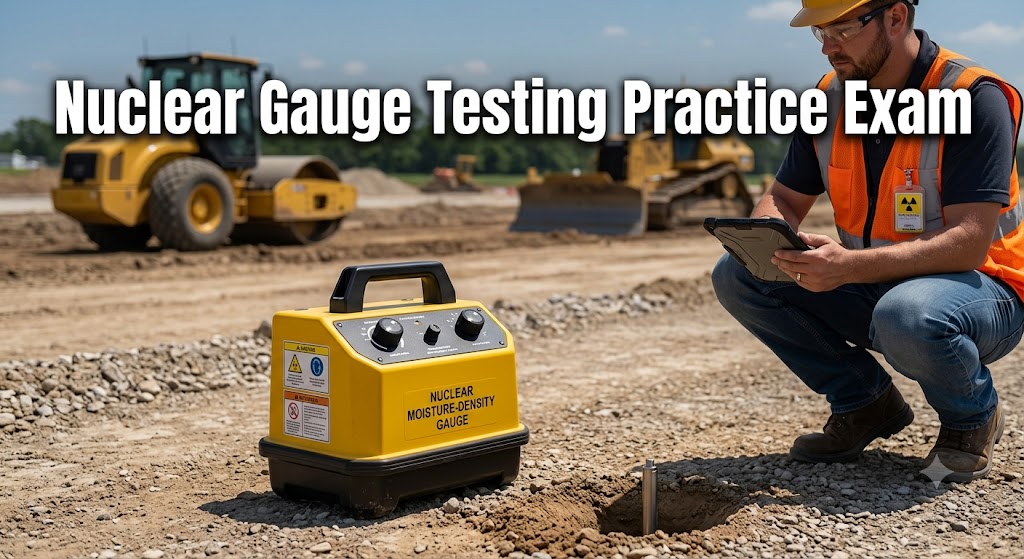
Additional Information
What the Course Entails and Exam Details
This examination covers a comprehensive range of technical, operational, and safety topics. Candidates must demonstrate proficiency in the underlying principles of radiation as well as the practical field applications of the gauge.
Radiation Fundamentals: You must understand types of radiation (alpha, beta, gamma, neutron), units of measurement (rem, sievert), principles of radiation protection (Time, Distance, Shielding), and the ALARA concept (As Low As Reasonably Achievable).
Gauge Operation: The exam tests your knowledge of how a moisture-density gauge functions, including the backscatter and direct transmission measurement modes and when to use each.
Regulations and Safety: You will be tested on licensing requirements, the duties of a Radiation Safety Officer (RSO), emergency procedures (e.g., source recovery), and routine maintenance (such as performing a "standard count").
Transportation (DOT): A critical component covers the Department of Transportation regulations for transporting radioactive materials, including required signage (Type A packaging), shipping papers, and security plans.
Calculation and Data Analysis: You must understand how the gauge calculates dry density, percent compaction, and moisture content, and how to verify these readings against laboratory reference data.
What to Expect in the Final Exam
The final certification exam is designed to be rigorous but manageable for those who have studied the official training curriculum.
Format: The exam typically consists of multiple-choice and true/false questions. These questions range from technical definitions and mathematical applications to scenario-based safety assessments.
Question Count: Exams usually feature between 25 and 50 questions, depending on the training provider and specific regulatory jurisdiction.
Time Limits: Candidates are typically given a generous time window, often 1 to 2 hours, to complete the exam.
Passing Score: A passing grade is usually set between 70% and 80%. Given the safety implications of working with radioactive materials, a solid grasp of all concepts is expected.
Rules: The final exam is closed-book. For many organizations, the exam is proctored either in-person or through an online testing environment.
How to Study and Exam Centers
Preparation is key to success on the Nuclear Gauge Testing Exam. Candidates should focus on both understanding the technical mechanics and memorizing key safety regulations.
Review Training Materials: Your primary study source is the official manual or course provided by your employer or an authorized training organization. Review this documentation thoroughly.
Focus on Regulations: Pay extra attention to the specific US NRC regulations (10 CFR Part 20 and 10 CFR Part 30) and DOT regulations (49 CFR Parts 100-185), as these are often the trickiest areas.
Use the Practice Exam: Treat the practice test like the real exam. Take it timed, closed-book, and identify areas where you struggle. Repeat this process until you are consistently scoring above 90%.
Practice Calculations: Review the mathematical relationships the gauge uses. Make sure you can calculate the Standard Count reference and interpret standard proctor test data.
Exam Centers: The final certification exam is rarely taken at general public centers like Pearson VUE. It is almost always administered:
Through authorized third-party training organizations (vendors who manufacture the gauges, like Troxler, InstroTek, or Humboldt, often provide certification courses and exams).
Directly by State Departments of Transportation (DOTs) for their internal staff or authorized contractors.
Within an internal company training program, provided that program has been reviewed and approved by the NRC or the applicable Agreement State licensing agency.
Job Opportunities from the Course
Successfully obtaining your Nuclear Gauge Operator Certification unlocks several key pathways in the field of construction and environmental inspection. This certification is a prerequisite for roles that involve structural and materials testing.
Field Density Technician: Responsible for visiting construction sites (roads, dams, commercial developments) to perform compaction testing on fill dirt, base materials, and asphalt.
Construction Materials Inspector (CMI): Monitors various aspects of a project, including concrete placement and soil compaction, ensuring that all work meets project specifications and codes.
Quality Control Technician (QC/QA): Employed by asphalt plants, aggregate quarries, or major general contractors to verify that materials being produced or installed meet required quality standards.
Civil Engineering Aide: Supports professional engineers by gathering field data, including density readings, which are then used in engineering reports and for project design validation.
Roadway Inspector: Specializes in inspecting infrastructure projects, focusing specifically on the layers of subgrade, aggregate, and pavement, where gauge testing is essential.
Frequently Asked Questions
Reviews
5.0
Based on 0 reviews
Leave a Review
No reviews yet. Be the first to review!