
Nursing Entrance Exam (NEX) Practice Exam
$69.00
- Buy to unlock unlimited access to all Quiz questions and Answers in this Quiz.
- After purchase you can print a PDF of the whole quiz at any point. The PDF will contain the questions and the correct answers.
About this Exam
The Nursing Entrance Exam (NEX), often administered by specific nursing programs and large institutions like the National League for Nursing (NLN), is a critical step for aspiring nurses. This standardized test serves as a crucial gateway to entering both Licensed Practical/Vocational Nurse (LPN/LVN) and Registered Nurse (RN) programs. Its primary goal is to evaluate a candidate's readiness for the academic rigor of a nursing curriculum by assessing their foundational skills in essential academic domains. This exam is designed for individuals with a high school diploma or equivalent who are ready to pursue their dreams in healthcare. Preparing for the NEX signifies a dedication to a future in nursing.
Ready to test your knowledge?
Buy Now to Access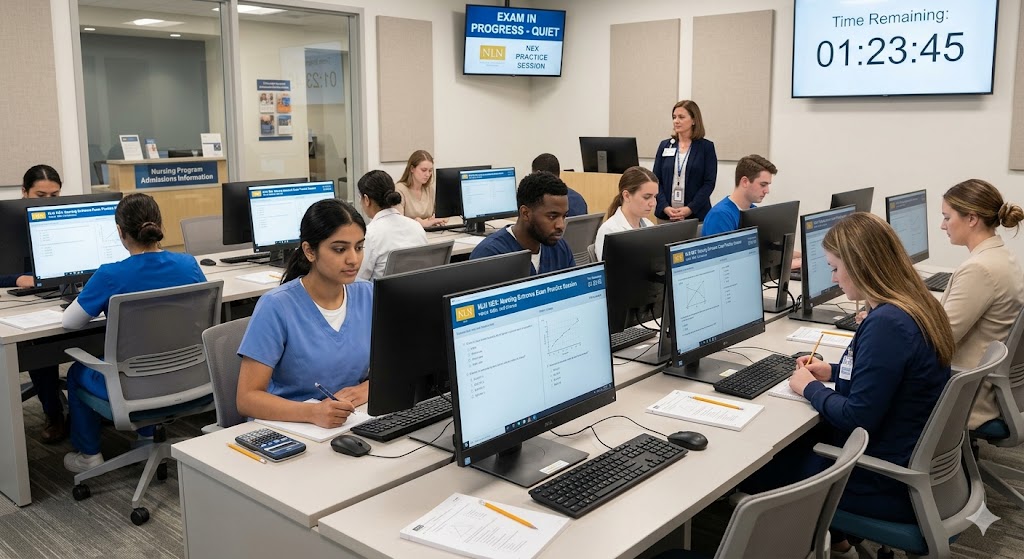
Additional Information
What the Course Entails and Exam Details
While the specific curriculum that leads to taking this test is the applicant's prior education, the NEX itself focuses on three primary academic pillars:
Verbal Ability: This section tests your vocabulary and reading comprehension skills, including your ability to understand complex texts and draw inferences.
Mathematics: Expect questions covering fundamental arithmetic, elementary algebra, and measurement, with an emphasis on practical application in a health-related context.
Science: This comprehensive section evaluates your understanding of fundamental high school and early college-level concepts in General Biology, Chemistry, Human Anatomy & Physiology, and Health-related principles.
The NEX is typically a computer-based examination. It is structured to deliver roughly 163 multiple-choice questions over a duration of approximately three hours.
What to Expect in the Final Exam
When you arrive at the final exam, either in person or remotely, you can expect a highly regulated and proctored environment.
Exam Format: All questions are multiple-choice with four response options, designed to be answered within specified time limits per section, generally around one hour for each.
Passing Score: There is no single, standardized national passing score for the NEX. Each individual nursing school or program establishes its own specific score requirements for admission based on their competitive standards.
Time Limits: You will need to manage your time effectively, as each of the three subject sections (Verbal, Math, and Science) is typically timed separately. The total time for the exam is about 180 minutes.
Specific Rules: All NEX exams are strictly proctored, which means you will be observed throughout the testing process. No external resources, cell phones, or electronic devices are allowed. Most administrations provide a standard virtual calculator or physical scratch paper as permitted aids.
How to Study and Exam Centers
Effective preparation is the single most important factor for success on the NEX.
Actionable Study Strategies: Start by diagnostic testing to identify your weak points. Use reputable, full-length NEX practice exams to simulate the real test experience and refine your time management. Dedicate focused study time to the core subject areas you find most challenging, utilizing high school textbooks or specialized NEX study guides and flashcards. Focus on understanding key concepts, not just memorization.
Exam Centers: Unlike some professional licensing exams, the NEX is not taken at general, third-party testing centers like Pearson VUE. Instead, you must register for and take the NEX directly through the specific nursing school you are applying to. They provide either on-campus testing at their designated testing facilities or proctored remote testing via an approved online platform. It is vital to consult your chosen program's admissions page for detailed instructions on scheduling your exam and determining the accepted location.
Job Opportunities from the Course
Successfully passing the NEX and gaining admission to and completing a nursing program opens doors to a diverse range of impactful careers. Here are some of the career paths you can unlock:
Registered Nurse (RN)
Licensed Practical Nurse (LPN) or Licensed Vocational Nurse (LVN)
Surgical Nurse
Pediatric Nurse
Intensive Care Unit (ICU) Nurse
Geriatric Nurse
Nurse Educator (with advanced degree)
Nurse Administrator (with advanced degree)
Nursing Assistant (many enter as a precursor to or while in nursing school)
Patient Care Technician
Frequently Asked Questions
Reviews
5.0
Based on 0 reviews
Leave a Review
No reviews yet. Be the first to review!