
Nursing Theorists Practice Exam
$69.00
- Buy to unlock unlimited access to all Quiz questions and Answers in this Quiz.
- After purchase you can print a PDF of the whole quiz at any point. The PDF will contain the questions and the correct answers.
About this Exam
Welcome to your essential preparation resource for the Nursing Theorists Practice Exam. Understanding the philosophical foundations of nursing is not just an academic exercise; it is the cornerstone of advanced clinical practice and compassionate, effective patient care. This comprehensive guide and practice test are specifically designed for nursing students and working registered nurses (RNs) who are aiming to master the conceptual models that shape the nursing profession. Whether you are preparing for your NCLEX, working toward an advanced degree, or seeking to ground your daily practice in sound theoretical principles, this assessment provides a robust overview of critical concepts and their real-world applications in healthcare settings.
Ready to test your knowledge?
Buy Now to Access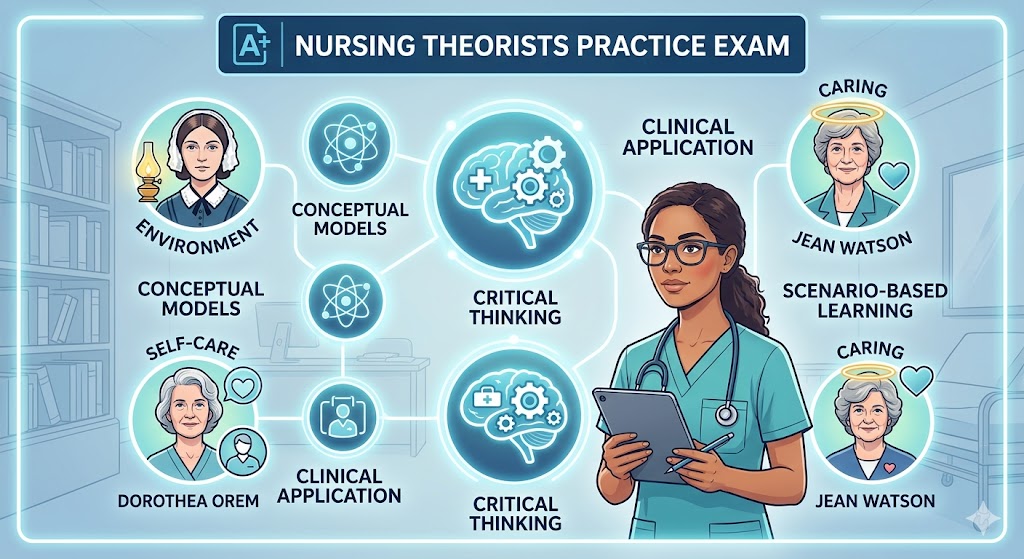
Additional Information
\What the Course Entails and Exam Details
Mastering nursing theory is critical for developing the critical thinking skills required of modern clinicians. This exam assesses your comprehensive understanding of the major frameworks and the ability to apply these concepts to diverse clinical scenarios. It moves beyond simple rote memorization, challenging you to identify, differentiate, and synthesize the contributions of key nursing leaders.
The core syllabus and skills covered in this practice assessment include:
The Foundation of Nursing Science: Introduction to concepts of the Nursing Metaparadigm: Person, Health, Environment, and Nursing.
Florence Nightingale: The Environment Theory, focusing on fresh air, cleanliness, and the nurse’s role in manipulating the environment for healing.
Hildegard Peplau: The Theory of Interpersonal Relations, emphasizing the distinct phases of the nurse-patient relationship.
Virginia Henderson: The Nursing Need Theory, focusing on the 14 fundamental components of patient independence.
Dorothea Orem: The Self-Care Deficit Theory, addressing a nurse's responsibility to help patients meet their therapeutic self-care demands.
Jean Watson: The Philosophy and Science of Caring, focusing on the 10 Caritas Processes and the transpersonal caring relationship.
Imogene King: The Theory of Goal Attainment, exploring the interactions between personal, interpersonal, and social systems.
Madeleine Leininger: The Cultural Care Diversity and Universality Theory (Transcultural Nursing), highlighting the necessity of culturally congruent care.
Sister Callista Roy: The Adaptation Model of Nursing, viewing the patient as an adaptive system needing help to respond to stimuli.
Patricia Benner: From Novice to Expert, outlining the five stages of clinical competence and skill acquisition.
What to Expect in the Final Exam
While the exact structure may vary by institution or specific curriculum, nursing theory assessments generally adhere to a standardized format designed to test both knowledge recall and higher-level synthesis. This practice test is modeled after common exams in accredited nursing programs and advanced certification pathways.
Exam Format: The assessment is typically conducted as a computer-based test (CBT) featuring primarily multiple-choice questions. A significant portion of the exam consists of scenario-based "application" questions, which present a clinical vignette and require you to identify the nursing theorist whose framework best applies to that situation.
Passing Score: For standard practice exams, a score of 80% or higher is recommended to demonstrate mastery. In academic settings, the passing threshold is set by your nursing program.
Time Limit: You will typically have a specific time allotment to complete the exam (e.g., 60 minutes for 50 questions), encouraging you to balance accuracy with pacing.
Exam Specifics: This is a closed-book examination. You will be expected to recall the primary themes, terminology, and publications associated with each major theorist without the aid of external materials.
How to Study and Exam Centers
Preparing for a theory-heavy exam requires strategic planning rather than passive reading. Here are actionable strategies to ensure success on the Nursing Theorists Practice Exam:
Leverage Active Recall: Create flashcards for each major theorist. On one side, list the theorist; on the other, include their primary theory title, key terminology (e.g., "Caritas Processes," "Self-Care Deficit," "Environmental Manipulation"), and a one-sentence summary of their model.
Apply Theory to Practice: As you review each framework, actively visualize how you would implement its core principles in a real-world clinical scenario. For example, consider how you would apply Leininger's theory when caring for a patient from a different cultural background than your own.
Take Mock Assessments: Utilizing this comprehensive Nursing Theorists Practice Exam is the single best predictor of your readiness. Identify areas where you consistently miss questions and focus your review on those specific models.
Create Mnemonics: Simplify complex models by developing mnemonics. For instance, think of Virginia "Henderson" as helping patients with their "Handson" (14 basic needs) for independence.
Exam Administration
As a preparatory assessment, this practice test is often available through your nursing program’s academic learning management system (e.g., Canvas, Blackboard). For standardized or advanced versions of nursing theory assessments (like those found in DNP or PhD programs), exams may be administered through secure university testing centers, private institutional portals, or sometimes via recognized testing providers such as ATI Testing or Kaplan Nursing, depending on your school’s requirements.
Job Opportunities from the Course
While this specific exam is a foundational milestone rather than a terminal credential, mastering nursing theory is essential for professional advancement. A deep understanding of these conceptual frameworks unlocks specialized pathways where theoretical application is critical. Mastery of nursing theory directly supports career growth in the following roles:
Nurse Educator (Academic or Clinical): Instructors must deeply understand theory to teach the next generation of nurses and model conceptual thinking.
Clinical Nurse Specialist (CNS): These advanced practice RNs use theory to develop new protocols, improve patient outcomes, and lead practice changes in specialized areas.
Nursing Administrator/Executive: Leaders utilize organizational and goal-attainment theories (like King’s or Watson’s) to manage large teams, define institutional philosophy, and shape healthcare policy.
Nurse Researcher: Grounding new research in established nursing theory is required for academic publication and securing grants.
Advanced Practice Registered Nurse (APRN): All APRNs (including Nurse Practitioners, CRNAs, and Certified Nurse Midwives) must possess a theoretical foundation to justify their practice at an expert level.
Case Manager: Utilizing frameworks like Orem’s Self-Care Deficit Theory is vital when coordinating long-term care plans focused on patient independenc
Frequently Asked Questions
Reviews
5.0
Based on 0 reviews
Leave a Review
No reviews yet. Be the first to review!