
NVG Night Vision Goggle Practice Exam Guide
$69.00
- Buy to unlock unlimited access to all Quiz questions and Answers in this Quiz.
- After purchase you can print a PDF of the whole quiz at any point. The PDF will contain the questions and the correct answers.
About this Exam
Welcome to your essential first step toward mastering the art of night operations. The Night Vision Goggle (NVG) certification is a specialized qualification designed for aviators, including pilots and aircrew across military, law enforcement, search and rescue (SAR), and emergency medical services (EMS). This comprehensive practice exam and study guide are crafted to equip you with the theoretical knowledge and operational insights needed to transition safely from daylight to data-driven night flight. NVGs do not replace traditional night flying skills; rather, they introduce a new dimension of visual cues and physiological challenges. This guide will help you bridge that gap, ensuring you understand not only how to operate the hardware, but also how to manage the altered perception and increased workload that come with "owning the night."
Ready to test your knowledge?
Buy Now to Access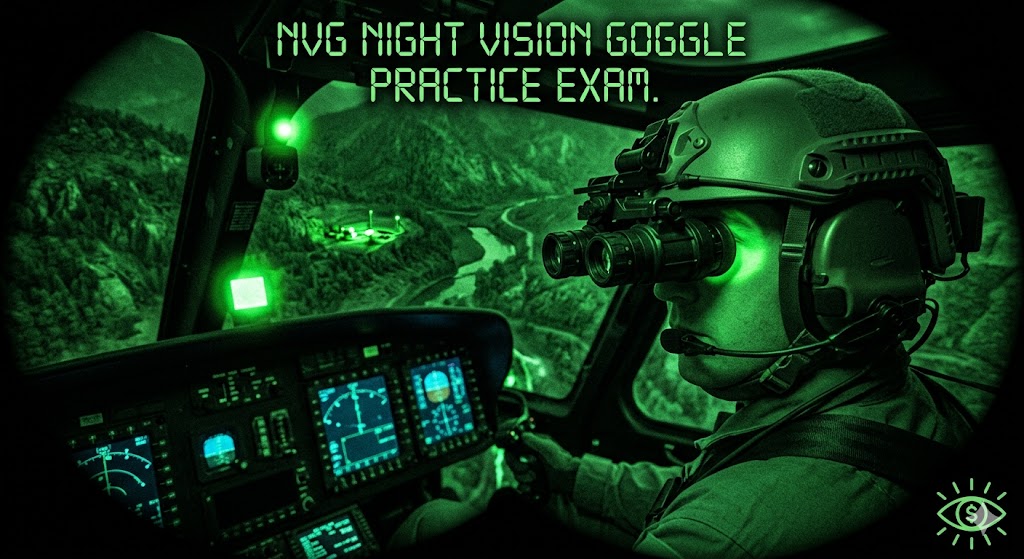
Additional Information
What the Course Entails and Exam Details
An NVG qualification course is a multifaceted program blending rigorous academic instruction with hands-on practical application. The initial study phase, reflected in this practice exam, covers several core domains essential for safe operations.
Your ground school curriculum, and by extension this exam, will likely cover:
Night Vision Physiology: Understanding human eye anatomy, specifically how rod and cone cells function in low light, the process of dark adaptation, and how NVGs interact with your natural vision.
NVG Technology and Mechanics: You must master the internal workings of image intensifier tubes (Generation 3 and beyond), including photocathodes, micro-channel plates, phosphor screens (green vs. white), power supplies, and helmet mounts.
Equipment Preparation and Maintenance: Detailed procedures for pre-flight inspection, focusing (objective lens and diopter adjustments), goggle alignment, battery management, and post-flight servicing.
Operational Limitations and Human Factors: This is a crucial section. Topics include the restricted field of view (typically 40 degrees), altered depth perception, visual illusions unique to NVG use (like distance estimation errors and "halos"), the effects of fatigue, and the critical importance of proper scanning techniques.
Regulations and Standard Operating Procedures (SOPs): Familiarity with regulatory requirements (e.g., FAA 14 CFR 61.31(k) and Part 91.205(h) in the U.S.) regarding aircraft lighting compatibility, crew currency, and weather minimums for NVG flight.
What to Expect in the Final Exam
While individual training providers may vary slightly, the final NVG certification generally consists of two distinct components: a theoretical (written) exam and a practical assessment.
Theoretical (Written) Exam
Format: Typically a multiple-choice exam, similar in structure to this practice guide. Some advanced courses might include short-answer or scenario-based questions.
Topics Covered: A comprehensive review of all ground school subjects listed in Section 2.
Passing Score: A high passing grade, often 80% or above, is usually required, reflecting the safety-critical nature of the content.
Time Limit: Expect a strict time limit, ranging from one to two hours, depending on the complexity and number of questions.
Practical Assessment (Flight/Simulator Check)
The practical exam is where you demonstrate mastery of the equipment in a dynamic, high-stakes environment, either in an aircraft or an advanced flight simulator.
Pre-Flight: You will be evaluated on your ability to inspect, mount, align, and focus your NVGs correctly. You must also ensure the aircraft cockpit has compatible, non-interfering lighting.
Operational Flight: An instructor will observe your execution of normal maneuvers, such as hovering (for rotary-wing), takeoff, approach, landing, and navigation using approved scanning techniques to compensate for a reduced field of view.
Emergency Procedures: You must demonstrate proficiency in handling NVG-specific abnormalities, including "Inadvertent IMC" (entering clouds while wearing NVGs), total goggle failure, power loss, and transition to unaided flight.
How to Study and Exam Centers
Preparation is paramount for the NVG exam. Do not rely solely on simple rote memorization.
Actionable Study Strategies
Immersive Technology Review: Do not just read about image intensifier tubes; use interactive diagrams and video tutorials to visualize the process of photon-to-electron-to-photon conversion.
Master the Pre-Flight Checklist: Create a mental and physical checklist for goggle preparation. Practice adjusting your specific NVG model in varied lighting conditions to ensure you can achieve a "clear, round image" without hesitation.
Scenario-Based Scanning Practice: While sitting in a dark room, practice the " Disciplined Head Move" scanning pattern. Visualize a 40-degree cone and move your head systematically to cover a wide field, reconciling what you see with imaginary instruments.
Understand the "Why" of Illusions: Instead of just memorizing the names of visual illusions, study the physiological reason they occur. Understanding why you might misinterpret distance or slope will help you counteract the effect during flight.
Authorized Exam Centers and Schools
You cannot take the NVG certification exam at a general computer testing center. It must be administered by an authorized flight training organization (FTO) or school that has received specific approval from their National Aviation Authority (NAA) to conduct NVG training.
Examples of organizations providing this training include specialized schools like ASU (Aviation Specialties Unlimited), Helicopter Institute, and large aeromedical or law enforcement operators with internal training capabilities. Military personnel are trained and certified within their respective branches. Contact your localized NAA for a list of approved Parts 141 and 135 flight schools offering NVG endorsements.
Job Opportunities from the Course
A certified NVG qualification is an indispensable requirement for numerous specialized, high-impact careers in modern aviation. Earning this certificate demonstrates a high level of proficiency and unlocks career paths where night operations are the norm.
Here is a list of job opportunities made available by this course:
Military Helicopter Pilot
Military Fixed-Wing Pilot (Special Operations/Transport)
Emergency Medical Services (EMS) Pilot
EMS Aircrew/Flight Paramedic
Law Enforcement Command/Tactical Pilot
Search and Rescue (SAR) Pilot
Search and Rescue Aircrew/Hoist Operator
Aerial Firefighting Pilot
Aviation Night Vision Imaging System (NVIS) Maintenance Technician
NVG Flight Instructor/Check Airman
Frequently Asked Questions
Reviews
5.0
Based on 0 reviews
Leave a Review
No reviews yet. Be the first to review!