
NWEA Reading MAP Practice Test
$69.00
- Buy to unlock unlimited access to all Quiz questions and Answers in this Quiz.
- After purchase you can print a PDF of the whole quiz at any point. The PDF will contain the questions and the correct answers.
About this Exam
The NWEA Reading MAP (Measures of Academic Progress) test is a computer-adaptive assessment designed to measure a student's reading achievement and growth over time. Unlike many standardized tests, it is not a high-stakes exam that determines a grade; rather, it is a tool used by K-12 educators in the United States and internationally to understand a student’s dynamic learning needs and track individual progress in essential literacy skills. This test is typically administered to students in kindergarten through twelfth grade to provide data that informs instruction and monitors a student's educational journey. It adapts to each student's current ability level, presenting questions that are appropriately challenging to find their unique learning baseline, making it highly valuable for personalized education.
Ready to test your knowledge?
Buy Now to Access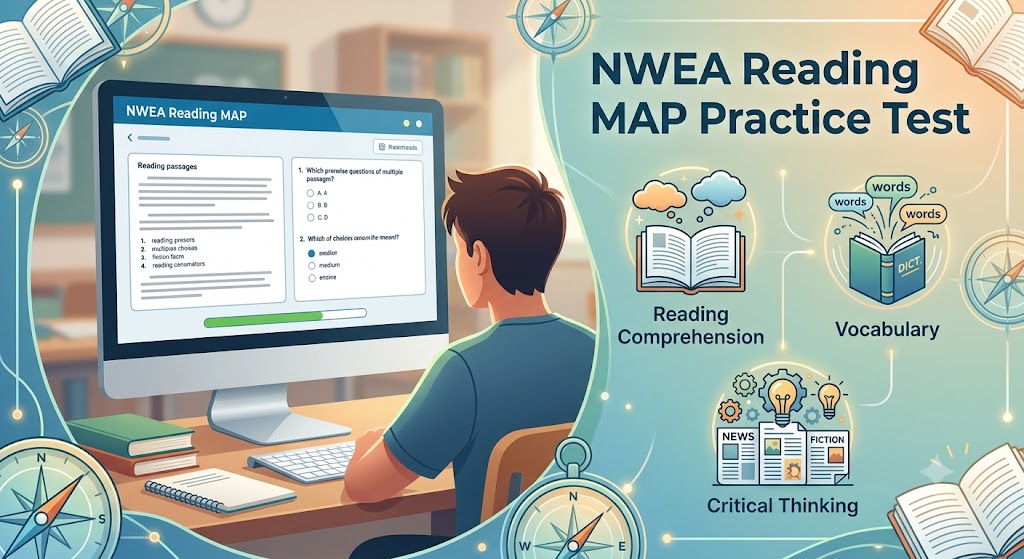
Additional Information
What the Course
Entails and Exam Details
The Reading MAP covers several foundational domains of
literacy, which evolve in complexity as students advance through school. It
evaluates skills across various areas, adapting the difficulty of questions
based on a student’s real-time responses.
For younger students (Grades K-2), the test focuses heavily
on foundational reading skills, early reader fluency, and comprehension of
simple literary and informational texts.
For older students (Grades 3-12), the Reading MAP rigorously
assesses:
Comprehension of Informational Text: Analyzing complex
non-fiction texts for main ideas, details, purpose, organizational structure,
and evaluating arguments.
Comprehension of Literary Text: Interpreting themes, plots,
characters, settings, literary devices, and the author's voice in fiction,
poetry, and drama.
Vocabulary: Understanding word meanings, identifying
synonyms and antonyms, and interpreting words within the context of phrases and
passages.
Foundational Skills: Evaluating knowledge of phonics,
sentence structure, and grammar usage, tested through interactive items.
What to Expect in the Final Exam
The NWEA Reading MAP offers a unique testing experience as
it is computer-adaptive. As the student answers questions, the computer
automatically adjusts the difficulty of subsequent questions. Correct answers
lead to harder questions, while incorrect answers lead to easier ones. This
process provides a precise measurement of what the student knows and is ready
to learn next.
The format is predominantly multiple-choice, though it may
also include interactive item types like sequencing, drag-and-drop, and
selecting answers from a list, depending on the grade level and specific
question focus.
There is no fixed time limit for the Reading MAP. Students
are encouraged to take their time and work through the questions at their own
pace without pressure.
The number of questions varies by test version and grade
level. The standard MAP Growth Reading test (Grades 2-12) typically contains
approximately 40 to 43 questions. The MAP Growth K-2 test may have slightly
fewer questions adapted for younger learners.
Unlike certification exams, the Reading MAP does not result
in a passing score. Instead, it provides a "RIT score" (Rasch Unit),
which measures academic growth along a vertical scale. This score allows
educators to monitor progress over time and compare a student's growth against
national norms for their grade level.
How to Study and
Exam Centers
Since the NWEA Reading MAP measures accumulated knowledge
rather than specific facts, traditional "cramming" is not effective.
The best preparation is consistent, high-quality instruction and consistent
reading practice throughout the school year.
However, targeted practice is beneficial for building
confidence and familiarity with the unique test format and its adaptive nature.
Actionable study strategies include:
Frequent Reading: Engaging with a wide variety of texts,
including fiction and informative articles, to improve comprehension skills and
expand vocabulary.
Interactive Reading: Encouraging discussions about what has
been read to deepen understanding and critical thinking skills.
Practice Tests: Utilizing dedicated NWEA Reading MAP
Practice Tests, such as the one described in the title, is essential. These
resources simulate the computer-adaptive environment and familiarize students
with the diverse question types. Look for online tools that mimic the visual
interface of the actual assessment.
Exam Administration: The NWEA Reading MAP is not
administered at commercial centers like Pearson VUE. It is administered
directly by local schools or school districts. Students take the assessment in
their regular classrooms or designated school computer labs, supervised by
their teachers. Parents and students interested in specific test dates or
procedures should contact their school administrator or district testing
coordinator directly.
Job Opportunities
from the Course
The NWEA Reading MAP is not a terminal qualification that
directly opens specific professional career paths in the workforce, as it is a
diagnostic tool for K-12 education. Its value lies in facilitating academic
growth and proficiency, which subsequently unlocks future educational and
professional opportunities.
Success and strong growth demonstrated on the Reading MAP
often correlate with:
Access to Advanced and Gifted Programs: Strong performance
can result in placement in advanced English language arts classes or
specialized learning tracks within the school system.
Preparation for Higher Education: High reading proficiency
is vital for success in demanding college coursework across all disciplines and
is crucial for achieving high scores on college entrance exams like the SAT or
ACT.
Success in Professional Fields: Strong literacy skills are
foundational requirements for virtually all professional careers, including:
- Educator
/ Teacher
- School
Administrator / Principal
- Journalist
/ Editor
- Content
Writer / Copywriter
- Marketing
Analyst / Research Analyst
- Policy
Analyst / Legislative Assistant
- Curriculum
Developer
- Librarian
/ Media Specialist
- Business
Executive / Manager (where effective communication and comprehension are
vital)
Frequently Asked Questions
Reviews
5.0
Based on 0 reviews
Leave a Review
No reviews yet. Be the first to review!