
NWSA Telecommunications Tower Technician 2 (TTT-2) Fall Protection and Rigging Standards Practice Test
$69.00
- Buy to unlock unlimited access to all Quiz questions and Answers in this Quiz.
- After purchase you can print a PDF of the whole quiz at any point. The PDF will contain the questions and the correct answers.
About this Exam
The NWSA Telecommunications Tower Technician 2 (TTT-2) certification is a significant milestone for experienced tower professionals seeking to advance their careers. It identifies individuals with a superior level of competence and skill. The NWSA TTT-2 Fall Protection and Rigging Standards Practice Test is a critical tool for candidates, designed to assess and reinforce their understanding of the complex safety protocols and technical standards required of a Lead Technician or Foreman.
Ready to test your knowledge?
Buy Now to Access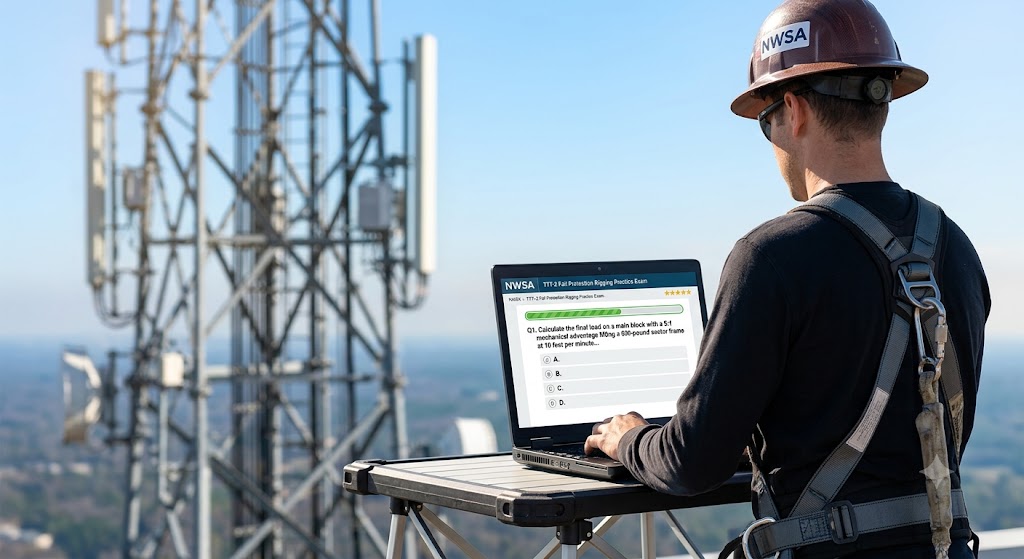
Additional Information
What the Course Entails and Exam Details
This specialized section of the TTT-2 curriculum is not a
course itself, but rather the knowledge domain you must master. It demands an
in-depth understanding and practical application of industry-leading standards,
including OSHA 1926 Subpart M (Fall Protection), ANSI/ASSE A10.48 (Criteria for
Safety Practices with the Construction, Demolition, Modification and
Maintenance of Communication Structures), and relevant TIA-222 standards. The
final exam, which this practice test prepares you for, evaluates your ability
to not only recite rules but also to apply them to complex, real-world
scenarios. It covers advanced knot tying, complex rigging systems involving
capstan hoists and multiple reeved sheaves, load calculations, mechanical
advantage, and the selection, use, and inspection of specialized fall
protection equipment like vertical lifelines and self-retracting lifelines (SRLs).
What to Expect in the Final Exam
The full NWSA TTT-2 certification consists of two distinct
components: a computer-based written exam and a hands-on practical evaluation.
Your mastery of the Fall Protection and Rigging Standards is heavily weighted
in both. In the written exam, you will encounter multiple-choice questions that
test your critical thinking and adherence to standards in complex situations,
with a passing score typically around 70-80%. The practical exam, administered
by an NWSA accredited Practical Examiner, is a 90-minute session where you must
perform a list of mandatory tasks perfectly, such as setting up a capstan hoist
system and configuring complex rigging. There is no partial credit for safety
violations during the practical; you must demonstrate complete proficiency and
100% tie-off compliance throughout.
How to Study and
Exam Centers
Preparation is paramount for the TTT-2. Your primary study
resources should be the exact industry standards the exam is based on: OSHA
1926, ANSI/ASSE A10.48, and TIA-222-H. Take this practice test repeatedly to
identify knowledge gaps and understand how the standards are applied in exam
questions. Combine theoretical study with hands-on practice; rehearse knot
tying and rigging configurations under the guidance of a mentor or at an
authorized training school. The NWSA does not provide training, but they partner
with third-party providers. The written exam is administered on demand via
Online Remote Proctoring (ORP), allowing you to take it on your own computer
24/7/365. The practical exam must be scheduled at an authorized NWSA test site
and evaluated by a credentialed examiner.
Job Opportunities
from the Course
Earning the TTT-2 certification is a clear signal to
employers that you possess advanced leadership skills and a safety-first
mindset, opening doors to higher-paying positions with increased
responsibility. This certification is a requirement for many supervisor roles
in the telecommunications construction and maintenance industry. Common career
paths include:
- Lead
Tower Technician
- Tower
Foreman / Crew Chief
- Rigging
Supervisor
- Quality
and Safety Auditor (Telecommunications)
- Fall
Protection Specialist / Rescue Team Member
- Project
Manager (Field Operations)
Frequently Asked Questions
Reviews
5.0
Based on 0 reviews
Leave a Review
No reviews yet. Be the first to review!