
NY Home Improvement Contractor Practice Exam
$69.00
- Buy to unlock unlimited access to all Quiz questions and Answers in this Quiz.
- After purchase you can print a PDF of the whole quiz at any point. The PDF will contain the questions and the correct answers.
About this Exam
The New York Home Improvement Contractor certification is a mandatory credential for anyone looking to perform residential construction, remodeling, or repair work within the state, particularly in heavily regulated areas like New York City.
This credential is specifically designed for general contractors, independent tradespeople, and construction business owners who want to legally operate and build a reputation of trust with homeowners.
Earning this license proves that you understand the strict local laws governing home improvements and consumer rights.
It acts as a shield of professional credibility, giving potential clients the peace of mind that their property and investment are in the hands of a knowledgeable, law-abiding professional.
Ready to test your knowledge?
Buy Now to Access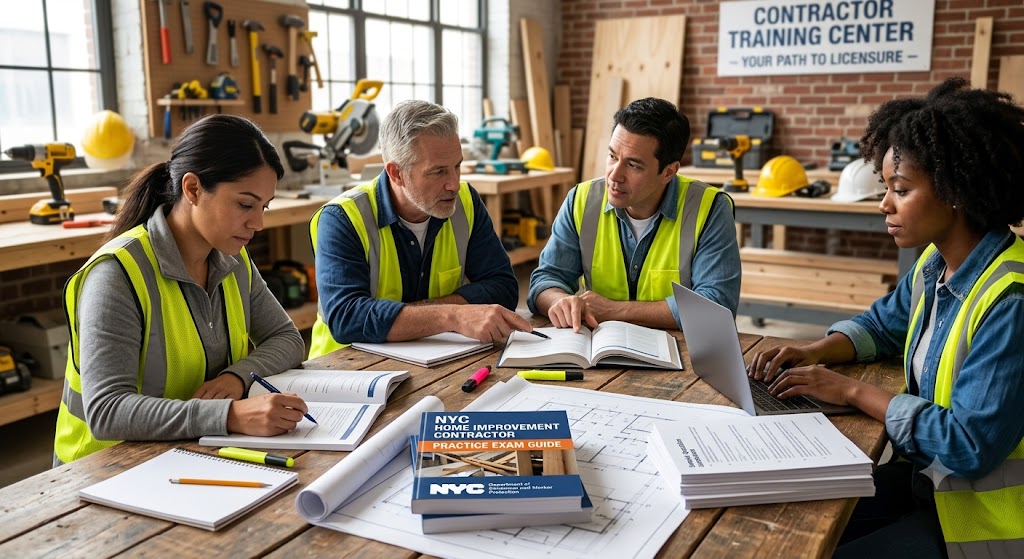
Additional Information
What the Course Entails and Exam Details
The curriculum leading up to this exam is heavily focused on the legal and administrative side of running a home improvement business, rather than your physical ability to swing a hammer.
You will dive deeply into consumer protection laws, which dictate exactly how you must interact with clients and present your services.
A major portion of the syllabus covers the strict requirements for writing legally binding contracts, including mandatory cancellation rights and specific language that must be included to protect the homeowner.
You will also learn about the rules surrounding advertising, accurate cost estimations, and the proper handling of dispute resolutions.
Furthermore, the course materials cover essential business operations such as workers' compensation requirements, proper insurance coverage, and the regulations regarding the employment of subcontractors.
What to Expect in the Final Exam
The official licensing test is typically administered as an open-book, multiple-choice examination.
Candidates are generally asked a total of 30 questions that directly test their knowledge of the local administrative code and consumer protection rules.
To achieve a passing grade, you must answer at least 21 questions correctly, which equates to a 70% passing score.
While the exact time limit can vary slightly based on the testing platform, most candidates are given around two hours to complete the exam.
Because it is an open-book test, you are usually allowed to use the official Department of Consumer and Worker Protection (DCWP) Home Improvement Business Trust Fund Guide during the exam, making it crucial to know how to navigate your reference materials quickly.
How to Study and Exam Centers
The most effective study strategy is to thoroughly read and tab your official consumer protection guides and local administrative codes.
Taking multiple practice exams is highly recommended, as it helps you get comfortable with the phrasing of the questions and the speed at which you need to look up information.
Create a personal index or use sticky notes to mark important sections in your reference books, such as contract requirements and cancellation policies, so you can find them instantly on test day.
When you are ready to take the final test, you will generally schedule it through the New York City Department of Consumer and Worker Protection (DCWP).
The exam can often be taken at designated local licensing centers or through approved online testing portals that monitor your progress remotely.
Job Opportunities from the Course
Obtaining your New York Home Improvement Contractor license opens the door to a wide variety of lucrative and independent career paths.
• Licensed Home Improvement Contractor: You can legally start and run your own remodeling business, bidding on residential projects directly with homeowners.
• Residential Construction Manager: You can oversee large-scale home renovations, coordinating between clients, architects, and specialty trades.
• Independent Remodeler: You can specialize in high-demand niches like kitchen and bathroom renovations, basement finishing, or custom carpentry.
• Project Estimator: Your deep knowledge of contracts and legal limits makes you an invaluable asset for larger construction firms needing accurate, compliant project bids.
• Subcontractor: While some specialty trades require separate licenses, holding this certification allows you to legally partner with larger general contractors on massive residential overhauls.
Frequently Asked Questions
Reviews
5.0
Based on 0 reviews
Leave a Review
No reviews yet. Be the first to review!