
NYC CFR-D Practice Exam
$69.00
- Buy to unlock unlimited access to all Quiz questions and Answers in this Quiz.
- After purchase you can print a PDF of the whole quiz at any point. The PDF will contain the questions and the correct answers.
About this Exam
The New York City Certified First Responder – Defibrillation (CFR-D) certification represents a vital level of emergency medical care. This specialized role is crucial for personnel who are often the first to arrive at a dynamic scene, such as police officers, certain fire department employees, and private security forces operating within the unique environment of the five boroughs.
This certification is designed specifically for individuals seeking foundational emergency medical knowledge with an immediate, life-saving focus. While it provides comprehensive basics, the CFR-D provider delivers critical interventions, with a specific, intense emphasis on high-quality cardiopulmonary resuscitation (CPR) and the rapid, efficient use of Automated External Defibrillators (AEDs) to maximize survival outcomes in cardiac arrest scenarios. If you are preparing to serve your community in this foundational first-responder capacity, understanding this exam is your critical next step.
Ready to test your knowledge?
Buy Now to Access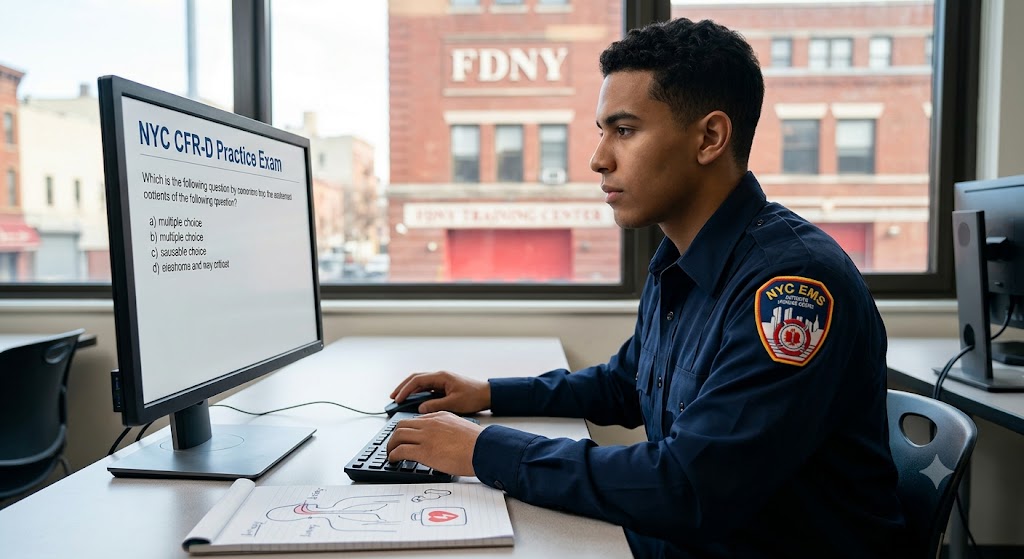
Additional Information
What the Course Entails and Exam Details
The comprehensive NYC CFR-D training curriculum, typically adhering strictly to the curriculum set forth by the New York State Department of Health (NYS DOH), is meticulously designed to equip you with the fundamental skills needed to sustain life during those critical minutes before a paramedic or ambulance crew arrives. This training goes far beyond standard first aid.
The core curriculum heavily emphasizes critical, life-sustaining skills. These essential topics include:
Rapid Patient Assessment and Primary Surveys.
High-Performance Cardiopulmonary Resuscitation (CPR) techniques for adults, children, and infants.
Comprehensive Automated External Defibrillator (AED) usage and integration.
Basic Airway Management, including suctioning and ventilation devices.
Basic Trauma Care, focusing on effective hemorrhage control and spinal immobilization.
Recognizing and managing immediate, common medical emergencies.
The depth of this training ensures that a Certified First Responder is not just present, but proficient in delivering life-saving defibrillation and basic stabilization during an dynamic medical crisis.
What to Expect in the Final Exam
The New York City CFR-D certification process concludes with a standardized final examination, which is a significant step designed to evaluate your readiness for high-stakes situations. This comprehensive assessment consists of two distinct components that are crucial for measuring your competence.
The Cognitive (Written) Exam:
This section typically consists of multiple-choice questions. It comprehensively tests your knowledge of the essential topics, including patient assessment, medical emergencies, trauma scenarios, and official first responder protocols. You will be allotted a specific time limit, which is typically 90 to 120 minutes. Candidates must achieve a minimum passing score, which is usually 70%, to successfully pass this section.
The Psychomotor (Practical) Skills Exam:
This hands-on evaluation requires you to successfully demonstrate proficiency in several critical skills, which are fundamental to the role. You will be tested on individual stations, which often include:
BVM Ventilation/Airway Management (Oxygen Administration).
Hemorrhage Control and Shock Management (Basic Trauma).
Patient Assessment (Medical or Trauma Scenario).
High-Performance CPR/AED Scenario (often the central practical skill).
This practical section is graded on a clear Pass/Fail basis, and successful completion of every station is mandatory to receive your final certification.
How to Study and Exam Centers
Thorough preparation for the NYC CFR-D exam requires a balanced blend of robust knowledge and practical, hands-on skill. Achieving confidence in both areas is absolutely key to your success on exam day.
Actionable Study Strategies:
Review the NYS DOH CFR Curriculum: Your course textbook and lecture notes provide the foundation for everything you will need to know. Master the vocabulary and the standard algorithmic treatments for medical and trauma emergencies.
Engage in Hands-on Practice: Utilize every opportunity during your training to physically practice skills, such as AED deployment and BVM usage. Ask your instructors for critical, constructive feedback on your performance.
Use Practice Exams: Utilizing dedicated NYC CFR-D practice exams is essential. These practice exams effectively familiarize you with the formatting and tempo of the questions, highlighting specific areas where you may need additional focused review.
Visualize Real-World Scenarios: Don’t just memorize the information; imagine yourself responding to an actual cardiac arrest in a crowded NYC subway station or park. Visualizing these scenarios can greatly improve your decision-making speed on both the written and practical tests.
Exam Centers:
The cognitive (written) portion of the examination is often administered at secure, third-party testing centers, such as authorized NYS computer-based testing locations (e.g., Pearson VUE). Alternatively, it may be proctored directly at approved New York State DOH test centers or leading authorized training institutions throughout New York City.
The psychomotor (practical) skills exam is always conducted on-site at your authorized training program or a designated regional testing facility within the five boroughs. Your specific instructor or training coordinator will provide you with the essential scheduling and location details for your exam.
Job Opportunities from the Course
Achieving your NYC CFR-D certification is a major accomplishment and an essential first step. It opens vital doors to numerous entry-level opportunities within the public safety and medical fields throughout New York City. This respected certification is widely recognized and valued, serving as a required credential for many crucial roles where minutes count and life-saving action is necessary.
Obtaining your certification can unlock a dynamic range of career paths, including:
New York City Police Officer (NYPD) (often mandatory training).
New York City Firefighter (as a required foundational prerequisite).
Private EMS Provider (at the First Responder Level).
Corporate Security Specialist for High-Rise Office Buildings.
Special Event Medical Staff at major NYC venues like Madison Square Garden.
Industrial First Aid Responder for construction or transit companies.
Volunteer Fire and Emergency Medical Services.
Frequently Asked Questions
Reviews
5.0
Based on 0 reviews
Leave a Review
No reviews yet. Be the first to review!