
NYC Corrections Peace Officer Practice Exam
$69.00
- Buy to unlock unlimited access to all Quiz questions and Answers in this Quiz.
- After purchase you can print a PDF of the whole quiz at any point. The PDF will contain the questions and the correct answers.
About this Exam
The New York City Corrections Peace Officer exam is the vital first step toward joining the dedicated ranks of the NYC Department of Correction (DOC), known as "The Boldest." This civil service examination is designed to evaluate whether candidates possess the necessary cognitive skills and judgment to manage the challenging and rewarding environment of New York City’s correctional facilities. It is an entry-level uniformed position meant for individuals committed to public safety, rehabilitation, and maintaining custody and control of inmates. Successfully passing this test allows individuals to be considered for further screening, academy training, and eventually, appointment as a NYS certified Peace Officer within the NYC DOC system.
Ready to test your knowledge?
Buy Now to Access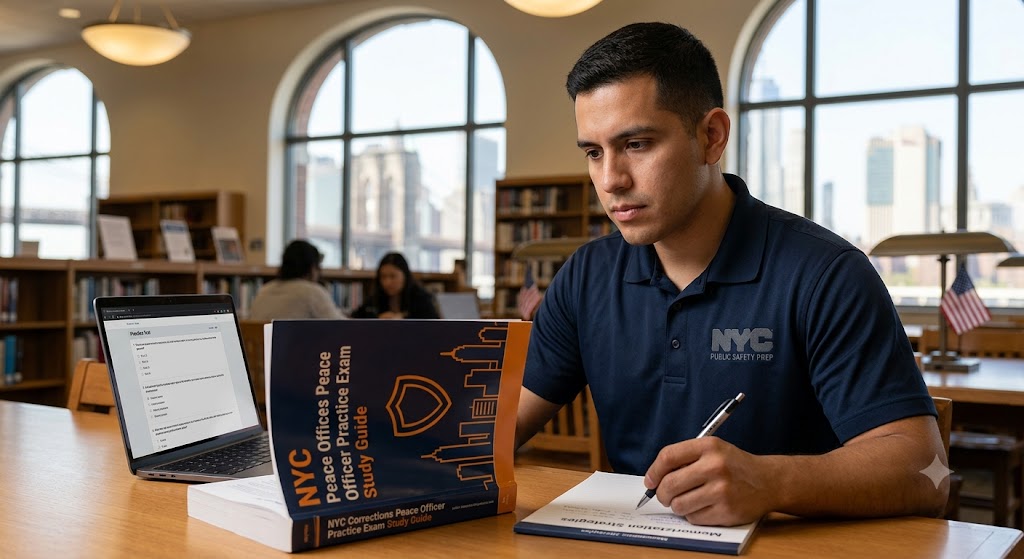
Additional Information
What the Course Entails and Exam Details
This examination is not a test of pre-existing correctional knowledge; rather, it assesses essential aptitude and cognitive abilities needed for the job. The exam syllabus primarily covers nine core areas.
Candidates will face questions on memorization, requiring them to recall details from photographs or written scenarios presented earlier in the test.
Written comprehension and expression are heavily featured to ensure officers can read and understand directives and write clear, accurate incident reports.
Critical thinking is assessed through deductive reasoning (applying rules to specific problems) and inductive reasoning (combining information to form a general rule).
Additionally, the test measures information ordering (placing steps in the correct sequence), mathematical reasoning (using basic math to solve operational problems), problem sensitivity (recognizing when something is wrong or likely to go wrong), and spatial orientation (knowing where you are in relation to objects or navigating complex environments).
What to Expect in the Final Exam
The official NYC Correction Officer Exam is administered on a computer at designated Department of Citywide Administrative Services (DCAS) testing centers. It is a strictly timed, multiple-choice assessment that usually lasts between two and a half to three and a half hours, depending on the specific exam series.
To pass, candidates must achieve a minimum score of 70%. Your final score dictates your placement on the established civil service list, which remains active for several years.
Specific rules are strictly enforced at the testing centers. Cheating is zero-tolerance. You are prohibited from bringing any unauthorized electronic devices, including cell phones, smartwatches, or tablets, into the testing room. Candidates are generally allowed to bring a non-programmable, quiet calculator if it is allowed for that specific exam session, though this is not always necessary for the mathematical reasoning questions provided. It is crucial to arrive on time, as latecomers are routinely turned away.
. How to Study and Exam Centers
Effective preparation is key to conquering this competitive exam. The best strategy is consistent practice using simulated exams. Because the test focuses on cognitive abilities, you must train your brain by taking specialized "NYC Corrections Peace Officer Practice Tests" repeatedly. These simulate the pressure and format of the real thing.
To improve specifically in weaker areas, practice reading complex directives for comprehension, drill basic math without a calculator, and practice incident report scenarios to enhance logic and written clarity. Memory training exercises, where you look at a picture for two minutes and then try to list every detail, are also highly beneficial.
The final, official examination must be taken in person. The NYC Department of Citywide Administrative Services (DCAS) operates several physical testing centers known as Computer-based Testing & Applications Centers (CTACs). These are located across the five boroughs, with prominent centers in Manhattan, Brooklyn, the Bronx, Queens, and Staten Island. You will select your preferred date and time when you apply for the exam through the DCAS Online Application System (OASys).
Job Opportunities from the Course
Passing this exam and completing the subsequent hiring process opens the door to a structured career path within the NYC Department of Correction. Here are the specific job titles and progression opportunities:
Correction Officer (Uniformed)
Correction Captain (Uniformed)
Correction Assistant Deputy Warden (Uniformed)
Correction Deputy Warden (Uniformed)
Correction Warden (Uniformed)
Correction Chief of Department (Uniformed)
Specialized Unit Officer (e.g., Emergency Service Unit, K-9, Transportation)
Investigator (Internal Affairs Bureau)
Frequently Asked Questions
Reviews
5.0
Based on 0 reviews
Leave a Review
No reviews yet. Be the first to review!