
NYC DOB Master Electrician Practice Exam
$69.00
- Buy to unlock unlimited access to all Quiz questions and Answers in this Quiz.
- After purchase you can print a PDF of the whole quiz at any point. The PDF will contain the questions and the correct answers.
About this Exam
The New York City Department of Buildings (DOB) Master Electrician License is the ultimate credential for electrical professionals operating in the five boroughs.
This highly coveted certification allows you to pull permits, operate your own electrical contracting business, and oversee complex electrical installations across New York City.
It is specifically designed for highly experienced journeyman electricians who have accrued years of documented, hands-on field experience and are ready to take the next major step in their careers.
Earning this license proves that you possess a master-level understanding of electrical theory, safety regulations, and local codes, setting you apart as an elite professional in a highly competitive market.
Sample Questions
Explanation:
Explanation:
Explanation:
Explanation:
Explanation:
Ready to test your knowledge?
Buy Now to Access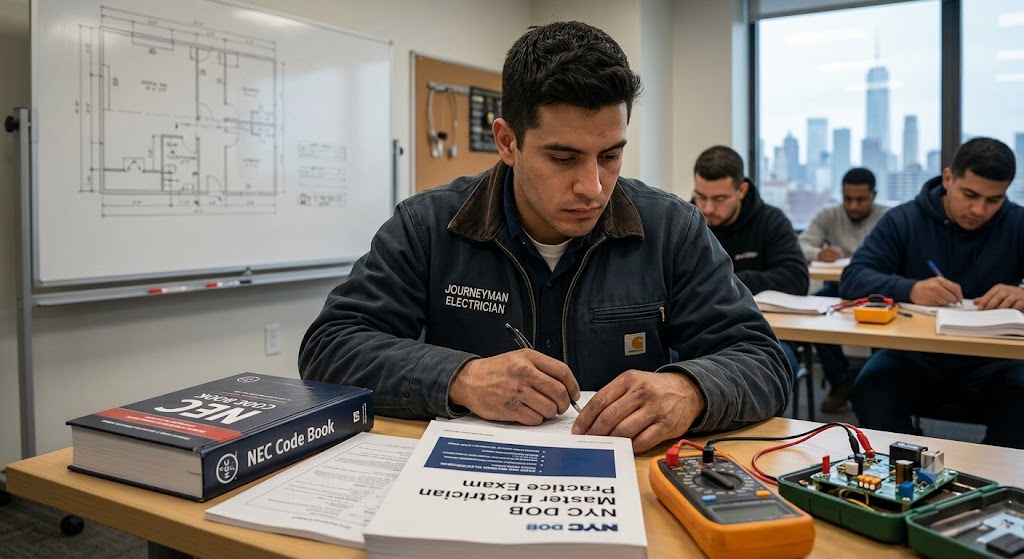
Additional Information
What the Course Entails and Exam Details
Preparation for the Master Electrician exam involves a deep and rigorous dive into both national standards and local regulations.
The syllabus is heavily rooted in the National Electrical Code (NEC), requiring an intimate knowledge of its countless articles and provisions.
However, because New York City has its own unique infrastructure and safety demands, you must also master the NYC Electrical Code Technical Standards and local amendments.
Key topics covered include electrical theory, wiring methods, load calculations, grounding and bonding, and commercial lighting systems.
You will also be tested on the administrative rules of the NYC Department of Buildings, blueprint reading, and business practices, ensuring you are equipped to run a compliant and successful contracting operation.
What to Expect in the Final Exam
The NYC DOB Master Electrician Exam is typically divided into two distinct parts to test both your theoretical knowledge and your practical abilities.
The first part is a comprehensive written exam, generally consisting of over 100 multiple-choice questions.
You will have a strict time limit—usually around four hours—to navigate complex code scenarios and perform difficult electrical calculations.
Once you successfully pass the written portion, you must take a practical exam.
The practical portion requires you to physically demonstrate your skills in a controlled environment, proving your competence in tasks like conduit bending, wiring motor controls, and troubleshooting live circuits.
You must typically achieve a minimum passing score of 70% on both parts to qualify for your license, so attention to detail under pressure is absolute key.
How to Study and Exam Centers
Success on this exam requires a highly structured and disciplined study strategy.
Begin by securing the most recent editions of the NEC and the NYC Electrical Code amendments, as these will be your primary resources.
Taking a high-quality NYC DOB Master Electrician Practice Exam is crucial, as it will help you get accustomed to the wording of the questions and the strict time constraints.
Consider joining a local exam preparation course or study group in New York, which can provide guided instruction on advanced load calculations and practical hands-on lab time.
When you are ready to test, the written exams are typically administered by authorized third-party testing vendors, such as CPS HR Consulting.
You will schedule and take your written test at designated, secure testing centers located throughout the New York City area, while the practical exam is held at a specific testing facility equipped with electrical lab stations.
Job Opportunities from the Course
Achieving your NYC Master Electrician License opens the door to the most lucrative and authoritative roles in the industry.
First and foremost, it allows you to become an independent Electrical Contractor, empowering you to start your own business, hire crews, and bid on massive commercial and residential projects.
You can also step into the role of a Senior Project Manager for large construction firms, where you will oversee multi-million dollar electrical installations from the blueprint phase to final inspection.
If you prefer a more analytical route, you can become an Electrical Estimator, utilizing your deep code knowledge to accurately price out complex jobs for major contractors.
Additionally, this credential qualifies you for positions in civic oversight, such as becoming a municipal Electrical Inspector, where you ensure that other contractors' work complies with the rigorous safety standards of New York City.
Frequently Asked Questions
Reviews
5.0
Based on 0 reviews
Leave a Review
No reviews yet. Be the first to review!