
NYPD Auxiliary Police Practice Exam
$69.00
- Buy to unlock unlimited access to all Quiz questions and Answers in this Quiz.
- After purchase you can print a PDF of the whole quiz at any point. The PDF will contain the questions and the correct answers.
About this Exam
The NYPD Auxiliary Police program is the largest of its kind in the United States, providing an essential civilian volunteer resource to support the official New York City Police Department. This program is designed for civic-minded men and women who want to give back to their community, get an inside look at law enforcement, or use it as a stepping stone to a full career as a sworn police officer. Auxiliary police are trained to serve as the "eyes and ears" of the regular force, performing non-enforcement and non-hazardous duties including community patrols, traffic and crowd control, and assisting in large city events. While a volunteer position, it requires dedication, training, and passing evaluations. This study guide focuses on helping potential candidates understand the path and prepare for the final exams.
Ready to test your knowledge?
Buy Now to Access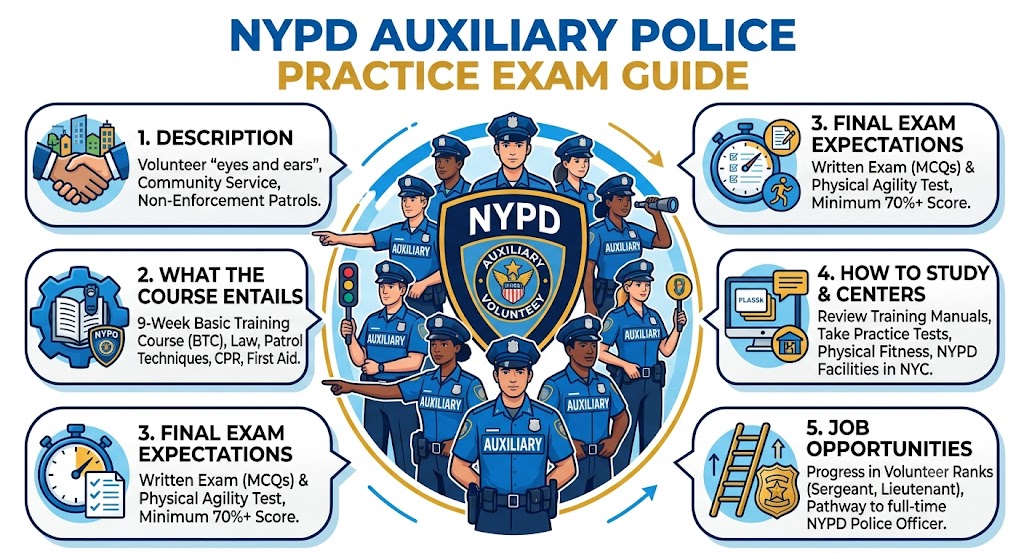
Additional Information
What the Course
Entails and Exam Details
Candidates to become an NYPD Auxiliary Police Officer must
complete a multi-week Basic Training Course (BTC). This course is intensive and
covers a wide array of topics crucial to the role. The syllabus typically
includes, but is not limited to: New York State Penal Law (specifically, the
laws of arrest and search), patrol techniques, de-escalation strategies,
emergency first aid and CPR, crowd control, traffic management, and proper use
of a police radio. The entire course is designed to equip volunteers with the
knowledge to support the department safely and effectively. At the culmination
of the training, candidates are required to pass a final evaluation which
consists of two key parts: a written exam and a physical agility test.
What to Expect in the Final Exam
The final examinations are the official gateway to becoming
a sworn NYPD Auxiliary Police Officer. The process is divided into two distinct
components: a written exam and a physical agility test.
The written exam is comprehensive, focusing on all the
theoretical knowledge gained during the Basic Training Course. It typically
takes the form of multiple-choice and short-answer questions, designed to test
a candidate's understanding of key legal concepts, patrol protocols, and safety
procedures. Candidates should expect a challenging assessment, and the passing
score requirement is usually a minimum of 70-80%.
The physical agility test, often referred to as a job
standard test, is a timed physical assessment. This test evaluates a
candidate's physical readiness to perform non-enforcement duties, including
scenarios like running, climbing stairs, and managing simple manual tasks. For
example, common elements may include a timed trigger pull station, a 176-pound
mannequin drag (simulating rescue), a stair climb, a fence surmount, and a
600-foot pursuit run.
How to Study and
Exam Centers
Preparation is the key to success in the NYPD Auxiliary
Police final exams. Here are essential study strategies:
First, be an active participant during the Basic Training
Course. Take detailed notes, ask questions, and practice scenarios. Consistency
is vital; create a study schedule to review your BTC materials multiple times.
Use the training manuals provided as your primary study guide, transforming
them into flashcards to drill important legal definitions and procedures.
Practice with a buddy; many of the physical and situational skills, like
de-escalation and radio usage, are best practiced in role-play scenarios.
Furthermore, simulate the written exam by taking practice tests. Time yourself
to build speed and accuracy. Do not neglect physical preparation. Begin a
structured physical fitness program that includes both cardiovascular exercise
(for the pursuit run) and strength training (for the mannequin drag and fence
surmount).
Finally, regarding exam centers, it is crucial to understand
that the final NYPD Auxiliary Police exams are not administered at commercial
testing locations like Pearson VUE or generalized online portals. These
official evaluations are conducted directly by the NYPD Training Bureau at
specific NYPD-authorized facilities and training sites within New York City.
Candidates will receive specific information about the location, date, and time
of their final written and physical exams directly from their Auxiliary Police
Unit coordinators during the final weeks of their training course.
Job Opportunities
from the Course
While the NYPD Auxiliary Police is a volunteer program, it
provides remarkable opportunities. Serving with distinction can open various
pathways and titles, both within the volunteer structure and as a pipeline to
professional law enforcement.
Career Paths and Opportunities Unlocked:
- Volunteer
Ranks: Successful completion of the program allows progression through
a clearly defined volunteer rank structure, starting as an Auxiliary
Police Officer and potentially advancing to Auxiliary Sergeant, Auxiliary
Lieutenant, Auxiliary Captain, and higher leadership roles.
- Pathway
to NYPD Police Officer: The training, experience, and inside knowledge
gained in the Auxiliary program are highly advantageous for those who
intend to apply to become a sworn NYPD Police Officer. It provides a
deeper understanding of the department's operations and values, and some
colleges even offer credit for auxiliary training.
- Career
in Law Enforcement: The foundational training and experience are
excellent for those interested in diverse careers within the criminal
justice and law enforcement sectors, including work in private security,
investigations, and community outreach.
- Community
Leadership: For individuals not seeking a law enforcement career, the
program offers unmatched leadership development, communication, and
emergency response training, which can enhance any career and foster
community leadership
Frequently Asked Questions
Reviews
5.0
Based on 0 reviews
Leave a Review
No reviews yet. Be the first to review!