
NYPD School Safety First Trimester Practice Test
$69.00
- Buy to unlock unlimited access to all Quiz questions and Answers in this Quiz.
- After purchase you can print a PDF of the whole quiz at any point. The PDF will contain the questions and the correct answers.
About this Exam
This study guide and practice resource is designed specifically for individuals preparing to enter the highly respected ranks of the New York City Police Department's School Safety Division. It serves as a preliminary, illustrative resource for the First Trimester exam within the foundational training of a School Safety Agent (SSA). School Safety Agents are a critical component of the NYC educational system, tasked with maintaining a safe, secure environment for students, teachers, and staff across the five boroughs. This exam, typically taken at the conclusion of the first phase of Police Academy training, assesses your comprehension of essential protocols, rules, legal definitions, and professional conduct required for the role.
Successful agents are highly motivated individuals, possessing strong character, communication skills, and a commitment to protecting the educational community. The First Trimester Practice Exam helps refine the knowledge and cognitive abilities necessary to excel in the rigorous training program and ultimately, on the job.
Ready to test your knowledge?
Buy Now to Access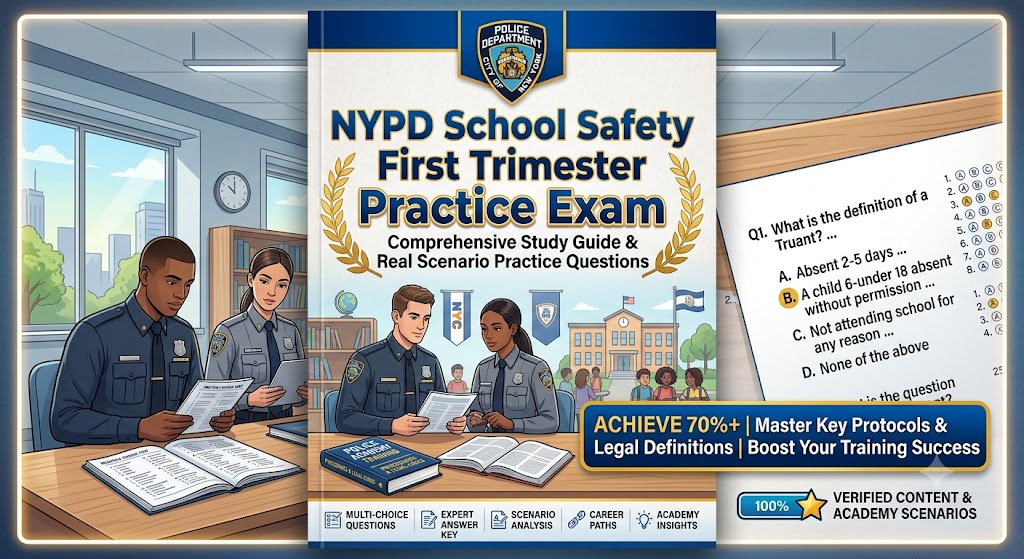
Additional Information
What the Course Entails and Exam Details
The initial phase of NYPD School Safety Agent training
covers a diverse and crucial curriculum designed to prepare you for various
challenges within a school setting. The complete course typically spans
approximately 17 weeks and includes comprehensive instruction at the NYPD
Police Academy, providing a robust mix of academic and physical training. While
the specific content for the First Trimester exam can slightly vary based on
current academy syllabus updates, the practice resources, including illustrative
tests, focus on these core areas:
- Role
and Organization: Understanding the NYPD organizational structure,
rank hierarchy, and the paramilitary nature of the institution.
- Patrol
Procedures and Guidelines: Familiarity with the Patrol Guide,
departmental procedures, uniform standards, and deployment protocols. This
includes knowledge of visitor control, vehicle inspections, and reporting
defective equipment.
- Legal
Foundations and Terminology: Grasping key legal definitions and
concepts relevant to the role. This includes understanding state and
federal law, the NYS Penal Law structure, the differences between civil
(tort) and criminal law, court systems, and relevant amendments (e.g., the
6th Amendment regarding a speedy trial). Specific definitions critical to
school safety, such as the definitions of truant, runaway, and juvenile
delinquent, are often included.
- Ethics
and Professional Conduct: Deep instruction in professional ethics,
code of conduct, the definition of values, and the importance of
integrity, honesty, and impartiality in all duties. This also covers
understanding child abuse reporting requirements and mandatory reporting
responsibilities.
- Cultural
Awareness and Communication: Training in cultural diversity, including
understanding different cultures, religions (e.g., practices within a
Mosque and handling sacred texts), and concepts like ethnocentrism,
acculturation, and de-escalation techniques. Strong written comprehension
and expression are also essential, particularly for drafting accurate
incident reports.
- Safety
and Security Protocols: Learning fundamental safety practices, visitor
management, access control, and established response methods for various
school-based scenarios. This also encompasses understanding scanning
equipment operations.
- Emergency
Response: Initial instruction on responding to emergencies and
managing crises, aligning with the "Safe Evacuation" protocols.
- Physical
Agility (assessed separately): While not part of the written
exam, the overall training includes rigorous physical agile requirements
which assess emergency response simulation, detainment, stair climbing,
and victim rescue.
The exam itself typically consists of multiple-choice
questions administered via computer. It evaluates not only memorization of
definitions and rules but also your ability to apply these concepts to
potential situations and demonstrate critical cognitive skills.
What to Expect in
the Final Exam
While the exact number of questions can vary for different
practice and actual trimester exams, here is a general breakdown of what to
anticipate for the actual First Trimester Exam or representative practice
tests:
- Format:
The exam will be in a multiple-choice format. Questions will present a
scenario, definition, or concept followed by several potential answers,
from which you must select the best option.
- Number
of Questions: Actual and practice exams can range from 80 to 100
questions.
- Passing
Score: To pass, candidates typically need to achieve a minimum score
of 70%. Your score directly reflects your understanding of the trimester’s
material and influences your progress in the academy training.
- Time
Limits: A specific time limit (e.g., 2-3 hours) will be established to
complete the entire exam. You must manage your time effectively to ensure
you can read, process, and answer every question. Practice tests are
excellent for developing this skill.
- Specific
Rules: The exam is officially administered in a controlled testing
environment, either at a designated NYPD or DCAS facility. Cheating, the
use of unauthorized materials (calculators, notes, devices, etc.), and
disruptive behavior are strictly prohibited. The integrity and
professionalism of the examination process reflect the core values
expected of any NYPD uniformed or civilian personnel. For official exams,
specific instructions regarding identification and conduct will be
provided.
It’s crucial to treat any official first-trimester test with
the utmost seriousness, as it is a decisive component of the overall academy
graduation requirements and your ability to be appo
inted as a School Safety Agent.
How to Study and
Exam Centers
Preparation is paramount to success. Actionable study
strategies for the NYPD School Safety First Trimester Exam include:
- Official
Materials & Academy Guidance: Rely first and foremost on the
officially provided study guides, lecture notes, and materials from the
NYPD Police Academy. Actively participate in all training sessions and
seek clarification from instructors on complex topics.
- Identify
and Focus on Core Cognitive Skills: The exam significantly tests
cognitive abilities. Practice questions and scenarios that challenge your:
- Written
Comprehension & Expression: Practice reading, analyzing incident
report examples, and completing sentences that test language
understanding.
- Memorization:
Create flashcards for key legal definitions, procedures, rank structures,
historical dates, and official names.
- Problem
Sensitivity: Use practice scenarios to identify potential issues,
risks, and determine appropriate responses.
- Deductive
& Inductive Reasoning: Engage in logical reasoning exercises and
practice applying general rules to specific situations, and forming
conclusions from specific details.
- Information
Ordering: Practice organizing sequences of events or procedural steps
correctly.
- Spatial
Orientation & Visualization: Work with maps or object rotation
problems to sharpen your understanding of location and visual
manipulation, as relevant to navigating schools or understanding
scanning.
- Practice
with Real and Simulated Tests: Utilize officially endorsed practice
tests, and find reputable online resources or preparatory materials that
offer simulated NYPD School Safety exams. This familiarizes you with the
structure, question types, and time constraints.
- Active
Recall & Scenarios: Discuss concepts and scenarios with fellow
recruits. Actively quiz each other and role-play situations, focusing on
proper procedural and legal responses. Discuss definitions of truant,
juvenile delinquent, runaways, legal terms, cultural considerations, and
ethical dilemmas. Time management during these practice sessions is also
critical.
- Review
Legal and Departmental Procedures Regularly: Dedicate specific study
blocks to memorizing and understanding the key elements of the NYS Penal
Law sections relevant to school safety, general legal concepts,
departmental procedures, and the definition of values/ethics.
- Physical
Preparation: Remember that your physical training is equally important
to the overall program and is evaluated in separate physical agility
assessments. Maintain a strong physical condition to meet these demands.
Exam Centers and Procedure: Official NYPD exams and
certifications are not generally taken through external commercial portals like
Pearson VUE, especially within the Police Academy context for internal
assessments. The First Trimester Exam, as part of internal training, is administered
by official NYPD personnel or the Department of Citywide Administrative
Services (DCAS) within official facilities.
- Recruitment/Preliminary
Steps: Initial qualification and background screening may involve
online components via NYC government portals (e.g., dcas.nyc.gov).
- Police
Academy: Once you are a recruit, all training, including the First
Trimester Exam and physical agility tests, takes place within the NYPD
Police Academy or designated Department facilities. Your instructors will
provide clear, specific details about the date, time, location, and
required conduct for all assessments.
- Official
Notifications: Always follow instructions provided directly by the
NYPD Recruitment unit, the Police Academy, or official NYC government
communications.
Successful completion of the overall training program
results in certification as an NYPD School Safety Agent.
Job Opportunities
from the Course
Graduating from the NYPD School Safety training program and
achieving certification unlocks a vital and specific career path within the NYC
government:
- School
Safety Agent: This is the primary and direct job title. Agents are
assigned to various schools across New York City and are responsible for
the physical safety and security within the school premises, maintaining
order, and interacting positively with students and staff while upholding
the laws and departmental procedures.
- Career
Advancement within the Division: Within the School Safety Division,
there are opportunities for promotion to supervisory ranks such as:
- Sergeant,
School Safety Division
- Lieutenant,
School Safety Division
- Other
subsequent supervisory roles that manage teams and operations across
schools or specific geographic areas.
- Wider
NYPD/Civil Service Opportunities: Becoming a certified School Safety
Agent can serve as a strong foundation for exploring other career paths
within the NYPD or the NYC Civil Service. These might include roles as
Police Officer (requires separate application and training), Traffic
Enforcement Agent, Police Communications Technician, Police Cadet,
Auxiliary Police (volunteer), and various administrative or specialist
roles.
- Apprenticeship
Certification: The NYPD School Safety Division participates in a
registered Apprenticeship Training Program with the NYS Department of
Labor. Completing the academy training, plus two years of on-the-job
training, results in a Certificate of Apprenticeship, recognizing your
skills and dedication in the field.
A career as an NYPD School Safety Agent offers opportunities
to serve the NYC community directly, ensuring a safe learning environment, and
opens doors to various advancement and related roles within the city's public
safety structure. Proper preparation, including engaging with practice exams,
is your first step toward succeeding in this rewarding field. Good luck!
Frequently Asked Questions
Reviews
5.0
Based on 0 reviews
Leave a Review
No reviews yet. Be the first to review!