
NYS EMT Practice Exam & Complete Study Guide
$69.00
- Buy to unlock unlimited access to all Quiz questions and Answers in this Quiz.
- After purchase you can print a PDF of the whole quiz at any point. The PDF will contain the questions and the correct answers.
About this Exam
The New York State Emergency Medical Technician (EMT) Practice Exam is your essential preparation tool for the actual New York State Bureau of EMS Certification Examination. This state exam is designed for individuals who have completed an authorized EMT training program and are now seeking licensure. Achieving this certification is the critical step toward becoming a qualified prehospital emergency medical provider in New York. If you are passionate about providing immediate care in high-pressure, life-saving situations, this exam is your final gateway into a rewarding career in Emergency Medical Services (EMS).
Ready to test your knowledge?
Buy Now to Access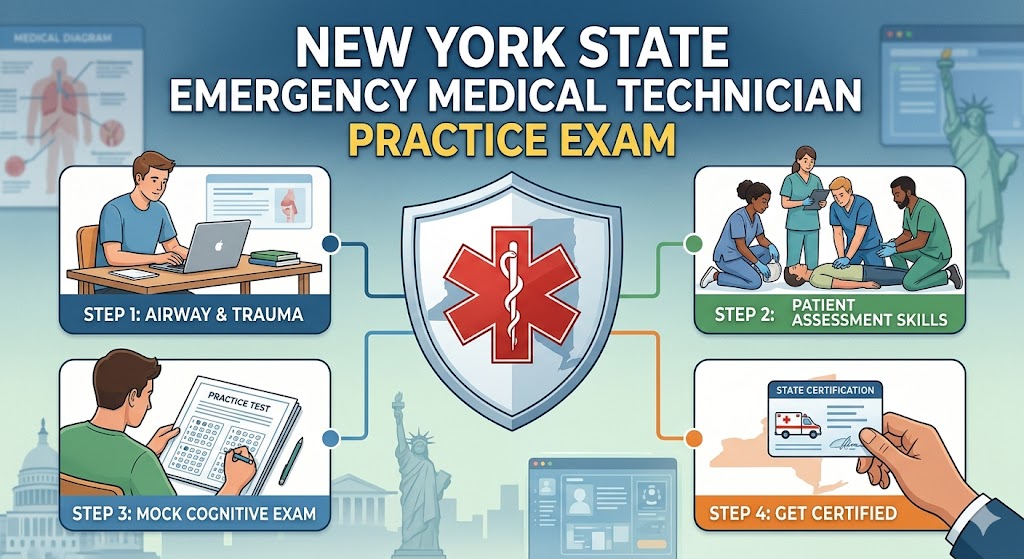
Additional Information
What the Course Entails and Exam Details
This examination does not exist in a vacuum; it validates the skills and knowledge you acquired during your extensive EMT training program.
The exam comprehensive curriculum covers the entire spectrum of basic life support. You must be prepared to answer questions on fundamental concepts of emergency medical care, legal considerations, and ethical issues in practice. The core topics, aligning with the National EMS Education Standards adapted for New York, include:
Airway Management & Ventilation: Ensuring clear airways and supporting breathing for responsive and unresponsive patients.
Patient Assessment: Mastering the rapid and accurate primary and secondary surveys for medical and trauma patients.
Medical Emergencies: Diagnosing and treating acute cardiovascular, respiratory, diabetic, and allergic crises.
Trauma Care: Managing soft tissue injuries, shock, and musculoskeletal trauma, including splinting and immobilization.
EMS Operations: Understanding ambulance standards, hazardous materials responses, and multiple casualty incident (MCI) triage.
Special Populations: Dedicated sections on obstetric care, neonatal resuscitation, and pediatric emergency procedures.
What to Expect in the Final Exam
The actual New York State EMT certification process consists of two primary parts, and you should treat your preparation accordingly:
The cornerstone of the state certification is the psychomotor (practical) exam. This section evaluates your ability to perform critical life-saving skills in real-time scenarios, such as spinal immobilization, cardiac arrest management, and patient assessment. You must successfully navigate several hands-on stations and cannot pass based on written knowledge alone.
Following the successful completion of the psychomotor exam, you will sit for the cognitive (written) examination. This is typically a computerized, multiple-choice test designed to measure your theoretical understanding of the course material. The number of questions can vary (often around 100-120), and you will have a specific time limit, typically 2.5 hours. To achieve licensure, you must pass both parts of the examination. The minimum passing score for the cognitive exam is typically determined by the state or testing authority, often around 70-75%, but you must check the specific requirements outlined in your candidate handbook.
How to Study and Exam Centers
Effective studying requires a structured approach that mirrors the two-part nature of the actual examination:
First, utilize high-quality practice exams as often as possible. Look for exams specifically modeled after the NYS EMT cognitive format. Practicing these allows you to become familiar with the phrasing of questions, learn to manage your time, and identify your weak subject areas (e.g., cardiology vs. trauma). Remember, the correct answer to a practice question is only as useful as your understanding of why it is correct. Always review the detailed rationales provided for both correct and incorrect answers.
Second, dedicate time to regular, physical skill practice. You cannot "cram" for the practical exam the night before. Rehearse every critical psychomotor skill from your skill sheets until it is automatic. Find a study partner to practice assessments, splinting, and airway management.
Regarding where and how to take the exams: In New York State, the official cognitive certification exams are administered through authorized testing centers, often utilizing computer-based testing networks such as Pearson VUE. These centers are located throughout the state for accessibility. However, you must first register with your instructor or training coordinator. Your course coordinator will guide you through the official process of registering with the New York State Bureau of EMS for both your psychomotor and cognitive exams.
Job Opportunities from the Course
Earning your New York State EMT certification is your license to practice and the key that opens numerous doors within the healthcare and emergency response sectors. Successful candidates can pursue a variety of rewarding career paths, including:
Ambulance EMT-Basic: Providing primary emergency medical response with commercial, municipal, or volunteer ambulance services.
Emergency Department Technician (ED Tech): Assisting medical staff in hospital emergency rooms.
Firefighter/EMT: Many municipal fire departments require their personnel to maintain an active EMT certification.
Tactical/SWAT Medic: specialized medical support for law enforcement operations.
Paramedic (Medic): This certification is the essential prerequisite for advancing to Paramedic licensure (the highest level of prehospital care).
Campus EMS Provider: Many universities and college campuses maintain their own quick-response EMS teams.
Community First Responder: Providing initial response in rural areas or with industrial rescue teams.
Frequently Asked Questions
Reviews
5.0
Based on 0 reviews
Leave a Review
No reviews yet. Be the first to review!