
OAR Mechanical Comprehension Practice Exam
$69.00
- Buy to unlock unlimited access to all Quiz questions and Answers in this Quiz.
- After purchase you can print a PDF of the whole quiz at any point. The PDF will contain the questions and the correct answers.
About this Exam
The OAR Mechanical Comprehension Practice Test is a essential component of the Officer Aptitude Rating (OAR) exam, used by the U.S. Navy, Marine Corps, and Coast Guard to select officer candidates. This assessment specifically gauges an applicant’s understanding of basic physical principles and their ability to apply mechanical concepts. It is designed for driven individuals seeking a commission as a military officer, particularly those aiming for technical or aviation-related roles.
Ready to test your knowledge?
Buy Now to Access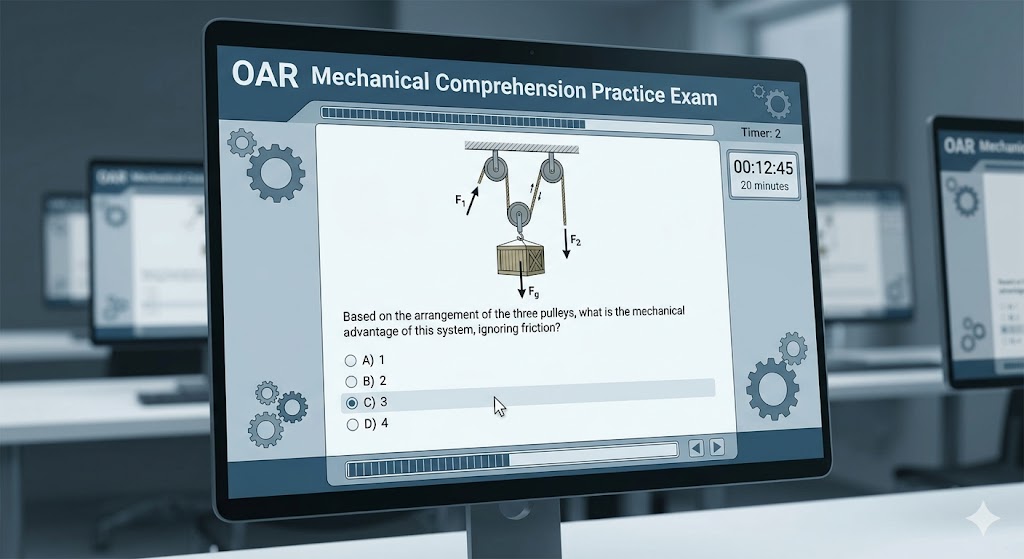
Additional Information
What the Course Entails and Exam Details
While there is no official "course" for the OAR, effective preparation covers foundational physics and mechanical reasoning concepts. Candidates must master topics involving simple machines, including the mechanical advantage of levers, pulleys, and gears. The exam tests your understanding of fluids, such as basic hydraulics, pressure, and buoyancy. Additionally, you will encounter principles of physics like force, friction, gravity, velocity, acceleration, and Newton's laws of motion.
What to Expect in the Final Exam
The actual OAR Mechanical Comprehension section is typically taken as a computer-adaptive test (CAT), meaning the difficulty of the questions adjusts based on your performance. You will usually have a strict time limit of approximately 15 to 20 minutes to answer around 30 multiple-choice questions. Because the test is computer-adaptive, accuracy on early questions is vital, and you cannot return to previous questions once you have submitted an answer. Scoring is part of the larger OAR composite score, and specific minimum score requirements vary significantly by military branch and specific officer program.
How to Study and Exam Centers
The key to success on the OAR Mechanical Comprehension subtest is consistent practice with mechanical reasoning questions under timed conditions. Review fundamental high school physics principles and focus heavily on the mechanics of simple machines and spatial visualization. We highly recommend utilizing practice exams to familiarize yourself with the question types and to improve your speed and accuracy. The official exam is administered at Military Entrance Processing Stations (MEPS) or at designated Naval Reserve Officers Training Corps (NROTC) units at various universities. You must coordinate scheduling through a military recruiter or an NROTC officer.
Job Opportunities from the Course
Performing well on the OAR, and specifically the Mechanical Comprehension section, is a prerequisite for highly competitive officer career paths in the U.S. Navy, Marine Corps, and Coast Guard. A strong score is essential for those aspiring to become Navy or Marine Corps Pilots or Naval Flight Officers (NFOs). It also unlocks critical roles in non-aviation fields such as Surface Warfare Officer (SWO), Nuclear Propulsion Officer, Civil Engineer Corps (CEC), and various Supply and Logistics leadership positions. Achieving officer status opens the door to unparalleled leadership training, management experience, and excellent benefits throughout a military career.
Frequently Asked Questions
Reviews
5.0
Based on 0 reviews
Leave a Review
No reviews yet. Be the first to review!