
Observer Check Ride Practice Exam
$69.00
- Buy to unlock unlimited access to all Quiz questions and Answers in this Quiz.
- After purchase you can print a PDF of the whole quiz at any point. The PDF will contain the questions and the correct answers.
About this Exam
The Observer Check Ride Practice Exam is a comprehensive study resource designed for individuals preparing for a critical certification evaluation – the practical test, or "check ride," for various professional observer roles. This specific test assesses your ability to practically apply the essential observational skills, procedural knowledge, and communication abilities required for certifications across different sectors, including aviation, small unmanned aircraft system (drone) operations, security surveillance, safety inspections, or environmental monitoring. Designed for students, trainees, or professionals seeking to validate their observational competence, this guide provides a general framework to understand the typical evaluation process, key content areas, and effective study strategies to build confidence and ensure a satisfactory outcome.
Ready to test your knowledge?
Buy Now to Access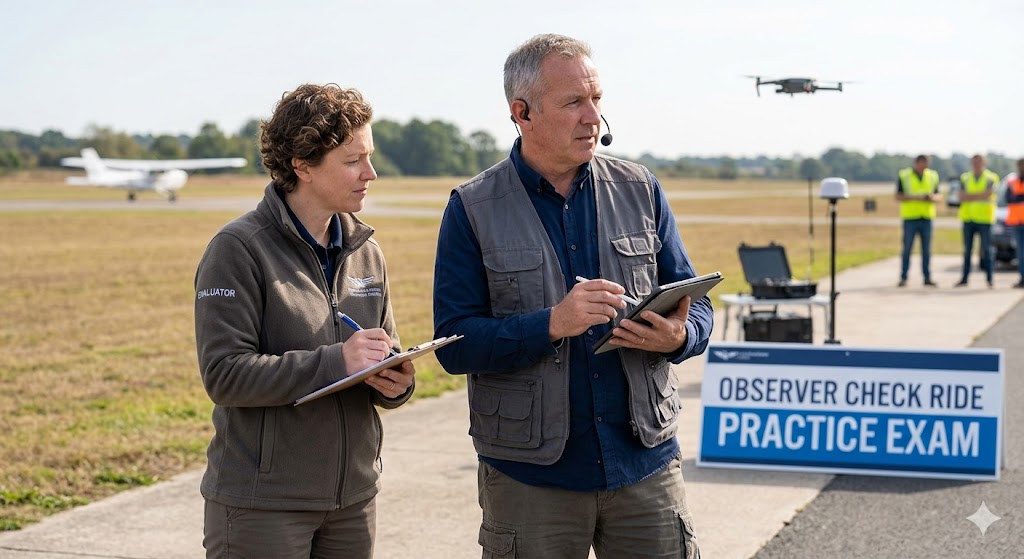
Additional Information
What the Course Entails and Exam Details
This guide focuses on preparing you for the practical check ride, which is typically the final stage of an observer certification process following the completion of relevant training courses. While the specific course content leading to this point varies by industry (e.g., a drone training program might include a Visual Observer module), this practice exam resource covers the core areas frequently evaluated:
Regulatory & Procedural Knowledge: General understanding of safety protocols, rules of the air/environment, and operational procedures relevant to your specific observer role and industry.
Observation Techniques: Practical application of scanning methods (e.g., vertical/horizontal for air, specific patterns for ground), visual acuity, situational awareness, and the use of technical aids (e.g., binoculars, thermal cameras).
Communication & Reporting: Proficiency in clear, concise, and accurate communication, including use of specific terminology (e.g., standard radio phrases, technical terms) for reporting observations to supervisors, pilots, or control centers, both orally and/or through written logs.
Equipment Proficiency: Practical familiarity and competence with essential equipment, such as communication devices, navigation tools (if relevant), observation instruments, and perhaps a ground control station, depending on the context.
Scenario-Based Evaluation: Preparation for practical scenarios where you must demonstrate your skills in real-time observation and decision-making under typical and simulated emergency conditions.
What to Expect in the Final Exam
While exact structures vary significantly by industry and certifying body, most observer check rides will follow a two-part evaluation process on the ground (and potentially in an operational environment) conducted by an authorized evaluator or instructor:
1. Oral Knowledge Exam:
The evaluator will typically begin with a question-and-answer session to assess your thorough understanding of the theory, regulations, and procedural knowledge related to your observer role. This part evaluates:
Regulations and Procedures: Specific industry rules and your organization's standard operating procedures.
Role and Responsibilities: Clear understanding of your duties as an observer.
Observational Theory: Knowledge of human factors, visual limitations, and effective scanning techniques.
Communication and Reporting: Understanding standard communication protocols and documentation requirements.
Equipment Knowledge: Technical details and operating procedures of relevant tools.
2. Practical Evaluation (The "Check Ride"):
This is the practical, hands-on demonstration of your observer skills, typically conducted as part of a real or simulated operational scenario. The evaluator will observe you performing observational tasks, communicating findings, and adhering to procedures. This part evaluates:
Scenario-Based Performance: Your ability to observe a scenario (e.g., a simulated flight, a defined survey area, a security feed) and accurately identify and communicate key events or hazards.
Observational Competence: Demonstrating effective scanning techniques and accuracy in real-time.
Communication Flow: Evaluated on the clarity, accuracy, and timeliness of your reports.
Equipment Operation: practical skill in using observation and communication tools under pressure.
Procedural Adherence: Consistently following established safety protocols and standard operating procedures.
Passing Requirements & General Rules:
Satisfactory Performance: You must consistently perform each evaluated task satisfactorily, demonstrating both technical skill and sound judgment. Evaluation is typically based on predefined performance criteria (or "tolerances") specific to your industry or certification program.
Time Limits: While there might not be a single strict overall time limit for a check ride, specific scenario phases or practical tasks might have expected timelines to demonstrate proficiency within practical constraints.
Examiner Role: The evaluator typically acts as a neutral observer and cannot provide instruction during the test unless to maintain safety or in pre-agreed coaching scenarios for specific certifications.
No Disapproval Items: Failure to satisfactorily perform any one critical area or a repetitive unsatisfactory performance can result in a notice of disapproval.
Always verify these details and any special rules, such as what to bring (e.g., valid photo ID, certificate, logbook), directly with your training organization or certifying authority.
How to Study and Exam Centers
Effective preparation for your observer check ride combines theoretical study, practical skill drills, and simulated evaluations:
Study Materials: Thoroughly review all course materials, textbooks, industry regulations, standard operating procedures, and any official study guides or practice quizzes provided by your training program or certifying authority.
Observation Drills: Actively practice your scanning techniques, visual estimation, and situational awareness in real-world environments (e.g., at an airport, near drone operations, during relevant safety inspections).
Communication Practice: Role-play communication scenarios, practicing clear, concise, and accurate reporting using standard terminology with a partner or instructor.
Equipment Familiarity: Ensure you are highly proficient and confident in operating all required equipment. Practice using communication devices and any technical aids relevant to your role.
Practice Tests: Utilize any available practice exams, knowledge quizzes, and simulated scenario evaluations, ensuring you simulate test conditions for maximum benefit.
Mock Evaluations: Request mock check rides with qualified instructors or experienced mentors who can provide constructive feedback on your practical performance and confidence levels.
Where to Take the Exam (Exam Centers):
The actual location for your observer check ride will vary drastically depending on the specific certification and authorizing body. You will likely find testing options through:
Your Training School or Organization: The most common location for initial certifications will be within the institution providing your observer training.
Specific Testing Facilities: Some industries may utilize approved physical testing centers similar to Pearson VUE or specialized aviation testing sites for knowledge exams and possibly some simulated practical components. However, practical check rides usually require an operational environment.
Authorized Instructors/Examiners: Certified individuals authorized to conduct these evaluations can often perform the check ride at various locations, including specific operating fields, safety sites, or even the client's operational premises, assuming proper authorization and conditions.
Online Portals: While practical evaluations generally happen in person, some online portals may be used for scheduling, accessing theoretical materials, and even completing knowledge exam portions of your overall certification process.
Consult your training provider and the specific certifying authority for the precise details on how and where to take your observer check ride.
Job Opportunities from the Course
A certified observer role, validated by a successful check ride, opens diverse and compelling career paths across numerous sectors:
Drone Visual Observer: Providing vital in-line-of-sight support for commercial, public safety, and infrastructure inspection drone operations.
Aerial Observer (General): Assisting in aerial surveys, environmental monitoring, photography, or search and rescue missions across various aircraft.
Security Surveillance Operator: Monitoring and analyzing live surveillance feeds for corporate security, events, critical infrastructure, or transportation hubs.
Aviation Safety Observer/Monitor: Ensuring safety protocols and procedures are met in ground handling, maintenance, or other aviation environments.
Environmental Compliance Observer: Monitoring development projects, wildlife habitats, or industrial sites for adherence to environmental regulations.
Fire Lookout/Forestry Observer: Monitoring and reporting fire outbreaks or forest health in vast, often remote, areas.
Wildlife Monitor/Surveyor: Observing and recording wildlife behavior, migration patterns, and species counts for conservation and research.
Safety Inspector (General): conducting observation-based safety inspections across various industries (e.g., construction, manufacturing, energy).
Election Observer: participating in the impartial observation and reporting of election processes to ensure fairness and integrity.
Tactical Observer (Security/Defense): involved in specialized surveillance, reconnaissance, or intelligence-gathering operations (requires extensive additional specialized training and security clearances).
Frequently Asked Questions
Reviews
5.0
Based on 0 reviews
Leave a Review
No reviews yet. Be the first to review!