
Occupational Health & Worker's Compensation Practice Exam
$69.00
- Buy to unlock unlimited access to all Quiz questions and Answers in this Quiz.
- After purchase you can print a PDF of the whole quiz at any point. The PDF will contain the questions and the correct answers.
About this Exam
The Occupational Health & Worker's Compensation Practice Test is a comprehensive preparatory tool designed for professionals and students seeking to master the crucial intersection of employee well-being and regulatory compliance.
This guide prepares you for various certifying exams and roles, such as a Certified Workers' Compensation Professional (CWCP) or a Certified Occupational Health Nurse (COHN).
It is an ideal resource for Occupational Health and Safety (OHS) managers, Human Resources professionals, claims adjusters, case managers, and healthcare providers who aim to demonstrate expertise in managing workplace safety, mitigating risks, handling claims, and facilitating successful return-to-work outcomes.
The practice test is built to challenge your understanding of legal frameworks, medical management, hazard control, and disability management, ensuring you are exam-ready and prepared for real-world challenges.
Ready to test your knowledge?
Buy Now to Access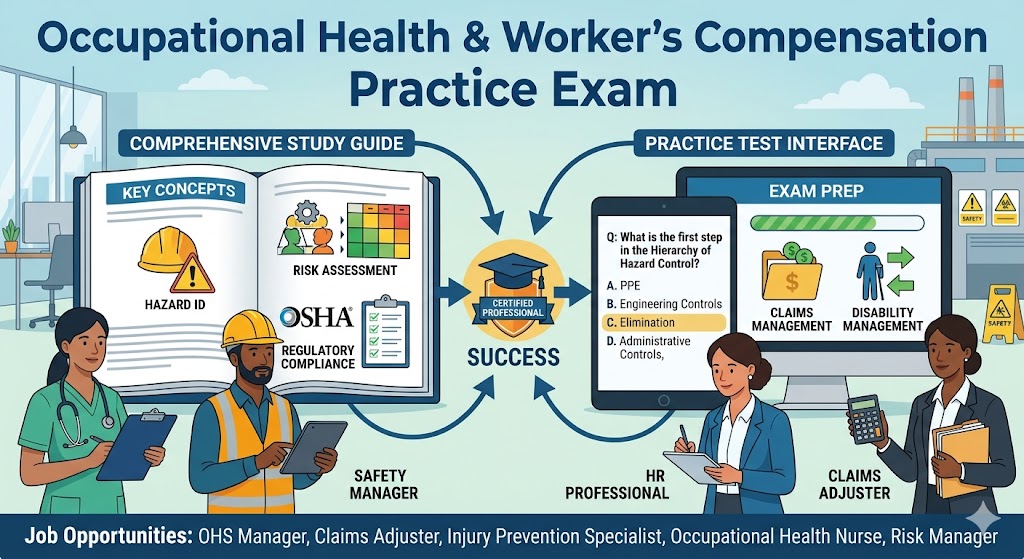
Additional Information
What the Course Entails and Exam Details
This practice exam covers a diverse and interconnected set of skills and knowledge domains.
Learners should be prepared to tackle detailed concepts within these core areas:
Principles of Disability Law: Elements of state workers' compensation laws, standard statutory schemes, and how they interact with federal disability laws like the Americans with Disabilities Act (ADA) and the Family and Medical Leave Act (FMLA).
Worker Health Needs and Assessment: Analyzing risks and barriers to recovery using structured assessment tools, navigating medical screening, and implementing health surveillance programs.
Hazard Identification and Risk Assessment: Methods to identify physical, chemical, and biological hazards in various industries and strategies for applying the hierarchy of controls (elimination, substitution, engineering, administrative, and PPE).
Claims and Case Management: The entire lifecycle of a workers' compensation claim, from initial reporting to resolution, including strategies for cost control, vocational rehabilitation, and coordinating multidisciplinary care.
Return-to-Work (RTW) Planning: Designing and implementing effective transitional and modified-duty programs that support injured workers while minimizing employer liability.
Regulatory Compliance: Mastery of key standards from OSHA (Occupational Safety and Health Administration) and relevant international safety standards like ISO 45001.
What to Expect in the Final Exam
While formats for specific professional certifications vary, the Occupational Health & Worker's Compensation Practice Test is structured to mimic standard industry exams, which are typically computer-based and administered in a timed environment.
Here is what you can expect in the practice environment and common corresponding certification exams:
Format: The primary component will consist of complex multiple-choice questions designed to test both knowledge recall and practical application through case scenarios. Some specific certifications may also include short essay or true/false sections.
Content Split: Expect a balanced mix between pure occupational safety knowledge and the legal and administrative aspects of worker's compensation.
Time Limits: Full-length practice exams are timed, typically ranging from 2 to 4 hours, forcing you to develop pacing strategies for the actual certification test.
Scoring: A passing score generally falls in the range of 70% to 80%, depending on the specific certifying body. The practice exam provides detailed rationale for every answer, allowing you to focus on your weak areas.
Rules: Just like in a real Pearson VUE or proctored setting, no reference materials are allowed during the test.
How to Study and Exam Centers
Preparation for this challenging dual-domain test requires a strategic and disciplined approach.
Use these actionable methods to ensure your success:
Utilize the Practice Test: Do not just take the test; study it. Use practice tests early to identify knowledge gaps. Analyze the rationale provided for every question, both correct and incorrect. Repeat the test multiple times to build confidence and refine your pacing.
Create Structured Study Guides: Break down the syllabus into OHS (hazard control, industrial hygiene) and Worker's Compensation (claims process, law). Use flashcards for key legal terms, OSHA regulations, and medical definitions.
Study Real-World Case Studies: Many questions on professional exams are scenario-based. Review common accident types, complex worker's compensation claims, and successful return-to-work case studies to practice applying your knowledge.
Where and How to Take the Exam:
Practice Test: You can access the Occupational Health & Worker's Compensation Practice Test through accredited online education portals, specific test preparation providers, and some university professional development programs that offer certification prep. It is entirely self-paced and digital.
Professional Certification Exams: To earn a formal designation (like COHN or CWCP), you must register with the specific certifying board (e.g., ABOHN for nurses, MSU for CWCP). These final, official exams are typically taken at authorized proctored testing centers, such as Pearson VUE locations, or through secure online proctoring services. They often require candidates to submit verification of work experience and educational prerequisites before scheduling the exam.
Job Opportunities from the Course
Mastering the combined field of Occupational Health and Worker's Compensation opens doors to diverse and in-demand career paths across all industry sectors.
Here are some of the job opportunities unlocked by this specialized expertise:
Occupational Health and Safety Manager
Workers' Compensation Claims Adjuster
Injury Prevention Specialist
Occupational Health Nurse / Case Manager
Director of Risk Management
Safety Coordinator
Disability Management Specialist
Return-to-Work Coordinator
Health and Safety Officer
Loss Control Consultant
Human Resources Manager (Safety Compliance Focus)
Frequently Asked Questions
Reviews
5.0
Based on 0 reviews
Leave a Review
No reviews yet. Be the first to review!