
Occupational Hygiene Monitoring Practice Exam
$69.00
- Buy to unlock unlimited access to all Quiz questions and Answers in this Quiz.
- After purchase you can print a PDF of the whole quiz at any point. The PDF will contain the questions and the correct answers.
About this Exam
The Occupational Hygiene Monitoring Techniques qualification is a cornerstone credential for professionals dedicated to protecting worker health. This exam assesses a candidate’s theoretical knowledge and practical ability to recognize, evaluate, and control physical, chemical, and biological hazards in the workplace. It is specifically designed for health and safety officers, aspiring industrial hygienists, environmental health specialists, and laboratory technicians who seek to formalize their skills in quantitative exposure assessment. Earning this certification demonstrates a commitment to evidence-based safety practices and technical competence in the field.
Ready to test your knowledge?
Buy Now to Access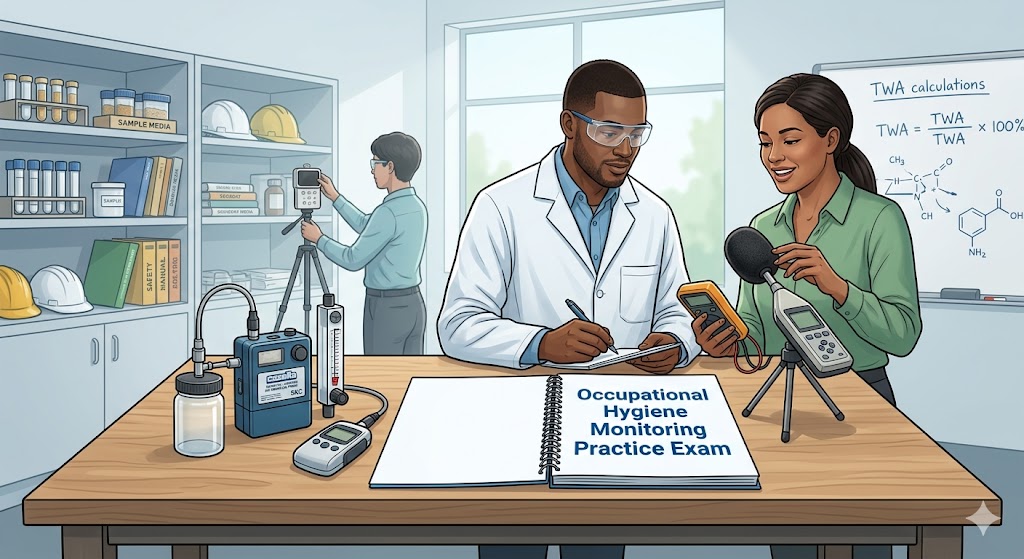
Additional Information
What the Course Entails and Exam Details
The preparatory coursework and the subsequent exam cover a wide spectrum of scientific and technical topics essential for accurate workplace assessment. The core syllabus includes fundamental concepts of industrial hygiene and the methodology behind developing effective sampling strategies. Candidates must master the use of various monitoring instruments for measuring air contaminants, such as personal sampling pumps, calibrators, sorbent tubes, and passive samplers. Furthermore, the curriculum details techniques for evaluating physical hazards, including noise dosimetry, thermal stress assessment, and ionizing or non-ionizing radiation monitoring. Finally, students learn how to interpret analytical data against established occupational exposure limits (OELs, PELs, and TLVs) to determine compliance.
What to Expect in the Final Exam
While specific formats may vary slightly depending on the issuing certification body, the final exam is typically a robust, proctored assessment. It generally consists of a theoretical component featuring multiple-choice or short-answer questions designed to test knowledge of regulations, calculations, and equipment principles. Many versions also include a practical or scenario-based component, requiring candidates to interpret realistic data sets or select appropriate monitoring methods for a given workplace hazard scenario. The exam is usually timed, often ranging from two to four hours, and requires a high passing score (typically 70% or higher) to demonstrate professional mastery.
How to Study and Exam Centers
Preparation for this technical exam should involve a comprehensive mix of theoretical review and practical application. We highly recommend utilizing this Occupational Hygiene Monitoring Techniques Practice Test repeatedly to identify knowledge gaps and become familiar with the phrasing of technical questions. Study the relevant regulations (such as OSHA, HSE, or local standards) and the specific NIOSH or ISO sampling methods included in the syllabus. Create flashcards for exposure limits and the mathematical formulas used in time-weighted average (TWA) calculations. If possible, seek hands-on time with the actual monitoring equipment to reinforce passive learning with practical experience.
Regarding exam logistics, testing is generally administered through formal, secure channels. Most candidates will take their exam at authorized physical testing centers, such as Pearson VUE or Prometric locations globally. Alternatively, depending on the specific certifying organization (such as BOHS, ABIH, or BCRSP), examinations may be offered at the conclusion of approved training courses or via secure, remotely proctored online portals.
Job Opportunities from the Course
Successfully navigating this course and exam opens doors to several critical roles within industrial, manufacturing, and consultancy sectors. Professionals with these validated skills are in high demand to ensure regulatory compliance and maintain worker wellbeing. Key career paths and specific job titles unlocked by this credential include:
Occupational Hygiene Technician
Industrial Hygienist
Environmental Health and Safety (EHS) Specialist
Workplace Compliance Officer
Occupational Health Manager
EHS Consultant / Auditor
Noise and Vibration Specialist
Air Quality Analyst
Frequently Asked Questions
Reviews
5.0
Based on 0 reviews
Leave a Review
No reviews yet. Be the first to review!