
OCFR SCBA Certification Practice Exam
$69.00
- Buy to unlock unlimited access to all Quiz questions and Answers in this Quiz.
- After purchase you can print a PDF of the whole quiz at any point. The PDF will contain the questions and the correct answers.
About this Exam
The Self-Contained Breathing Apparatus (SCBA) certification is a vital credential for individuals working in immediately dangerous to life or health (IDLH) atmospheres. This intensive training program equips personnel with the essential knowledge and practical skills required to safely operate an SCBA. It is primarily designed for firefighters, industrial emergency response teams, hazardous materials (HAZMAT) technicians, confined space rescue workers, and anyone whose duties may involve encountering oxygen-deficient or toxic environments. Mastering the use of SCBA not only ensures personal safety but is critical for successful rescue and incident stabilization. This practice test is a powerful tool to gauge your readiness and build confidence for the high-stakes final examination.
Ready to test your knowledge?
Buy Now to Access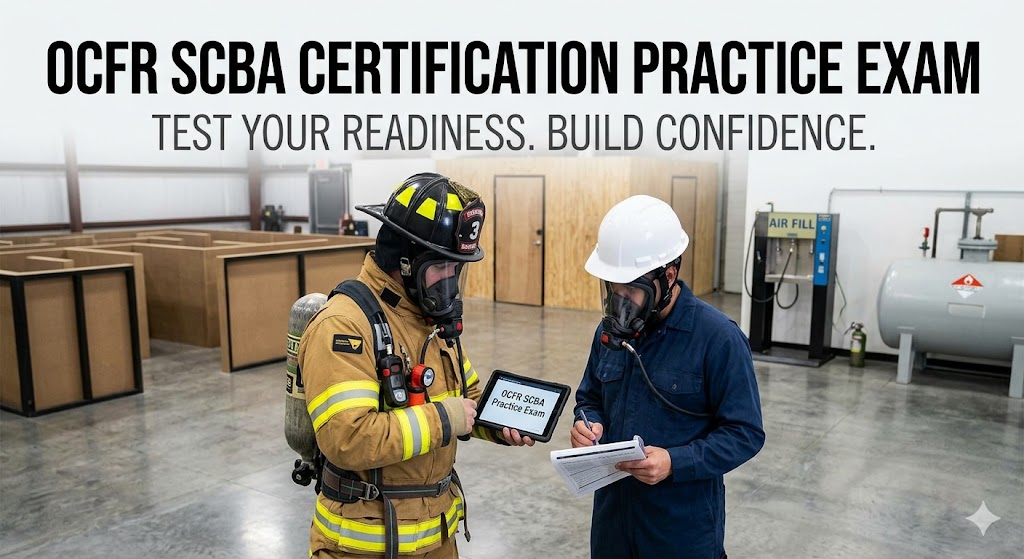
Additional Information
What the Course Entails and Exam Details
A comprehensive SCBA course covers a broad spectrum of theoretical and hands-on topics. You will dive into the physiology of respiration and how different hazardous environments affect the human body. The curriculum details the individual components of an SCBA—including the cylinder, harness, regulator, facepiece, and PASS device—explaining their functions and interconnection. A significant portion of the training focuses on the crucial steps of pre-use inspection, including visual checks, leak tests, and functional tests of all systems. Donning and doffing techniques are practiced repeatedly to ensure speed and precision under stress. Students learn to calculate and manage air consumption, interpret low-air alarms, and execute emergency procedures, such as regulator failure protocols or using a 'buddy breather' system. Other essential areas include movement techniques in low visibility, team communication, maintenance, cleaning, and storage of the equipment.
What to Expect in the Final Exam
The final certification exam typically consists of two distinct parts: a comprehensive written evaluation and a rigorous practical skills assessment. The written portion, which this practice test is specifically designed to simulate, is usually a multiple-choice exam. It assesses your knowledge of SCBA theory, safety regulations (such as OSHA 1910.134 and NFPA standards), component identification, and emergency procedures. You should be prepared to answer a significant number of questions within a strict time limit, often requiring a minimum passing score of 70% to 80%. The practical skills assessment requires candidates to demonstrate proficiency in a variety of hands-on tasks in front of an evaluator. This generally includes performing a complete pre-use inspection, correctly and rapidly donning the full SCBA apparatus, navigating a smoke-filled or maze-like training environment, managing your air supply, and demonstrating effective emergency techniques. You must pass both the written and practical components to earn your certification.
How to Study and Exam Centers
Effective preparation is the key to success. For the written exam, leverage this practice test to identify your knowledge gaps. Take it multiple times and thoroughly review the rationale for correct and incorrect answers. Deepen your understanding by studying the manufacturer's user manual for the specific SCBA model you will use, and review industry standards and safety regulations, such as those from NFPA and OSHA. For the practical assessment, nothing replaces hands-on practice. Dedicate significant time to mastering the donning and pre-use inspection sequences, aiming for speed and a systematic approach without sacrificing accuracy. Final certification exams are conducted at authorized training centers, specific vocational schools, fire academies, or your employer’s approved testing facility. While the written portion might sometimes be available through secure online portals, the practical assessment always requires physical attendance to use real equipment. Upon completing your course, you will be directed to the designated testing locations and given instructions on how to schedule your examination.
Job Opportunities from the Course
Obtaining your SCBA certification unlocks a wide array of career opportunities across various critical sectors. It is a fundamental requirement for most first responder roles and a highly valued skill in numerous industrial settings. Here are some of the key job opportunities this course supports:
Firefighter (Municipal, Volunteer, and Industrial)
Emergency Medical Technician (EMT) and Paramedic (with rescue duties)
Hazardous Materials (HAZMAT) Technician
Confined Space Rescue Technician
Search and Rescue (SAR) Specialist
Industrial Safety Officer
Oil and Gas Field Operator
Chemical Plant Operator
Mining Safety Personnel
SCBA Service Technician
Environmental Remediation Worker
Frequently Asked Questions
Reviews
5.0
Based on 0 reviews
Leave a Review
No reviews yet. Be the first to review!